


- Products
- Catalogs
- News & Trends
- Exhibitions
SP ENGINEERING MANUAL

SP ENGINEERING MANUAL
This document serves as a technical manual for Grundfos' SP pumps, highlighting their durability and efficiency. It complements existing product data and installation manuals, providing quick answers to common questions about SP pumps.
Resources: Only 2.5% of global water is fresh, with less than 1% available for human use. Groundwater: High-quality due to natural filtration, ideal for irrigation and water supply. Riverbank Filtration: Reduces treatment needs and maintains river levels. Surface Water: Requires treatment; submersible pumps recommended. Sea and Saltwater Sources: Intake should be positioned to minimize salinity.
For capacities over 1,000 m3/h, extend intake far from the shore. For smaller capacities, use corrosion-safe wells to save on maintenance costs.
Used for freshwater supply, dewatering, horizontal applications, corrosive water, and hot water. Material selection depends on water quality and conditions.
Service intervals depend on water velocity, pump material, and environmental conditions. Efficiency loss and renovation costs are calculated accordingly.
Corrosion resistance is crucial, especially in seawater applications. The PRE formula helps determine the appropriate stainless steel grade.
Enhance water pressure in distribution networks, offering quieter operation and eliminating leakage risks.
SP pumps are centrifugal pumps that convert mechanical energy into velocity energy, increasing pressure through multiple stages.
Radial designs are for high head requirements, while semi-axial designs suit larger flow pumps.
Regular inspections are recommended to replace wear parts and maintain efficiency.
Involves estimating flow and pressure, considering factors like dynamic water table and discharge pressure.
Performance curves aid in pump selection, showing efficiency and power consumption.
Submersible motors conform to NEMA standards, with various types available for specific applications.
Necessary for high water temperature or voltage tolerances, affecting efficiency.
Protect against short-circuiting, phase failures, and overloads.
Thermal protectors and temperature sensing devices like Tempcon are used for monitoring.
Various methods are discussed, including DOL, SD, AT, RR, SS, and FC, each with specific advantages.
Output filters are necessary to limit voltage peaks and reduce motor stress.
Includes guidelines for frequency converters, motor flow rates, and temperature protection.
External frequency converters can lead to power loss and increased heat.
Controls pump performance by changing frequency, minimizing damage risk.
Filter selection depends on pump type and cable length.
Voltage variations should be within +6/-10% of the rated value.
Discusses the use of VFDs for motors and the importance of using filters.
Understanding grid characteristics is crucial before connection.
Maintaining low current asymmetry is essential for efficiency.
Filters and lightning arresters are recommended for protection.
Emphasizes proper casing and filtering to prevent sand and silt entry.
Advises on installation depth and aligning the duty point with required flow.
Proper design ensures water passes through the clearance, reducing turbulence.
Monitoring the water table is crucial to prevent overpumping.
Peak efficiency occurs within a narrow flow range.
Cooling is critical for motor longevity, with specific flow rate requirements.
Involves selecting a larger motor size based on a derating factor.
Motors should be installed below the dynamic water level.
Cooling sleeves ensure correct flow and prevent local heating.
Depends on discharge pressure and friction loss.
Criteria include current capacity, voltage drop, and local regulations.
Formulas provided for calculating maximum cable length.
Cable derating is required at temperatures above 30°C.
Grundfos motors come with drinking water-approved cables.
Recommended methods for ensuring watertight connections.
Various flange types are available for better handling.
Parallel operation suits variable consumption patterns.
Limiting starts maximizes pump life.
Generators must be derated based on environmental factors.
Data communication is crucial for optimizing performance.
Includes fiber optics and radio communication for automation systems.
Consist of a master computer, outstations, and a communications infrastructure.
Include system health monitoring, alarm logging, and control operations.
Allows global access via web browsers.
Common topologies include star, ring, and bus.
Protocols define data interchange rules between devices.
Specifies a device's network interface.
Connects sensors, actuators, and controllers in automation.
A proprietary fieldbus for water pump applications.
Specifications include a bus topology and data format details.
Includes timing specifications and medium access model.
Use twisted pair cables with shields and avoid long stubs.
Include the MP 204 electronic motor protector for remote monitoring.
Common issues and solutions are provided.
Cooling sleeves and corrosion protection systems are recommended.
Visit the Grundfos website for more details and product selection tools.
Catalog excerpts
GRUNDFOS SP ENGINEERING MANUAL
Open the catalog to page 1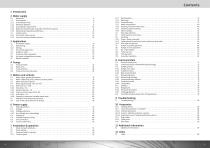
Contents 1 Introduction 2 Water supply Resources . . . . . . . . . . . . . . . . . . . . . . . . . . . . . . . . . . . . . . . . . . . . . . . . . . . . . . . . . . . . . . . . . . . . . . . . . . . . . . . . . . . . . . . Groundwater . . . . . . . . . . . . . . . . . . . . . . . . . . . . . . . . . . . . . . . . . . . . . . . . . . . . . . . . . . . . . . . . . . . . . . . . . . . . . . . . . . . Groundwater wells . . . . . . . . . . . . . . . . . . . . . . . . . . . . . . . . . . . . . . . . . . . . . . . . . . . . . . . . . . . . . . . . . . . . . . . . . . . . . Riverbank filtration . ....
Open the catalog to page 3
Introduction Serving our common interests This engineering manual has been created with a specific focus on one of Grundfos’ most recognisable and popular pumps: the SP. When it was created in the late 1960’s, this breakthrough product set new standards within durability, efficiency, and construction in thin-plate stainless steel. The numerous product types, sizes, and configuration possibilities available today serve as a testament to the innovative nature of the original SP pumps. Working with SP pumps on a daily basis often gives rise to lots of different questions. We have created this engineering...
Open the catalog to page 4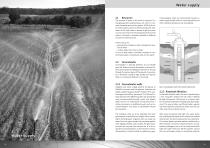
Water supply The amount of water in the world is constant. It is changing position, quality, phase, etc., but it is constant. Seawater accounts for approx. 97.5% of all water. Fresh water accounts for the remaining 2.5%. Two- thirds of the fresh water is bound as glaciers, polar ice, and snow cover. The remaining, less than 1% of all water in the world, is somehow available in different sources for mankind to use. These sources are: • groundwater, shallow or deep underground aquifers of water • surface water, from rivers or lakes. In case no fresh water is available, seawater or contaminated...
Open the catalog to page 5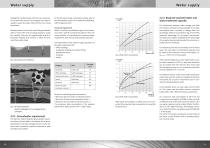
Water supply feeding the riverbank wells when the river water level runs low in dry season. The storage of river water in aquifers causes less water stress on the river during dry seasons. Riverbank wells can be constructed like groundwater wells, or from 7-8m vertical casings dug down under the riverbed. They can be supplemented with 8-12 horizontal injected steel screens or filters for sediment-free water intake. Water supply To find the peak hourly consumption, please refer to the MPC-Booster section of Grundfos WinCAPS/WebCAPS or figures 4 and 5. Pump-out requirement Water is used by many...
Open the catalog to page 6
Water supply Water supply An increase from 10 to 20 m3/h will consequently result in a lowering of the water level of approx. 1 m. An increase from 10 to 30 m3/h will give a lowering of the water level of approx. 2m. Clean-water tank size as a percentage of daily consumption % 100 90 Clean-water tank size as a percentage of daily consumption: Tank volume (m3) x 100 = % tank capacity Daily consumption (m3/24h) If the well yield is not sufficient to meet the water requirement, even by prolonged operation, the following should be done: • Have a specialist look at the problem. • Have a supplementary...
Open the catalog to page 7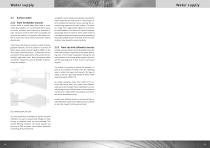
Water supply Surface water 2.3.1 From freshwater sources Surface water is usually taken from lakes or rivers. Unlike groundwater, it is not protected from nature or human activities, and treatment is therefore always necessary. Surface water level and quality will vary over the seasons. For example, after heavy rainfall, or snow melt, lots of solids and sand are washed downstream. These sharp and abrassive minerals as well as biodegradable materials are to be settled or screened off before pump intake to avoid negative effects on the final water treatment process. Submersible pumps are ideal...
Open the catalog to page 8
The supply of fresh water for drinking water, irrigation and various industrial applications is the most common application for submersible pumps. Pumps of many different designs, and made from many different materials can be used with a reasonably good result here. Grundfos SP pumps made of stainless steel EN 1.4301/ AISI 304 are the obvious choice for this application. If the well is made correctly and produces clean, sandfree water, the pump can last for many years. However, in some livestock watering and irrigation applications, the water quality is so poor that pumps made of standard stainless...
Open the catalog to page 9
4. rop directly down (90°).The aggressive CO2 conD tent has increased the material loss to 0.25mm. Note the salinity level of the water (point 4). Draw a horizontal line through this point; follow it to the left and read the results. 5. ecommended service intervals for your pump: AfR ter every 6,000 hours of operation (point 5). 6. oss of efficiency: Approx. 18% (point 6). L 7. stimated cost of renovating the pump: 75% of the E price of a new pump (point 7). to the submersible pump, and high-grade stainless steel is recommendable. A special mining application is leach mining, where an aggressive...
Open the catalog to page 10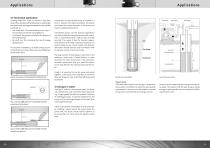
Pumping water from a tank or reservoir is very often done with a standard submersible pump. A submersible pump has many advantages compared to a dry-installed pump such as: • ow noise level: The submersible pump is very siL lent and does not disturb any neighbours. • heft proof: The pump is installed at the bottom of T the tank/reservoir. • o shaft seal: This eliminates the risk of leakage N above ground. In horizontal installations, Grundfos always recommends that you include a flow sleeve and baffle plate at low water levels. If more than one submersible pump is installed in a tank or reservoir...
Open the catalog to page 11
Submersible pumps are used for many seawater applications like fish farming, offshore industrial applications and water supply for reverse osmosis-treated water. SP pumps are available in different materials and corrosion classes depending on the application of the pumps. The combination of salinity and temperature is not favourable to stainless steel, and must always be taken into consideration. A good way to compare the corrosion resistance of stainless steel, is to compare its resistance against pitting. The figure used as a comparison is called: ‘Pitting Resistance Equivalent’ (PRE). Fig....
Open the catalog to page 12All GRUNDFOS catalogs and technical brochures
 GRUNDFOS PUMPS FOR MINING
5 Pages
 GF 270, Solar modules
2 Pages
 GRUNDFOS ALPHA2
20 Pages
 Grundfos ALPHA1
24 Pages
 Grundfosliterature-145421
21 Pages
 Grundfosliterature-145418
3 Pages
 Grundfosliterature-6119761
59 Pages
 Grundfosliterature-4352972
3 Pages
 Grundfosliterature-3081300
5 Pages
 ALPHA1 L
2 Pages
 DME
DME2 Pages
 GRUNDFOS CR 95 - CR 155
2 Pages
 UPM3
UPM392 Pages
 GRUNDFOS UPM3
11 Pages
 Vaccuperm VGA and VGB
28 Pages
 PURIFY YOUR BUSINESS
9 Pages
 PUST 1700 RANGE
3 Pages
 GRUNDFOS WASTEWATER PRODUCTS
10 Pages
 Grundfos LiqTec
2 Pages
 CRN high pressure programme
2 Pages
 ATEX approved CR pumps
2 Pages
 CRN Air-Cooled Top
2 Pages
 CRN MAGdrive
2 Pages
 GRUNDFOS CRE
2 Pages
 Customised solutions
21 Pages
 TPE3
TPE37 Pages
 Grundfosliterature
5 Pages
 CIM/CIU
3 Pages
 BMS
BMS5 Pages
 BM
BM2 Pages
 BACMON
16 Pages
 AQtap
AQtap7 Pages
 ALPHA2 L OEM
19 Pages
 SEG Autoadapt and GRM
2 Pages
 E-Solutions and GRM
2 Pages
 Grundfos Remote Management
3 Pages
 CRE GRUNDFOS
2 Pages
 MTA
MTA3 Pages
 Unilift CC
2 Pages
 HS Horizontal Split Case
4 Pages
 DMH-API - Product leaflet
2 Pages
 DMH -Product leaflet
2 Pages
 ALPHA1
2 Pages
 BMEX Booster Seawater
2 Pages
 AMD-AMG-AFG
3 Pages
 S - product brochure
16 Pages
 Customised pump solutions
12 Pages
 CRT for seawater
2 Pages
 CRT for industry
2 Pages
 CRT - for desalination
2 Pages
 HS
HS5 Pages
 SQ
SQ3 Pages
 MAGNA/UPE
12 Pages
 Pressure Manager
5 Pages
 Selcoperm SES
20 Pages
 Conex DIA-1, DIA-2, DIA-2Q
2 Pages
 Conex DIS-G
2 Pages
 Conex DIS-C
2 Pages
 Sololift2
9 Pages
 VGA and VGB
28 Pages
 Oxiperm Pro
8 Pages
 DMX
DMX18 Pages
 DMH
DMH18 Pages
 MP 204
3 Pages
 TP/TPE
5 Pages
 TP,TPE - product brochure
5 Pages
 SP Product
7 Pages
 SMART Digital dosing pumps
2 Pages
 GRUNDFOS SE & SL ranges
8 Pages
 S-Tube
4 Pages
 SB & SBA
8 Pages
 HOME AND GARDEN
52 Pages
 Product Brochure
5 Pages
 Multilift
21 Pages
 NB, NBG, NK, NKG
3 Pages
 MAGNA3 - MORE THAN A PUMP
7 Pages
 KPL and KWM
3 Pages
 GRUNDFOS BOOSTER (Hydro MPC)
3 Pages
 Grundfos GO
3 Pages
 DW
DW12 Pages
 DIP
DIP16 Pages
 GF100 TF solar module
2 Pages
 GRUNDFOS CONTROL MPC
5 Pages
 E-solution with Grundfos E-pumps
16 Pages
 Sanitary Assembly Tool Kit
2 Pages
 Durietta - Product brochure
3 Pages
 Food application pumps
7 Pages
 CM ? product brochure
7 Pages
 SQFlex ? product brochure
7 Pages
 SRP ? product brochure
3 Pages
 NEW ALPHA2
7 Pages
 Wastewater products
10 Pages
 GRUNDFOS DWK
3 Pages
 GRUNDFOS DPK range
3 Pages
 GRUNDFOS DP
5 Pages
 DIT-L, DIT-M Photometer
16 Pages
 DME, DMS, DDI
14 Pages
 Diffuser
3 Pages
 CUE E-SOLUTIONS
12 Pages
 CR ? Innovation inside
20 Pages
 A WIDE RANGE 2019
60 Pages



Archived catalogs
 CR monitor
8 Pages
 CIM / CIU
3 Pages
 Control MPC
4 Pages
 CMV
CMV8 Pages
 CM, CME Booster
52 Pages
 BMP
BMP9 Pages
 Electro Magnetic Technology
52 Pages
 A WIDE RANGE 2015
60 Pages
 Grundfos CR - Custom-built Pumps
15 Pages
 A Wide Range of Quality Products
32 Pages


