


- Products
- Catalogs
- News & Trends
- Exhibitions
GRUNDFOS ALPHA2

GRUNDFOS ALPHA2
The GRUNDFOS ALPHA2 series consists of energy-efficient circulator pumps designed for heating systems. Key features include the AUTOADAPT function for automatic system adjustment, integrated differential-pressure control, and an Automatic Night SetBack option. These pumps comply with the EuP Directive and have an energy efficiency index (EEI) of ≤ 0.23.
ALPHA2 pumps are suitable for circulating liquids in heating systems and domestic hot-water systems with stainless-steel pump housing. They are ideal for systems with constant or variable flows and where night setback is desired.
The ALPHA2 adjusts differential pressure to match heating demand, reducing energy consumption and noise. The AUTOADAPT function optimizes pump performance over time, especially in underfloor and two-pipe systems.
The pump features a canned-rotor design with integrated control functions, a permanent-magnet motor, and a display for power consumption. It includes a ceramic shaft, stainless-steel components, and a composite impeller.
Installation involves mechanical setup and electrical connection, requiring a horizontal motor shaft. The pump is self-venting and must be filled with liquid before start-up. It operates within specific temperature and pressure ranges, adjustable via a control box.
The ALPHA2 series includes models like 15-50 and 15-60, each with specific performance characteristics.
Available accessories include union and valve kits, insulation kits, and service kits.
Detailed product numbers and further documentation can be accessed through WebCAPS and WinCAPS systems.
The document provides technical specifications, performance data, and guidelines for the GRUNDFOS ALPHA2 pump series, focusing on energy efficiency, performance curves, and available accessories.
Each pump setting has a specific performance curve (Q/H curve), with AUTOADAPT covering a range. The power curve (P1 curve) indicates power consumption in watts. Guidelines for interpreting these curves are included, based on airless water at a density of 983.2 kg/m³ and a temperature of +60 °C.
The GRUNDFOS ALPHA2 pump is optimized for energy efficiency, complying with the EuP Directive effective from January 2013. The energy efficiency index (EEI) is ≤ 0.23, making it a leading choice for domestic installations. The AUTOADAPT function further reduces energy consumption beyond the EEI.
The document lists technical specifications for various ALPHA2 models, including voltage, system pressure, and liquid temperature ranges. It also provides dimensions, weights, and shipping volumes for different pump types.
Available accessories include union and valve kits, insulation kits, and service kits. The insulation kits are tailored to specific pump types and are easy to install.
The document references WebCAPS and WinCAPS, tools for product selection and documentation. These platforms offer detailed information, including technical data, service parts, and CAD drawings, for over 220,000 Grundfos products.
Catalog excerpts

GRUNDFOS DATA BOOKLET GRUNDFOS ALPHA2 Circulator pumps 50/60 Hz
Open the catalog to page 1
General data Circulator pumps Type key Performance range Applications Pumped liquids Control of heating systems Advantages of pump control Automatic Night SetBack Construction Sectional drawing Material specification Motor and control box Pump housing with air separator Installation Electrical data Start-up Liquid temperature System pressure Inlet pressure Setting of pump head Guide to performance curves Curve conditions Technical data Union and valve kits Insulation kits Service kit Product numbers Further product documentation WebCAPS WinCAPS
Open the catalog to page 2
1. General data GRUNDFOS ALPHA2 offers a host of advantages: Circulator pumps GRUNDFOS ALPHA2 is a complete range of circulator pumps featuring: • AUTOADAPT function which suits most installations. • Integrated differential-pressure control enabling adjustment of pump performance to the actual system requirements. • Automatic Night SetBack (selectable). • Display showing the actual power consumption in Watt. • Motor based on permanent-magnet/compact-rotor technology. The GRUNDFOS ALPHA2 pump is energy-optimised and complies with the EuP Directive (EC Commission Regulation No 641/2009) which will...
Open the catalog to page 3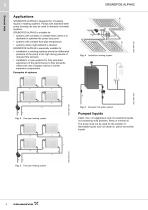
1 GRUNDFOS ALPHA2 is designed for circulating liquids in heating systems. Pumps with stainless-steel pump housing can also be used in domestic hot-water systems. GRUNDFOS ALPHA2 is suitable for • systems with constant or variable flows where it is desirable to optimise the pump duty point. • systems with variable flow-pipe temperature. • systems where night setback is desired. GRUNDFOS ALPHA2 is especially suitable for • installation in existing systems where the differential pressure of the pump is too high during periods of reduced flow demand. • installation in new systems for fully automatic...
Open the catalog to page 4
1 Advantages of pump control The heating required in a building varies greatly during the day due to changing outdoor temperatures, solar radiation and heat emanating from human beings, electric appliances, etc. Add to this that the need for heating may vary from one section of the building to another and that the thermostatic valves of some radiators may be turned down by the users. These circumstances will cause an uncontrolled pump to produce a too high differential pressure when the heating demand is low. Possible consequences: • too high energy consumption • irregular control of the system...
Open the catalog to page 5
Material specification GRUNDFOS ALPHA2 features selectable Automatic Night SetBack. Automatic Night SetBack is activated with the button on the control box. Factory setting of Automatic Night SetBack: Not active. Note If the pump has been set to speed I, II or III, the night setback function is deactivated. Controller complete Stainless steel Radial bearing Construction GRUNDFOS ALPHA2 is of the canned-rotor type, i.e. pump and motor form an integral unit without shaft seal and with only two gaskets for sealing. The bearings are lubricated by the pumped liquid. The pump is characterised by •...
Open the catalog to page 6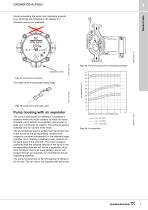
Standard position General data Faults preventing the pump from operating properly (e.g. blocking) are indicated in the display by "- -". Possible control box positions: Fig. 13 Pump housing with air-separating chamber [%] 100 Fig. 12 Cable entry with cable relief The cable entry incorporates cable relief. The pump housing with air separator is installed in systems where the liquid contains so much air that a circulator pump without air separator cannot start or keep up a continuous circulation. The pump housing is available only for upward water flows. The air-containing liquid is guided from...
Open the catalog to page 7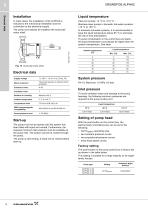
Cast-iron pumps: +2 °C to +110 °C. Stainless-steel pumps in domestic hot-water systems: +15 °C to +65 °C. In domestic hot-water systems, it is recommended to keep the liquid temperature below 65 °C to eliminate the risk of lime precipitation. To avoid condensation in the control box and stator, the liquid temperature must always be higher than the ambient temperature. See table. Liquid temperature In most cases, the installation of the ALPHA2 is reduced to the mechanical installation and the connection to the electricity supply. The pump must always be installed with horizontal motor shaft. General...
Open the catalog to page 8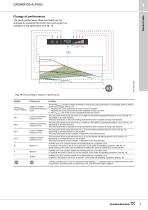
Change of performance The pump performance (flow and head) can be changed by pressing the control box push-button as indicated in the table below and fig. 16. AUTO ADAPT Fig. 16 Pump setting in relation to performance Setting Pump curve AUTOADAPT (factory setting) Highest to lowest proportional-pressure curve The AUTOADAPT function enables ALPHA2 to control the pump performance automatically within a defined performance range, see fig. 16: • Adjusting the pump performance to the size of the system. • Adjusting the pump performance to the variations in load over time. In AUTOADAPT, the pump is...
Open the catalog to page 9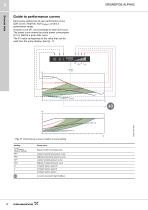
Guide to performance curves Each pump setting has its own performance curve (Q/H curve). However, AUTOADAPT covers a performance range. A power curve (P1 curve) belongs to each Q/H curve. The power curve shows the pump power consumption (P1) in Watt at a given Q/H curve. The P1 value corresponds to the value that can be read from the pump display. See fig. 17. AUTO ADAPT Fig. 17 Performance curves in relation to pump setting Setting Pump curve AUTOADAPT (factory setting) Setpoint within the shaded area Lowest proportional-pressure curve Highest proportional-pressure curve Lowest constant-pressure...
Open the catalog to page 10
The guidelines below apply to the performance curves on the next pages: • Test liquid: airless water. • The curves apply to a density of ρ = 983.2 kg/m3 and a liquid temperature of +60 °C. • All curves show average values and should not be used as guarantee curves. If a specific minimum performance is required, individual measurements must be made. • The curves for the speeds I, II and III are marked. • The curves apply to a kinematic viscosity of = 0.474 mm2/s (0.474 cSt). • The conversion between head H [m] and pressure p [kPa] has been made for water with a density of = 1000 kg/m3. For...
Open the catalog to page 11All GRUNDFOS catalogs and technical brochures
 GRUNDFOS PUMPS FOR MINING
5 Pages
 GF 270, Solar modules
2 Pages
 Grundfos ALPHA1
24 Pages
 Grundfosliterature-145421
21 Pages
 Grundfosliterature-145418
3 Pages
 Grundfosliterature-6119761
59 Pages
 Grundfosliterature-4352972
3 Pages
 Grundfosliterature-3081300
5 Pages
 ALPHA1 L
2 Pages
 DME
DME2 Pages
 GRUNDFOS CR 95 - CR 155
2 Pages
 UPM3
UPM392 Pages
 GRUNDFOS UPM3
11 Pages
 Vaccuperm VGA and VGB
28 Pages
 PURIFY YOUR BUSINESS
9 Pages
 PUST 1700 RANGE
3 Pages
 GRUNDFOS WASTEWATER PRODUCTS
10 Pages
 Grundfos LiqTec
2 Pages
 CRN high pressure programme
2 Pages
 ATEX approved CR pumps
2 Pages
 CRN Air-Cooled Top
2 Pages
 CRN MAGdrive
2 Pages
 GRUNDFOS CRE
2 Pages
 Customised solutions
21 Pages
 TPE3
TPE37 Pages
 Grundfosliterature
5 Pages
 CIM/CIU
3 Pages
 BMS
BMS5 Pages
 BM
BM2 Pages
 BACMON
16 Pages
 AQtap
AQtap7 Pages
 ALPHA2 L OEM
19 Pages
 SEG Autoadapt and GRM
2 Pages
 E-Solutions and GRM
2 Pages
 Grundfos Remote Management
3 Pages
 CRE GRUNDFOS
2 Pages
 MTA
MTA3 Pages
 Unilift CC
2 Pages
 HS Horizontal Split Case
4 Pages
 DMH-API - Product leaflet
2 Pages
 DMH -Product leaflet
2 Pages
 ALPHA1
2 Pages
 BMEX Booster Seawater
2 Pages
 AMD-AMG-AFG
3 Pages
 S - product brochure
16 Pages
 Customised pump solutions
12 Pages
 CRT for seawater
2 Pages
 CRT for industry
2 Pages
 CRT - for desalination
2 Pages
 HS
HS5 Pages
 SQ
SQ3 Pages
 SP ENGINEERING MANUAL
47 Pages
 MAGNA/UPE
12 Pages
 Pressure Manager
5 Pages
 Selcoperm SES
20 Pages
 Conex DIA-1, DIA-2, DIA-2Q
2 Pages
 Conex DIS-G
2 Pages
 Conex DIS-C
2 Pages
 Sololift2
9 Pages
 VGA and VGB
28 Pages
 Oxiperm Pro
8 Pages
 DMX
DMX18 Pages
 DMH
DMH18 Pages
 MP 204
3 Pages
 TP/TPE
5 Pages
 TP,TPE - product brochure
5 Pages
 SP Product
7 Pages
 SMART Digital dosing pumps
2 Pages
 GRUNDFOS SE & SL ranges
8 Pages
 S-Tube
4 Pages
 SB & SBA
8 Pages
 HOME AND GARDEN
52 Pages
 Product Brochure
5 Pages
 Multilift
21 Pages
 NB, NBG, NK, NKG
3 Pages
 MAGNA3 - MORE THAN A PUMP
7 Pages
 KPL and KWM
3 Pages
 GRUNDFOS BOOSTER (Hydro MPC)
3 Pages
 Grundfos GO
3 Pages
 DW
DW12 Pages
 DIP
DIP16 Pages
 GF100 TF solar module
2 Pages
 GRUNDFOS CONTROL MPC
5 Pages
 E-solution with Grundfos E-pumps
16 Pages
 Sanitary Assembly Tool Kit
2 Pages
 Durietta - Product brochure
3 Pages
 Food application pumps
7 Pages
 CM ? product brochure
7 Pages
 SQFlex ? product brochure
7 Pages
 SRP ? product brochure
3 Pages
 NEW ALPHA2
7 Pages
 Wastewater products
10 Pages
 GRUNDFOS DWK
3 Pages
 GRUNDFOS DPK range
3 Pages
 GRUNDFOS DP
5 Pages
 DIT-L, DIT-M Photometer
16 Pages
 DME, DMS, DDI
14 Pages
 Diffuser
3 Pages
 CUE E-SOLUTIONS
12 Pages
 CR ? Innovation inside
20 Pages
 A WIDE RANGE 2019
60 Pages



Archived catalogs
 CR monitor
8 Pages
 CIM / CIU
3 Pages
 Control MPC
4 Pages
 CMV
CMV8 Pages
 CM, CME Booster
52 Pages
 BMP
BMP9 Pages
 Electro Magnetic Technology
52 Pages
 A WIDE RANGE 2015
60 Pages
 Grundfos CR - Custom-built Pumps
15 Pages
 A Wide Range of Quality Products
32 Pages


- Grundfos industrial pump
- Grundfos electric pump
- Grundfos stationary pump
- Electromotor
- Grundfos water pump
- Grundfos centrifugal pump
- Self-priming pump
- Chemical pump
- Grundfos stainless steel pump
- Dynamic agitator
- Submersible pump
- Suction pump
- Grundfos transfer pump
- Liquid filter
- Pump for the chemical industry
- Multipole motor
- Grundfos diaphragm pump
- Compact pump
- Batch agitator