


- Products
- Catalogs
- News & Trends
- Exhibitions
Grundfos ALPHA1

Grundfos ALPHA1
The Grundfos ALPHA1 series consists of circulator pumps with integrated differential-pressure control and energy-efficient permanent-magnet motors. These pumps are designed to minimize power consumption and noise while enhancing system control.
Applications
These pumps are suitable for heating systems with both constant and variable flows, ideal for new and existing installations. They are intended for use with clean, non-aggressive liquids and are not suitable for flammable substances.
Construction
The ALPHA1 features a maintenance-free design with a permanent-magnet motor, ceramic bearings, and stainless-steel components for durability. It includes a unique air vent system for systems with high air content.
Installation and Startup
Installation requires mechanical setup and power connection, with the pump needing a horizontal motor shaft. The pump is self-venting and should only be started once the system is filled and vented.
Control of Heating Systems
The pump automatically adjusts differential pressure based on heating demand, offering proportional-pressure, constant-pressure, and constant-curve control modes to optimize performance and reduce noise.
Performance Curves and Technical Data
Performance curves are provided for various models, indicating flow rates and pressure capabilities. The pump operates at constant speeds and is energy-optimized, complying with the EuP Directive since 2013.
Technical Data
Models include 15-40, 20-40, 25-40, and 32-40, operating at 230 V, 50/60 Hz. They feature overload protection, with system pressure up to 10 bar and liquid temperatures ranging from 2-110°C.
Accessories
Available accessories include union and valve kits, insulating kits, and ALPHA plugs with NTC protection circuits to manage inrush currents.
Product Range
The ALPHA1 range is available in different versions for various markets, including stainless-steel versions for specific applications like drinking water.
Further Product Information
Grundfos provides WebCAPS and WinCAPS tools for detailed product information and support, offering resources like catalogues, literature, service, sizing, replacement, and CAD drawings.
Catalog excerpts
GRUNDFOS DATA BOOKLET Grundfos ALPHA1 Circulator pumps 50/60 Hz
Open the catalog to page 1
Pumped liquids Control of heating systems Advantages of pump control Type key Performance range Product introduction Stainless-steel versions N Sectional drawing Material specification Motor and control box Unique air vent system Guide to performance curves Energy labelling Curve conditions Installation Electrical data Startup Liquid temperature System pressure Inlet pressure Setting the pump Change of pump performance Product range Further product information WebCAPS WinCAPS GO CAPS ALPHA1 (N), Germany ALPHA1 (N), Austria and Switzerland ALPHA1 (N), international Union and valve kits Insulating...
Open the catalog to page 2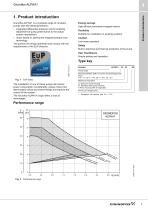
Grundfos ALPHA1 is a complete range of circulator pumps with the following features: • integrated differential-pressure control enabling adjustment of pump performance to the actual system requirement • motor based on permanent-magnet/compact-rotor technology. The pumps are energy-optimised and comply with the requirements of the EuP directive. Product introduction 1. Product introduction Energy savings High-efficient permanent-magnet motors. Flexibility Suitable for installation in existing systems. Comfort Low-noise operation. Safety Built-in electrical and thermal protection of the pump. User...
Open the catalog to page 3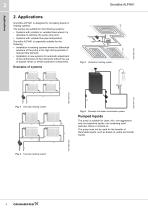
Grundfos ALPHA1 is designed for circulating liquids in heating systems. The pumps are suitable for the following systems: • Systems with constant or variable flows where it is desirable to optimise the pump duty point. • Systems with variable flow-pipe temperature. Grundfos ALPHA1 is especially suitable for the following: • Installation in existing systems where the differential pressure of the pump is too high during periods of reduced flow demand. • Installation in new systems for automatic adjustment of the performance to flow demands without the use of bypass valves or similar expensive components....
Open the catalog to page 4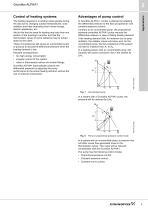
Control of heating systems Advantages of pump control The heating required in a building varies greatly during the day due to changing outdoor temperatures, solar radiation and heat emanating from human beings, electric appliances, etc. Add to this that the need for heating may vary from one section of the building to another and that the thermostatic valves of some radiators may be turned down by the users. These circumstances will cause an uncontrolled pump to produce an excessive differential pressure when the heating demand is low. Possible consequences: • too high energy consumption • irregular...
Open the catalog to page 5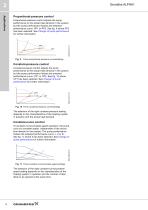
Proportional-pressure control Proportional-pressure control adjusts the pump performance to the actual heat demand in the system, but the pump performance follows the selected performance curve, PP1 or PP2. See fig. 9 where PP2 has been selected. See Change of pump performance for further information. Three proportional-pressure curves/settings Constant-pressure control Constant-pressure control adjusts the pump performance to the actual heat demand in the system, but the pump performance follows the selected performance curve, CP1 or CP2. See fig. 10 where CP1 has been selected. See Change of...
Open the catalog to page 6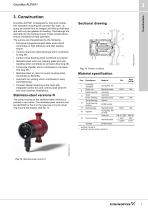
Sectional drawing Grundfos ALPHA1 is designed for long and troublefree operation including the canned-rotor type, i.e. pump and motor form an integral unit without shaft seal and with only two gaskets for sealing. The bearings are lubricated by the pumped liquid. These constructions ensure maintenance-free operation. The pumps are characterised by the following: • Permanent-magnet/compact-stator motor which contributes to high efficiency and high starting torque. • Ceramic shaft and radial bearings which contribute to long life. • Carbon thrust bearing which contribute to long life. • Stainless-steel...
Open the catalog to page 7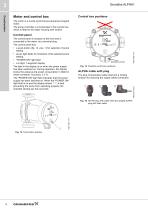
The motor is a 4-pole synchronous permanent-magnet motor. The pump controller is incorporated in the control box, which is fitted to the stator housing with screws. Control panel Standard position Fig. 15 Possible control box positions ALPHA cable with plug The plug incorporates cable relief and a locking function for securing the supply cable connection. Fig. 16 ALPHA plug with cable relief and angled ALPHA plug with fixed cable The control panel is located on the front and is connected to the stator via a terminal plug. The control panel has: • a push-button (fig. 14, pos. 1) for selection...
Open the catalog to page 8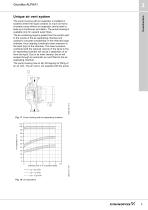
Unique air vent system The pump housing with air separator is installed in systems where the liquid contains so much air that a circulator pump without air separator cannot start or keep up a continuous circulation. The pump housing is available only for upward water flows. The air-containing liquid is guided from the suction port to the nozzle of the air-separating chamber and caused to circulate considerably in the relatively large chamber, thus creating a relatively lower pressure at the back (top) of the chamber. This lower pressure combined with the reduced velocity of the liquid in the...
Open the catalog to page 9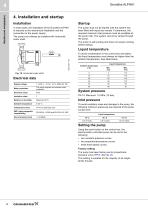
4. Installation and startup Installation In most cases, the installation of the Grundfos ALPHA1 is reduced to the mechanical installation and the connection to the power supply. The pump must always be installed with horizontal motor shaft. The pump must not be started until the system has been filled with liquid and vented. Furthermore, the required minimum inlet pressure must be available at the pump inlet. The system cannot be vented through the pump. The pump is self-venting and does not require venting before startup. Liquid temperature To avoid condensation in the control box and stator,...
Open the catalog to page 10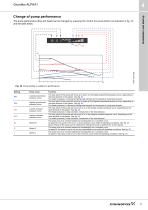
Change of pump performance The pump performance (flow and head) can be changed by pressing the control box push-button as indicated in fig. 20 and the table below. Fig. 20 Pump setting in relation to performance Setting Pump curve Lowest proportionalpressure curve Highest proportionalpressure curve Lowest constantpressure curve Highest constantpressure curve Function The duty point of the pump will move up or down on the lowest proportional-pressure curve, depending on the heat demand in the system. See fig. 20. The head (pressure) is reduced at falling heat demand and increased at rising heat...
Open the catalog to page 11All GRUNDFOS catalogs and technical brochures
 GRUNDFOS PUMPS FOR MINING
5 Pages
 GF 270, Solar modules
2 Pages
 GRUNDFOS ALPHA2
20 Pages
 Grundfosliterature-145421
21 Pages
 Grundfosliterature-145418
3 Pages
 Grundfosliterature-6119761
59 Pages
 Grundfosliterature-4352972
3 Pages
 Grundfosliterature-3081300
5 Pages
 ALPHA1 L
2 Pages
 DME
DME2 Pages
 GRUNDFOS CR 95 - CR 155
2 Pages
 UPM3
UPM392 Pages
 GRUNDFOS UPM3
11 Pages
 Vaccuperm VGA and VGB
28 Pages
 PURIFY YOUR BUSINESS
9 Pages
 PUST 1700 RANGE
3 Pages
 GRUNDFOS WASTEWATER PRODUCTS
10 Pages
 Grundfos LiqTec
2 Pages
 CRN high pressure programme
2 Pages
 ATEX approved CR pumps
2 Pages
 CRN Air-Cooled Top
2 Pages
 CRN MAGdrive
2 Pages
 GRUNDFOS CRE
2 Pages
 Customised solutions
21 Pages
 TPE3
TPE37 Pages
 Grundfosliterature
5 Pages
 CIM/CIU
3 Pages
 BMS
BMS5 Pages
 BM
BM2 Pages
 BACMON
16 Pages
 AQtap
AQtap7 Pages
 ALPHA2 L OEM
19 Pages
 SEG Autoadapt and GRM
2 Pages
 E-Solutions and GRM
2 Pages
 Grundfos Remote Management
3 Pages
 CRE GRUNDFOS
2 Pages
 MTA
MTA3 Pages
 Unilift CC
2 Pages
 HS Horizontal Split Case
4 Pages
 DMH-API - Product leaflet
2 Pages
 DMH -Product leaflet
2 Pages
 ALPHA1
2 Pages
 BMEX Booster Seawater
2 Pages
 AMD-AMG-AFG
3 Pages
 S - product brochure
16 Pages
 Customised pump solutions
12 Pages
 CRT for seawater
2 Pages
 CRT for industry
2 Pages
 CRT - for desalination
2 Pages
 HS
HS5 Pages
 SQ
SQ3 Pages
 SP ENGINEERING MANUAL
47 Pages
 MAGNA/UPE
12 Pages
 Pressure Manager
5 Pages
 Selcoperm SES
20 Pages
 Conex DIA-1, DIA-2, DIA-2Q
2 Pages
 Conex DIS-G
2 Pages
 Conex DIS-C
2 Pages
 Sololift2
9 Pages
 VGA and VGB
28 Pages
 Oxiperm Pro
8 Pages
 DMX
DMX18 Pages
 DMH
DMH18 Pages
 MP 204
3 Pages
 TP/TPE
5 Pages
 TP,TPE - product brochure
5 Pages
 SP Product
7 Pages
 SMART Digital dosing pumps
2 Pages
 GRUNDFOS SE & SL ranges
8 Pages
 S-Tube
4 Pages
 SB & SBA
8 Pages
 HOME AND GARDEN
52 Pages
 Product Brochure
5 Pages
 Multilift
21 Pages
 NB, NBG, NK, NKG
3 Pages
 MAGNA3 - MORE THAN A PUMP
7 Pages
 KPL and KWM
3 Pages
 GRUNDFOS BOOSTER (Hydro MPC)
3 Pages
 Grundfos GO
3 Pages
 DW
DW12 Pages
 DIP
DIP16 Pages
 GF100 TF solar module
2 Pages
 GRUNDFOS CONTROL MPC
5 Pages
 E-solution with Grundfos E-pumps
16 Pages
 Sanitary Assembly Tool Kit
2 Pages
 Durietta - Product brochure
3 Pages
 Food application pumps
7 Pages
 CM ? product brochure
7 Pages
 SQFlex ? product brochure
7 Pages
 SRP ? product brochure
3 Pages
 NEW ALPHA2
7 Pages
 Wastewater products
10 Pages
 GRUNDFOS DWK
3 Pages
 GRUNDFOS DPK range
3 Pages
 GRUNDFOS DP
5 Pages
 DIT-L, DIT-M Photometer
16 Pages
 DME, DMS, DDI
14 Pages
 Diffuser
3 Pages
 CUE E-SOLUTIONS
12 Pages
 CR ? Innovation inside
20 Pages
 A WIDE RANGE 2019
60 Pages



Archived catalogs
 CR monitor
8 Pages
 CIM / CIU
3 Pages
 Control MPC
4 Pages
 CMV
CMV8 Pages
 CM, CME Booster
52 Pages
 BMP
BMP9 Pages
 Electro Magnetic Technology
52 Pages
 A WIDE RANGE 2015
60 Pages
 Grundfos CR - Custom-built Pumps
15 Pages
 A Wide Range of Quality Products
32 Pages


