
- Catalogs
- Grünbeck Wasseraufbereitung
- Water treatment for private water supply

Water treatment for private water supply

Water treatment for private water supply
This document discusses effective and cost-efficient solutions for water treatment in private water supplies, focusing on maintaining hygienic standards.
Microbiology and Disinfection
Ultrafiltration is highlighted as a key disinfection method, using membranes with a separation capacity of less than 0.01 µm to retain germs, viruses, and bacteria. This method acts as a barrier between polluted and pure water and is not affected by raw water quality fluctuations. A backwash process is necessary to clean the membranes.
Three disinfection processes are available: chemical disinfection with chlorine dioxide, UV light irradiation, and ultrafiltration. GENODOS® DM-B/DM-BO dosing systems with GENO®-Baktox can be used for continuous dosing to eliminate germs. UV disinfection uses a special lamp to kill germs with a germicidal effect of over 99.99%, but lacks a depot effect.
Deacidification, Deferrisation, and Demanganisation
Ground or well water may have low pH values due to excess carbon dioxide, which can corrode metal pipes. Deacidification can be achieved by dosing lye or using calcium carbonate. Iron and manganese in water can cause discoloration and stains. Deferrisation and demanganisation can be done using potassium permanganate or catalytic filter material, depending on concentration levels.
Nitrate Reduction and Salt Concentration Reduction
Nitrate levels can be high in areas of intensive farming. Ion exchangers are used to reduce nitrate concentrations by replacing nitrate with chloride. Reverse osmosis is used to reduce total salt concentration, especially in coastal areas, by using a semi-permeable membrane to separate solutions of different concentrations. This process also reduces bacteria, germs, and dissolved organic substances.
Conclusion
The document emphasizes the importance of water treatment in private systems to comply with drinking water standards and prevent damage to infrastructure.
Catalog excerpts
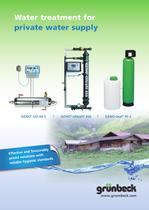
0187_Eigenwasserv_en_2012-03-21.qxd:Layout 1 21.03.2012 13:58 Uhr Seite 1 Water treatment for private water supply GENO®-UV-60 S GENO®-Ultrafil 450 GENO-mat® FE-Z favourably fective and Ef tions with priced solu s ic standard ble hygien relia www.gruenbeck.com
Open the catalog to page 1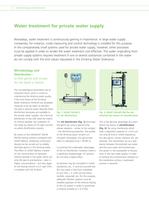
0187_Eigenwasserv_en_2012-03-21.qxd:Layout 1 2 21.03.2012 13:59 Uhr Seite 2 Microbiology and disinfection Water treatment for private water supply Nowadays, water treatment is continuously gaining in importance. In large water supply companies, for instance, costly measuring and control technology is installed for this purpose. In the comparatively small systems used for private water supply, however, other processes must be applied in order to render the water treatment cost-effective. The water originating from private supply systems requires treatment if one or several substances contained...
Open the catalog to page 2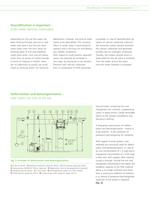
0187_Eigenwasserv_en_2012-03-21.qxd:Layout 1 21.03.2012 13:59 Uhr Seite 3 Deacidification / Deferrisation/demanganisation Deacidification is important – acidic water destroys metal pipes Depending on the soil the water has been flowing through, ground or well water may have a very low pH value (even lower than the limit value for drinking water of 6.5) and therefore might react acidic. Such low pH values result from an excess of carbon dioxide. In terms of hygiene or health, there are no objections to purely use acidic water as drinking water. For technical applications, however, this kind of...
Open the catalog to page 3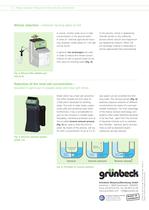
0187_Eigenwasserv_en_2012-03-21.qxd:Layout 1 13:59 Uhr Seite 4 Nitrate reduction / Reduction of the total salt concentration Nitrate reduction – intensive farming takes its toll In nature, nitrates rarely occur in high concentrations in the ground water. In areas of intensive agricultural manuring, however, nitrate values of > 50 mg/l can be found. In this process, nitrate is replaced by chloride (similar to the softening process where calcium and magnesium are replaced by sodium). When the ion exchange material is exhausted, it will be regenerated fully automatically. In general, ion exchangers...
Open the catalog to page 4All Grünbeck Wasseraufbereitung catalogs and technical brochures
 AVRO 125
3 Pages
 GENO®-Ultrafil
3 Pages
 softliQ:SD23
6 Pages
 softliQ:SD21
6 Pages
 softliQ:SD18
6 Pages
 Water treatment in private pools
12 Pages
 Sanitary and Heating
96 Pages
 Decentralised Aqua Container
4 Pages
 Delta-p®
8 Pages
 Reliable filter technology
8 Pages
 Water treatment in public pools
12 Pages
 Company´s Brochure
20 Pages


Archived catalogs

- Liquid filter
- Filter with cartridge
- Industrial use filter
- Pressure separator filter
- Stainless steel pre-filter
- Water pre-filter
- Filtration unit
- Dust separator filter
- Safety valve
- Basket filter
- VOC-free liquid filtration unit
- Automatic filter
- Water purification unit
- Filtration system
- Absorption filtration unit
- Fine pre-filter
- Activated carbon filter
- Liquid filtration system
- Reverse osmosis water purification unit
- Process sterilizer