
- Catalogs
- Grünbeck Wasseraufbereitung
- Decentralised Aqua Container

Decentralised Aqua Container

Decentralised Aqua Container
- Hydrocyclone for removing coarse particles
- Pre-oxidation
- pH value correction
- Flocculation
- Mechanical cleaning using a drum filter or tilted plate separator
- Intensive ventilation for oxidation
- Ultrafiltration with two modules and a CIP system for automatic cleaning
- Reverse osmosis for hard or saline water
- Final treatment with chlorine or fluorine dosing to meet legal standards
Catalog excerpts
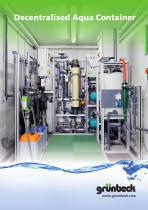
Decentralised Aqua Container
Open the catalog to page 1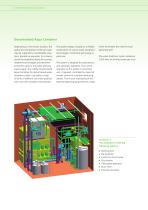
Decentralised Aqua Container Decentralised Aqua Container Depending on the chosen location, the quality and composition of the raw water may be subjected to considerable variations. Brackish or sea water, for instance, cannot be treated by means of common treatment technologies and therefore cannot be used for the public drinking water supply. The mobile, Decentralised Aqua Container for decentralised water treatment makes it possible to treat all kinds of different raw water qualities, even such with complex characteristics. The system design is based on a flexible combination of various water...
Open the catalog to page 2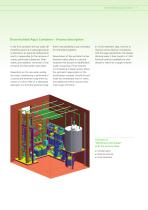
Decentralised Aqua Container Decentralised Aqua Container – Process description In the first container, the raw water delivered by means of a submerged pump is directed to an optional hydrocyclone which is responsible for the removal of coarse, particulate substances. Afterwards, pre-oxidation, correction of the pH value and flocculation take place. Depending on the raw water quality, the water conditioning is performed in a second pre-treatment step either by means of a drum filter or a tilted plate separator. In a third pre-treatment step, there is the possibility to use a ventilator for intensified...
Open the catalog to page 3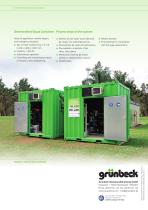
Decentralised Aqua Container Decentralised Aqua Container Process steps of the system Areas of application: remote regions and emergency situations ● Two 10-feet containers (w x h x d) 2,438 x 2,896 x 2,991 mm ● Capacity: 1,000 l/h ● Autonomous operation ● Controlling and monitoring by means of remote control engineering Delivery of raw water as per demand by means of a submerged pump Pre-treatment by means of hydrocyclone Pre-oxidation, correction of pH value, flocculation Mechanical cleaning by means of filter or sedimentation systems Ultrafiltration Reverse osmosis Final treatment in compliance...
Open the catalog to page 4All Grünbeck Wasseraufbereitung catalogs and technical brochures
 AVRO 125
3 Pages
 GENO®-Ultrafil
3 Pages
 softliQ:SD23
6 Pages
 softliQ:SD21
6 Pages
 softliQ:SD18
6 Pages
 Water treatment in private pools
12 Pages
 Sanitary and Heating
96 Pages
 Delta-p®
8 Pages
 Reliable filter technology
8 Pages
 Water treatment in public pools
12 Pages
 Company´s Brochure
20 Pages


Archived catalogs

- Liquid filter
- Filter with cartridge
- Industrial use filter
- Pressure separator filter
- Stainless steel pre-filter
- Water pre-filter
- Filtration unit
- Dust separator filter
- Safety valve
- Basket filter
- VOC-free liquid filtration unit
- Automatic filter
- Water purification unit
- Filtration system
- Absorption filtration unit
- Fine pre-filter
- Activated carbon filter
- Liquid filtration system
- Reverse osmosis water purification unit
- Process sterilizer