
- Catalogs
- Groupe SIFCOR
- CODE OF CONDUCT ANTI-CORRUPTION

CODE OF CONDUCT ANTI-CORRUPTION
CODE OF CONDUCT ANTI-CORRUPTION
- Gifts and Invitations: Must not compromise professional judgment or integrity. They should be legitimate, reasonable, transparent, and traceable. Prohibited practices include cash gifts, gifts to influence officials, and gifts of unreasonable value.
- Authorized Practices: Modest gifts and professional invitations are allowed if they meet specific criteria. Gifts exceeding certain values require pre-authorization or subsequent validation by a supervisor.
Catalog excerpts
CODE OF CONDUCT ANTI-CORRUPTION GROUP SIFCOR GROUP CODE OF CONDUCT VERSION OF 13/11/2019
Open the catalog to page 1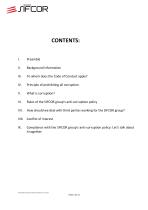
III. To whom does the Code of Conduct apply? IV. Principle of prohibiting all corruption VI. Rules of the SIFCOR group's anti-corruption policy VII. How should we deal with third parties working for the SIFCOR group? VIII. Conflict of interest IX. Compliance with the SIFCOR group's anti-corruption policy: Let's talk about it together SIFCOR GROUP CODE OF CONDUCT VERSION OF 13/11/2019
Open the catalog to page 2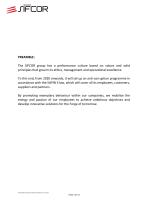
PREAMBLE: The SIFCOR group has a performance culture based on values and solid principles that govern its ethics, management and operational excellence. To this end, from 2020 onwards, it will set up an anti-corruption programme in accordance with the SAPIN II law, which will cover all its employees, customers, suppliers and partners. By promoting exemplary behaviour within our companies, we mobilise the energy and passion of our employees to achieve ambitious objectives and develop innovative solutions for the Forge of tomorrow. SIFCOR GROUP CODE OF CONDUCT VERSION OF 13/11/2019
Open the catalog to page 3
Corruption is a major obstacle to the proper functioning of the company. It generates costs by reducing economic efficiency and damaging the company's image and reputation, and the dignity and integrity of those who suffer its consequences. The SIFCOR group applies a principle of zero tolerance towards any form of corruption. The SIFCOR group is committed to an approach aimed at ensuring the irreproachable conduct and ethics of its employees. The SIFCOR group has decided to set up a corruption prevention programme in accordance with article 17 of the “Sapin 2” law of 9 December 2016. This code...
Open the catalog to page 4
II. TO WHOM DOES THE CODE OF CONDUCT APPLY? The code of conduct applies to all SIFCOR Group employees, regardless of their hierarchical level, role or geographical location. All employees of the SIFCOR group, as well as external and occasional employees (temporary staff, interns, service providers seconded for more than three months), directors and officers, members of all administrative, supervisory and management committees of the SIFCOR group and its direct and indirect subsidiaries in France and worldwide, are considered as employees. III. PRINCIPLE OF PROHIBITING ALL CORRUPTION SIFCOR...
Open the catalog to page 5
DEFINITION OF CORRUPTION AND INFLUENCE PEDDLING: Corrupt practices consist, with regard to private persons (customers, suppliers, etc.) or persons holding public office, in proposing, paying, requesting, soliciting or accepting offers, promises, donations, gifts or benefits of any kind for the employees themselves or for others, directly or indirectly, For one of these persons to perform or refrain from performing, or because he has performed or refrained from performing: - an act of his office, mission or mandate, or facilitated by his office, mission or mandate, in the case of a public official;...
Open the catalog to page 6
Corruption can be: - active: it is then characterised by offering, promising, paying or granting an undue advantage to a third party; - passive: in this case, it consists in requesting, soliciting, accepting or receiving an undue advantage from a third party. The objective being that one of these persons performs or refrains from performing, facilitating or delaying an act that is directly or indirectly within the scope of his or her duties. Corruption is private when it occurs in the context of relationships between natural or legal persons in the private sector such as suppliers, service providers,...
Open the catalog to page 7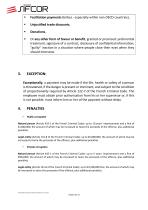
■ Facilitation payments (bribes - especially within non-OECD countries), ■ Unjustified trade discounts, ■ Or any other form of favour or benefit, granted or promised: preferential treatment, signature of a contract, disclosure of confidential information, "guilty" inaction in a situation where people close their eyes when they should intervene. Exceptionally, a payment may be made if the life, health or safety of a person is threatened, if the danger is present or imminent, and subject to the condition of proportionality required by Article 122-7 of the French Criminal Code. The employee must...
Open the catalog to page 8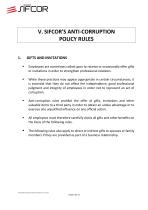
V. SIFCOR'S ANTI-CORRUPTION POLICY RULES1. GIFTS AND INVITATIONS ■ Employees are sometimes called upon to receive or occasionally offer gifts or invitations in order to strengthen professional relations. ■ While these practices may appear appropriate in certain circumstances, it is essential that they do not affect the independence, good professional judgment and integrity of employees in order not to represent an act of corruption. ■ Anti-corruption rules prohibit the offer of gifts, invitations and other valuable items to a third party in order to obtain an undue advantage or to exercise any...
Open the catalog to page 9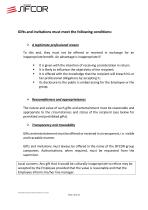
Gifts and invitations must meet the following conditions:> A legitimate professional reason To this end, they must not be offered or received in exchange for an inappropriate benefit. An advantage is inappropriate if: ■ It is given with the intention of receiving consideration in return; ■ It is likely to influence the objectivity of the recipient; ■ It is offered with the knowledge that the recipient will breach his or her professional obligations by accepting it; ■ Its disclosure to the public is embarrassing for the Employee or the group. The nature and value of such gifts and entertainment...
Open the catalog to page 10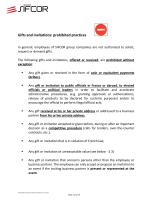
Gifts and invitations: prohibited practices In general, employees of SIFCOR group companies are not authorised to solicit, request or demand gifts. The following gifts and invitations, offered or received, are prohibited without exception: Any gift given or received in the form of cash or equivalent payments (bribes), Any gift or invitation to public officials in France or abroad, to elected officials or political leaders in order to facilitate and accelerate administrative procedures, (e.g. granting approvals or authorisations, release of products to be declared for customs purposes) and/or...
Open the catalog to page 11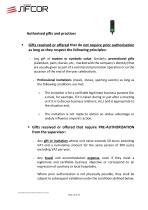
Authorised gifts and practices Gifts received or offered that do not require prior authorisation as long as they respect the following principles: - Any gift of modest or symbolic value. Similarly, promotional gifts (calendars, pens, diaries, etc., marked with the company's identity) that are usually given as part of a commercial promotion operation or on the occasion of the end of the year celebrations. - Professional invitations (meals, shows, sporting events) as long as the following conditions are met: o The invitation is for a verifiable legitimate business purpose (for a meal, for example,...
Open the catalog to page 12All Groupe SIFCOR catalogs and technical brochures
- Machining service
- Machining
- Metal machining
- ISO machining
- ISO 9001 machining
- Automotive machining
- Forging
- Metal forging
- Steel machining
- ISO 9001 forging
- Cold forging
- Steel forging
- Automotive forging
- ISO 14001 machining
- Hot forging
- ISO 14001 forging
- Large series forging
- Medium series forging
- Carbon steel machining
- Small series forging