

Guidelines for slurry pumping
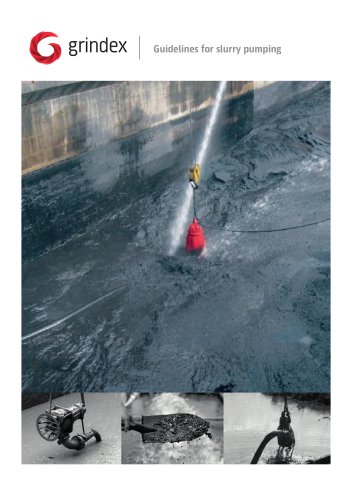
Guidelines for slurry pumping
Slurry is a mixture of solids and liquid, typically water, used in various industrial applications. This document provides guidelines on slurry pumps, focusing on their types, applications, and the parameters necessary for selecting submersible slurry pumps. It includes a manual calculation example in the appendix for deeper understanding.
Slurry pumps are robust centrifugal pumps designed for handling abrasive duties. They are used in industries such as mining, construction, and mineral processing. The main types of slurry pumps are horizontal, vertical, and submersible. Horizontal pumps are dry-mounted, vertical pumps can be tank or cantilever types, and submersible pumps operate directly in the slurry, offering benefits like compactness and low noise.
Grindex pumps are designed with features like effective cooling, insulation, and robust shaft and bearings to handle slurry's abrasive nature. They use water cooling for high power density and have a unique hydraulic design to minimize wear and maintain efficiency. The pumps can be equipped with agitators to keep solids in suspension.
Understanding slurry properties is crucial for pump selection. Key parameters include particle size and distribution, mass fraction of small particles, and concentration of solids. These factors influence the pump's performance and efficiency.
The document outlines the design and performance considerations for slurry pump systems, including calculating system requirements and sizing the pump. It emphasizes the importance of understanding slurry characteristics and system parameters for optimal pump selection.
This section provides an overview of common industries and applications for slurry pumps, highlighting the versatility and adaptability of these pumps in various settings.
The appendix includes a step-by-step calculation guide, an index, designations and formulas, and a slurry questionnaire to assist in accurate pump selection and system design.
The document discusses the specific gravity (SG) of solids, which is calculated by dividing the density of the solid by the density of the liquid. Water has a density of 1000 kg/m³ and an SG of 1.0 at 20°C. The specific gravity of slurry can be determined using a nomograph or calculated if two of the values of SGs, Cv, and Cm are known. The shape of particles affects slurry behavior during pumping and wear on the pump and pipe system.
Slurries are categorized into settling and non-settling types. Non-settling slurries have particles that remain in suspension and act in a homogeneous, viscous manner, but are non-Newtonian. Settling slurries settle quickly but can be kept in suspension by turbulence and are defined as pseudo-homogeneous or heterogeneous mixtures.
Liquids are characterized by viscosity, which decreases with increasing temperature. Newtonian liquids have a linear relationship between shearing stress and velocity gradient, while non-Newtonian liquids, such as water-based slurries with fine particles, do not follow this relationship and have a yield stress.
The performance of centrifugal pumps differs when pumping slurry compared to clean water, affected by particle size, density, and shape. Calculations for pump dimensioning require data about the slurry, head, flow, and pipe system design. Critical velocity must be maintained to prevent sedimentation.
Static head, friction losses, and total discharge head are crucial for pump calculations. NPSH (Net Positive Suction Head) must be considered to prevent cavitation, which can damage the pump. Cooling systems are necessary for certain conditions, and wear inside the pump depends on velocity, concentration, and impact angle of particles.
Grindex Bravo slurry pumps can be installed in various ways, including dry, submerged, and raft installations. They are used in industries such as iron & steel, coal-fired power plants, pulp & paper, oil & gas, wastewater treatment, and mining operations. Each application has specific requirements for handling slurry effectively.
This document provides detailed guidelines for the use of pumps in various industrial applications, including quarries, dredging, and concrete recycling plants. It emphasizes the importance of selecting the appropriate pump type and installation method based on the specific requirements of the slurry being pumped, such as its density and concentration of solids.
The document outlines a step-by-step procedure for calculating the necessary parameters for pump selection, including specific gravity, critical velocity, total discharge head, and power consumption. It provides formulas and examples to assist in these calculations, ensuring that the selected pump meets the operational demands.
Recommendations are provided for minimizing sedimentation and ensuring efficient pump operation, such as using a clean sump design and selecting appropriate pipe diameters to maintain velocities above critical levels. The document also advises on the power margin required for motors in slurry applications to accommodate variations in slurry density.
An example calculation is provided for selecting a pump in a coal mine, detailing the steps to determine specific gravity, critical velocity, and total discharge head. The example illustrates the application of correction factors and the selection of a pump with adequate power capacity.
The appendix includes nomographs and graphs for determining specific gravity and critical velocity, as well as tables for friction losses and correction factors. These tools aid in the accurate calculation of parameters necessary for pump selection and operation.
Catalog excerpts

Guidelines for slurry pumping
Open the catalog to page 1
Slurry A mixture of solids and liquid, generally water. The particles may not be abrasive although this is common.
Open the catalog to page 2
• Where are slurry pumps used? • Can submersible slurry pumps replace other types of pumps? • Which parts are of special importance in a submersible slurry pump? • Which parameters of the slurry and pipe system are required to be able to dimension a pump correctly? The purpose of this book is, in a simple way, to describe slurry pumps, slurry pumping and the various parameters required when selecting submersible slurry pumps. To provide a deeper understanding of the calculations, a manual calculation example is given in the appendix of the book. about the type of slurry, the choice of pump, the...
Open the catalog to page 4
Slurry pumps are a heavy and robust version of centrifugal pumps, capable of handling tough and abrasive duties. Slurry pumps should also be considered a generic term, to distinguish them from other centrifugal pumps mainly intended for clear liquids. Slurry pumps are used to move mixtures of liquid and solids in many industries with a broad spectrum of applications, for example mine drainage, dredging of settling lagoons and pumping of drilling mud. • To pump a medium where abrasive particles are present • To transport as much solids as possible, hydraulically • To pump the end product in a...
Open the catalog to page 5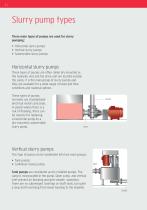
Slurry pump types Three main types of pumps are used for slurry pumping: • Horizontal slurry pumps • Vertical slurry pumps • Submersible slurry pumps These types of pumps are often called dry mounted as the hydraulic end and the drive unit are located outside the sump. It is the main group of slurry pumps and they are available for a wide range of head and flow conditions and material options. These types of pumps normally use standardized electrical motors and seals. In plants where there is a risk of flooding, there can be reasons for replacing a horizontal pump by a dry-mounted, submersible,...
Open the catalog to page 6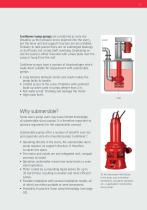
Cantilever/sump pumps are considered as semi-dry installed, as the hydraulic end is lowered into the slurry, but the drive unit and support structure are dry installed. Similarly to tank pumps there are no submerged bearings or shaft seals, but a long shaft overhang. Depending on size the pump is either mounted with a base plate over the sump or hung from the roof. Cantilever-pumps have a number of disadvantages which make them suitable for replacement with submersible pumps: • Long distance between motor and volute makes the pump bulky to handle. • Limited access to the sump. Problems with sediment...
Open the catalog to page 7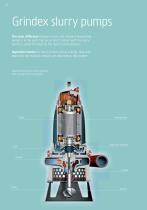
Grindex slurry pumps The main difference between slurry and standard dewatering pumps is in the parts that are in direct contact with the slurry and thus subject to wear by the slurry’s solid particles. Important factors for slurry pumps such as cooling, seals and especially the hydraulic design, are described in this chapter. Grindex Bravo slurry pump equipped with cooling jacket and agitator Cooling jacket Inspection chamber
Open the catalog to page 8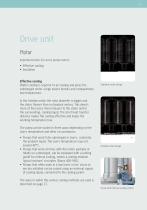
Drive unit Motor Important factors for slurry pump motors: • Effective cooling • Insulation Effective cooling Water cooling is superior to air cooling and gives the submerged motor a high power density and comparatively low temperature. Standard motor design Standard motor design Standard motor design In the Grindex motor the rotor diameter is bigger and the stator thinner than in standard motors. This directs more of the losses (heat release) to the stator and to the surrounding, cooling liquid. The short heat transfer distance makes the cooling effective and keeps the working temperature low....
Open the catalog to page 9
Class H insulation (180°C) is applied to the stator winding by a trickle impregnation system. The Grindex Bravo pump has a motor limit to Class B (140°), which reduces thermal stress resulting in extended lifetime. Trickle impregnation gives a winding fill much greater than typical dip and bake systems. This gives much higher protection against short circuits in the winding. Shaft and bearings Important factors for shafts and bearings: • Shaft design and dimensioning • Bearing type and protection Shaft design and dimensioning The shaft and bearings are of sturdy design. The distance between the...
Open the catalog to page 10
Important factors for submersible pump seals: • Low leakage or even zero leakage! • Wear resistance Leakage and wear resistance In conjunction with leakage rate, the most important feature for seals in slurry applications is the ability to resist wear from abrasive particles. The seals for the slurry pumps are designed to cope with highly abrasive pump media. Only the seal rings are exposed to the media. Other parts of the seal, such as springs and torque locks are protected from wear, clogging and corrosion inside the seal housing. In addition, an isolation zone takes the pressure of the mechanical...
Open the catalog to page 11
Protection systems Important factors for submersible pump protection: • The possibility of detecting a leaking seal before any damage occurs • Spin-out™ seal protection • Overheating protection Possibility of detecting a leaking seal Stator housing leakage: A float switch shuts the pump down if water is detected. The inspection chamber between the seal unit and the bearings has a built-in sensor for early detection of fluid leakage. The space can be inspected and emptied via a screw, which is easily accessible from the outside. Spin-out™ seal protection A patented outer seal design that protects...
Open the catalog to page 12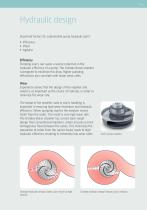
Hydraulic design Important factors for submersible pump hydraulic parts: • Efficiency • Wear • Agitator Efficiency Pumping slurry can cause a severe reduction in the hydraulic efficiency of a pump. The Grindex Bravo impeller is designed to minimize this drop. Higher pumping efficiencies also correlate with lower wear rates. Wear Experience shows that the design of the impeller and volute is as important as the choice of material, in order to minimize the wear rate. The shape of the impeller used in slurry handling is important in ensuring high wear resistance and hydraulic efficiency. When pumping...
Open the catalog to page 13All Grindex catalogs and technical brochures
 PUMP HANDBOO 2026
80 Pages
 GRINDEX’S GREAT PUMP GUIDE
44 Pages
Archived catalogs
 Bravo series
8 Pages
 Micro
Micro2 Pages
 Drainage pumps
12 Pages
 Handbook 60 Hz
68 Pages
 Handbook 50 Hz
68 Pages