


Hooded Propeller Roof Fans (Model RE2/RS2/RCEe/RC3/RBE/RBS/RBI/RBCE/RBCS/RBCI)

Hooded Propeller Roof Fans (Model RE2/RS2/RCEe/RC3/RBE/RBS/RBI/RBCE/RBCS/RBCI)
This document provides a comprehensive overview of Greenheck's hooded roof propeller fans, designed for general ventilation in factories, warehouses, and industrial applications. The fans are available in various models, including exhaust, supply, and reversible types, with options for belt or direct drive mechanisms.
Greenheck fans are built to high standards of reliability and durability, with options for fabricated steel, aluminum, or cast aluminum propellers. They are certified with the AMCA Seal for performance and listed for electrical safety under UL/cUL 705.
The document details various models categorized by construction levels and performance capabilities, with wheel diameters ranging from 18 to 72 inches and airflow capacities up to 87,000 cfm.
Standard features include heavy-duty ball bearing motors, precisely ground fan shafts, and robust drive frames. The fans are designed with interlocking rib hoods for strength and weather resistance. Propellers are dynamically balanced for efficiency.
Reversible models like RPDR and RPBR offer flexibility for non-ducted systems, allowing for both exhaust and supply functions to maintain optimal working conditions.
Available accessories include tall bases, safety guards, aluminum housings, roof curbs, insect screens, hood insulation, special coatings, and extended lubrication lines. Disconnect switches and wiring options are also offered for enhanced safety and convenience.
Most units ship fully assembled to minimize installation time. Larger models may require hood assembly on-site. The design facilitates easy access for maintenance, with features like hinged or removable hoods and quick-release birdscreens.
Greenheck's hooded roof propeller fans provide versatile and reliable solutions for industrial ventilation needs, with a wide range of models and customizable options to suit various applications.
The document outlines specifications for various fan models, including internal or external power supply options, factory-mounted end switches, and different types of dampers such as backdraft dampers for exhaust and supply, which can be gravity or motorized. Heavy-duty dampers are available for higher air volumes, and ultra-low leakage dampers are also mentioned.
Fans are tested for high wind and hurricane ratings according to Miami-Dade County and Florida standards. Seismic ratings are also provided, with certification to California OSHPD and IBC standards.
Key considerations include air volume, resistance, belt drive vs. direct drive, and fan size. Belt drive fans offer speed adjustment and flexibility, while direct drive fans are preferred for difficult maintenance access. Larger fans have higher initial costs but lower operating costs, whereas smaller fans have stable performance but higher sound levels.
Fans for high static pressures produce higher sound levels, while low-pressure applications are recommended for sound-sensitive environments. Accessories like dampers add minimal pressure when installed correctly.
Motors can operate within a service factor range without overheating. Performance tables show RPM selections for belt and direct drive fans, with service factors up to 1.2 Bhp.
For reversible models, filter performance graphs help determine static pressure drop. An example calculation is provided for a 42-inch fan at 20,000 cfm.
The ES-CC control center is designed for reversible fan models, offering remote operation and ease of installation. It includes a mode selector switch and optional indicator light.
Detailed dimensions for various fan sizes and configurations are provided, including standard and tall base options.
Material gauges and construction details for different fan models are listed, including reversible models with specific codes for identification.
Each fan model is listed with its motor horsepower, fan RPM, maximum BHP, and sound levels. The airflow capacity (CFM) is provided at various static pressure levels, indicating the fan's efficiency and suitability for different applications.
The document explains the coding system used to identify fan models, including details on belt drive configurations, propeller types, and motor sizes.
Specific limits for each fan model are outlined, including maximum RPM and motor frame size. The document highlights the importance of selecting the appropriate fan based on these limits to ensure optimal performance.
Sound levels are measured in sones at a distance of 5 feet in a hemispherical free field, following AMCA Standard 301. The document emphasizes that these ratings apply to the highest cataloged CFM at each fan RPM.
Recommendations are provided for selecting the most efficient fan models based on CFM values, with a focus on minimizing sound levels and maximizing performance.
CFM values in black indicate the most efficient selections, while gray values are not recommended. Numbers in blue indicate a larger BHP, requiring the next size larger motor. Performance is certified for installation type A, which involves a free inlet and outlet.
The document serves as a comprehensive guide for selecting and understanding the performance of various fan models in HVAC systems, ensuring that users can make informed decisions based on detailed technical specifications.
The document outlines specifications for various models of Greenheck's hooded propeller roof fans, including belt drive and direct drive models. Propellers are constructed from fabricated steel, aluminum, or cast aluminum, and are balanced both statically and dynamically. Fan hoods and bases are made from galvanized or painted steel, or aluminum, with arched panels and interlocking ribs for weather protection. Motors are heavy-duty, permanently lubricated, and matched to fan loads.
Installation involves securing propellers to motor shafts using a standard square key and set screw or tapered bushing. Fan bases are typically low profile, with taller bases specified when access doors are needed for damper and actuator service. Safety features include birdscreens and safety guards.
Fans bear the AMCA Certified Ratings seal for sound and air performance. Bearings are selected for a minimum life of 100,000 hours, with drives sized for at least 150% of driven horsepower.
Models RPBR and RPBRF are reversible, belt drive axial type, with cast aluminum, airfoil propellers. They include features for easy maintenance and are designed for durability and reliability.
Greenheck offers a one-year warranty on equipment, covering defects in material and workmanship. Motors are warranted by the manufacturer for one year. Greenheck supports green building efforts by providing energy-efficient, low-maintenance products.
The document also mentions other fan products like upblast propeller fans and sidewall propeller fans, designed for various commercial and industrial applications, offering high reliability and durability.
Catalog excerpts

Hooded Roof Propeller Fans Belt and Direct Drive Exhaust, Supply and Reversible
Open the catalog to page 1
[fi[greenheck^ Building Value in Air. Hooded Roof Propeller Fans Exhaust Supply/Reversible Belt and Direct Drive From general ventilation of factories and warehouses to industrial duty, the range of construction and performance capabilities offered in this catalog represent the most comprehensive hooded propeller roof fan line available. Regardless of fan size, performance or duty level, all Greenheck hooded propeller roof fans are built to perform with the same high standards of reliability and durability. Exhaust, supply and reversible models are available in belt or direct drive. Filtered...
Open the catalog to page 2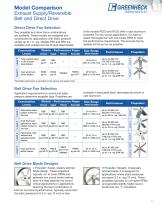
Direct Drive Fan Selection Two propeller and drive frame combinations are available. These models are designed and constructed for applications with static pressure ranges up to 1 in. wg. Models RE2 and RS2 are available with welded and die formed steel blades, while models RCE3 and RCS3 offer a cast aluminum propeller. For low sound applications, it is best to select the largest fan with the lowest RPM to meet the performance requirements. This ensures the tip speeds will be as low as possible. H Propeller: Straight, moderately pitched blade. It is designed for applications where static pressures are...
Open the catalog to page 3
Superior Hood Design Greenheck’s interlocking rib design combines four material thicknesses with I-beam design principles producing a hood far superior in strength to conventional designs (an important feature in high snow or wind load regions). Formed channels adjacent to the ribs provide water drainage to ensure weather tightness. Hoods are available in galvanized steel, painted steel or aluminum construction. Hood support angles are heavy-gauge galvanized steel. Construction Features • Fan hoods and bases are constructed of galvanized, aluminum, steel or painted steel as specified. Hood panels...
Open the catalog to page 4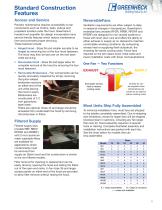
[^GREENHECK Building Value in Air. Access and Service Periodic maintenance requires accessibility to fan components such as motors, belts, pulleys and propellers located under the hood. Greenheck’s hooded roof propeller fan design incorporates many service friendly features which reduce maintenance time and promotes proper servicing. These features include: • Hinged Hood - Sizes 36 and smaller are able to be hinged by removing two of the four hood fasteners. The hood may then be laid over on the roof deck while servicing. • Removable Hood - Sizes 36 and larger allow for complete removal of the...
Open the catalog to page 5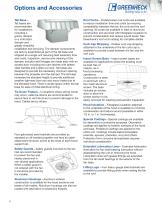
Tall Base -Tall bases are recommended for installations including a gravity damper or a motorized damper and greatly simplifies installation and servicing. The damper components are factory assembled as part of the tall base and shipped as a single unit reducing field assembly time and costs. Inspection, service and cleaning of the damper, actuator and linkages are made easy with an access door including two cam latches with plated steel handles and a slide-out rack. Tall bases are designed to provide the necessary minimum spacing between the propeller and the damper. The tall base increases...
Open the catalog to page 6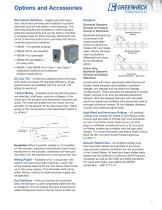
Options and Accessories Disconnect Switches – Toggle type and heavyduty disconnect switches are available for positive electrical shut-off and safety in servicing fans. The following switches are available to meet individual electrical requirements and can be factory mounted or shipped loose for field mounting. Wiring from the motor to the disconnect box is provided with factory mounted disconnect switches. • NEMA-1 for general purpose • NEMA-3R for rain resistant • NEMA-4 for watertight • NEMA-3R and NEMA-4 for heavy-duty • NEMA-7 and NEMA-9 for Class 1 and Class 2 hazardous locations and explosion...
Open the catalog to page 7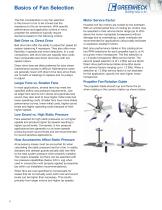
[^GREENHECK^ Building Value in Air. The first consideration in any fan selection is the amount of air to be moved and the resistance to this air movement. With specific performance and application criteria in mind, propeller fan selections typically require decisions based on the following criteria: Belt Drive vs. Direct Drive Belt drive fans offer the ability to adjust fan speed for system balancing if necessary. They also offer more flexibility in speeds and motor selections. In a cost comparison, belt drive fans are typically less costly than comparable size direct drive fans with low speed...
Open the catalog to page 8
Reversible Models Only Filter Performance and Control Center 0.7 Filter Performance Reversible Fan Control Center For reversible models RPDRF and RPBRF, with 2‑inch washable aluminum filters, use the filter performance graph above to determine the static pressure drop added by the filters. The filter loss is included in the performance data and no calculation will need to be determined for the RBF and RBCF models. Model ES-CC The airflow (cfm) and the desired fan size must be known to determine the pressure drop added by the filters. Example: Size 42‑inch RPDRF for 20,000 cfm at 0.125 in. wg....
Open the catalog to page 9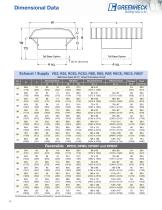
Dimensional Data A sq.- Exhaust / Supply RE2, RS2, RCE3, RCS3, RBE, RBS, RBF, RBCE, RBCS, RBCF (Belt Drive Sizes 20-72 Direct Drive Sizes 18-54) All dimensions shown in inches (millimeters); *square dimensions
Open the catalog to page 10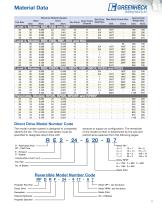
Material Data J 5 [^GREENHECK ^ Building Value in Air. B 7 Tm Direct Drive Model Number Code The model number system is designed to completely identify the fan. The correct code letters must be specified to designate direct drive with R E 2 - 24 R - Fabricated Prop RC - Cast Prop E - Exhaust S - Supply Construction Level 2 or 3 Fan Size No. of Blades - exhaust or supply air configuration. The remainder of the model number is determined by the size and performance selected from the following pages. Minimum Material Gauges Blade Pitch Propeller Roof Fan Direct Drive Reversible Filtered (Optional)...
Open the catalog to page 11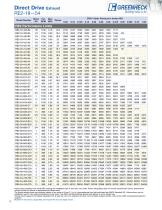
Direct Drive Exhaust RE2-18 — 54 Building Value in Air. Model Number Performance certified is for model RE2 exhaust for installation type A: free inlet, free outlet. Power rating (Bhp) does not include transmission losses. Performance ratings include the effects of appurtenances (Birdscreen). The sound ratings shown are loudness values in fan sones at 5 feet (1.5 m) in a hemispherical free field calculated per AMCA Standard 301. Values shown are for installation type A: free outlet hemispherical sone levels. The AMCA Certified Ratings Sound Seal applies to sone ratings only. *Sones shown apply...
Open the catalog to page 12All Greenheck catalogs and technical brochures
 building value in air WORLDWIDE
56 Pages
 Model TAUD TAUB-CA
24 Pages
 Model TAUB-L/H
16 Pages
 Model AX
8 Pages
 Models QEI QEID
52 Pages
 Models TCB TCBRU TCBRS
32 Pages
 Inline Fans (Models SQ and BSQ)
48 Pages
 Greenheck Coils Brochure
8 Pages
 Bypass Air Plenum
2 Pages
 Belt Drive Duct Fans (Model BDF)
12 Pages
 Models IDHC and IDHB
8 Pages
 Centrifugal Roof Exhaust Fans
52 Pages
 Industrial Process Fans
12 Pages
 AMCA & Greenheck
2 Pages
 Air Measuring Products
8 Pages


