
- Catalogs
- Granlund Tools
- NEPTUNE - The automatic backspotfacer

NEPTUNE - The automatic backspotfacer
1 / 2 PagesView full catalog
NEPTUNE - The automatic backspotfacer
Product catalog summary
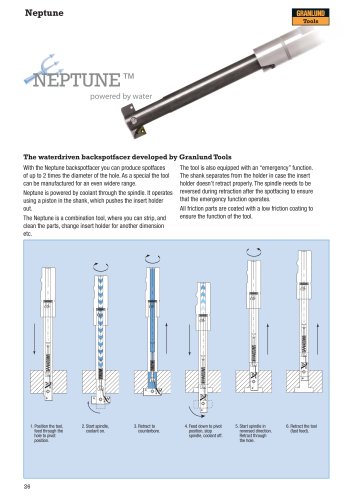
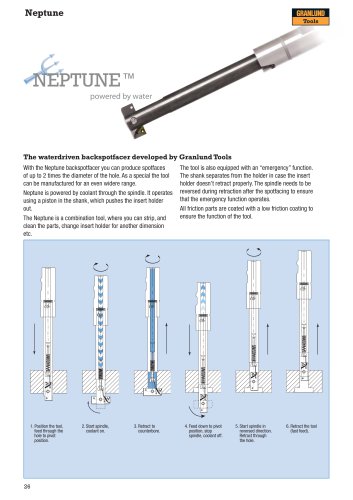
Overview: The Neptune backspotfacer is a tool designed for creating spotfaces up to twice the diameter of a hole. It is powered by coolant through the spindle and operates using a piston mechanism. The tool is versatile, allowing for part cleaning and insert holder changes for different dimensions.
Specifications: The Neptune tool can be manufactured for a wide range of applications. It includes an emergency function where the shank separates from the holder if the insert holder fails to retract properly. All friction parts are coated with a low friction coating to ensure smooth operation.
Operating Procedure:
- Position the tool and feed through the hole to the pivot position.
- Start the spindle and turn on the coolant.
- Retract to counterbore.
- Feed down to pivot position, stop spindle, and turn off coolant.
- Start spindle in reversed direction and retract through the hole.
- Retract the tool with fast feed.
Cutting Data: The document provides specific speed and feed rates for different materials such as steel, cast iron, and cast aluminum. For example, steel with a tensile strength of less than 450 N/mm should be operated at 50-100 m/min with a feed of 0.05-0.15 mm/rev.
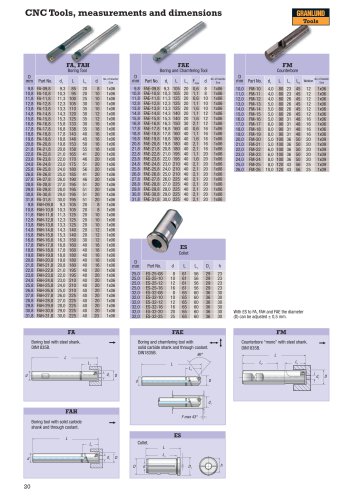
Tool Specifications: The document lists various Neptune tool models with their respective part numbers, insert types, and dimensions. For instance, the NE-17,0/33,0 model uses TPMT-10T inserts and has specific dimensions for shank and holder.
Application Example: An example is provided using the NE-17,0/33,0 tool on a workpiece SS 1672 with a thickness of 33 mm and a spotface of 3 mm.
Important Notes: Coolant through the spindle is required for operation, with a minimum pressure of 3 bars and flow of 30 l/min. The insert holder should pivot freely, and lubrication and cleaning are necessary if required.
Spare Parts Kit: The document lists components included in a spare parts kit, such as links, distributor, screws, springs, axles, and nuts.
Caution: The tool should not be operated as a single flute, and feed should be reduced by at least 50% when entering a slope.
See more
Catalog excerpts

1. Position the tool, feed through the hole to pivot position.2. Start spindle, coolant on.3. Retract to counterbore.4. Feed down to pivot position, stop spindle, coolant off.5. Start spindle in reversed direction. Retract through the hole.6. Retract the tool (fast feed). 26 >
Open the catalog to page 1All Granlund Tools catalogs and technical brochures
 Backspotfacing system
2 Pages
 Hard Part Reaming
3 Pages
 Neptune
2 Pages
 CNN tools
3 Pages
 Counterboring System Size 01
2 Pages
 carbide reamer
2 Pages
 Countersinks
2 Pages
 granlund Machinery
24 Pages
 Main Catalogue EN
42 Pages
 Original UNIMETER
5 Pages
Archived catalogs
 CNC Tools
3 Pages
 Counterboring System
2 Pages
Related Searches
- Milling tool
- Chuck
- Measuring device
- Solid milling cutter
- Drilling tool
- Steel milling cutter
- Milling tool with replaceable insert
- Solid drill bit
- Metal milling cutter
- Clamping milling cutter
- Milling cutter with cylindrical shank
- End mill
- Face milling cutter
- Solid carbide milling cutter
- Indexable insert milling cutter
- Ball nose milling cutter
- Multi-purpose drilling tool
- High-performance milling cutter
- Tungsten carbide drill bit
- Twist drill bit
*Prices are pre-tax. They exclude delivery charges and customs duties and do not include additional charges for installation or activation options. Prices are indicative only and may vary by country, with changes to the cost of raw materials and exchange rates.
About DirectIndustry
DirectIndustry is a marketplace that offers B2B players a complete experience, from product sourcing to purchase. DirectIndustry is an entity of VirtualExpo Group.
Are you a buyer?
Are you a supplier?