
- Catalogs
- Granlund Tools
- Backspotfacing system

Backspotfacing system

Backspotfacing system
Overview
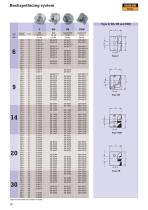
This document provides detailed specifications and part numbers for a backspotfacing tool system, including various sizes, types, tolerances, and shank configurations. It covers multiple tool types (U, UD, UH, UDH) and shank types (US MT, US Weldon), with dimensions and tolerances for each.
1. Tool Types and Sizes
The tools are categorized into four main types: U, UD, UH, and UDH. These types correspond to different tool designs or features. The sizes are given primarily by the diameter d in millimeters, ranging from 6 mm up to 80 mm, grouped by nominal size categories (6, 9, 14, 20, 30).
Each size has associated dimensions D and L (both in mm), with a constant L dimension of 17 mm for the smaller sizes and increasing for larger sizes. The tools are available in two material grades: High-Speed Steel (HSS) and Carbide (K40), each with specific tolerance classes (k12 for HSS and p8 for Carbide).
Key Points:
- Tool diameters range from 6 mm to 80 mm.
- Material options: HSS (Tol. k12) and Carbide K40 (Tol. p8).
- Part numbers are assigned per size and type, e.g., U-06/12, UD-06/12, etc.
- Some sizes/types are not available in all variants (e.g., UH or UDH missing for some diameters).
2. Shank Types and Dimensions
The document specifies two main shank types for the backspotfacing tools: US MT (Morse Taper) and US Weldon. Each shank type has detailed dimensions:
- US MT Shank: Sizes 6 to 30 mm with d1, L1, and L2 dimensions provided. Shank types MT1 to MT4 correspond to different Morse taper sizes.
- US Weldon Shank: Similar size range with d1, L1, and L2 dimensions, and Weldon shank sizes 12, 16, 20, and 25.
Dimensions such as d1 (shank diameter), L1 (length 1), and L2 (length 2) are specified for each size and shank type. For example, a 6 mm diameter tool with MT1 shank has d1=6.0 mm, L1=55 mm, and L2=92 mm.
Important Notes:
- Some sizes marked with an asterisk (*) indicate they should not be used with carbide cutters.
- Shank thread sizes are also indicated for MT3 (M12) and MT4 (M16).
3. Tolerances and Material Specifications
Tolerances are critical for tool fit and performance:
- HSS tools have tolerance class k12.
- Carbide tools have tolerance class p8.
The document ensures that each tool size and type complies with these tolerances to guarantee interchangeability and precision.
4. Ordering and Part Numbering
Each tool variant is identified by a unique part number that encodes the type, size, and sometimes the shank type. For example:
- U-06/12: Type U, diameter 6 mm, length 12 mm.
- US-06/06,0-MK1: US MT shank, diameter 6 mm, d1=6.0 mm, Morse Taper 1.
- US-06/06,0-W12: US Weldon shank, diameter 6 mm, Weldon 12.
5. Additional Notes
- Larger and intermediate sizes are available upon request, indicating customization options.
- The document includes a caution that certain sizes marked with an asterisk (*) should not be combined with carbide cutters.
Summary
This technical document serves as a comprehensive catalog and specification sheet for backspotfacing tools, detailing size ranges, tool types, material grades, tolerances, shank types, and corresponding part numbers. It is intended to guide selection, ordering, and application of these tools in machining operations, ensuring compatibility and precision.
Catalog excerpts
Backspotfacing system Tools Larger and intermediate sizes available on request.
Open the catalog to page 1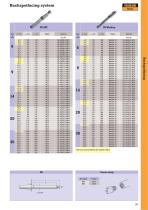
Backspotfacing system
Open the catalog to page 2All Granlund Tools catalogs and technical brochures
 Hard Part Reaming
3 Pages
 Neptune
2 Pages
 CNN tools
3 Pages
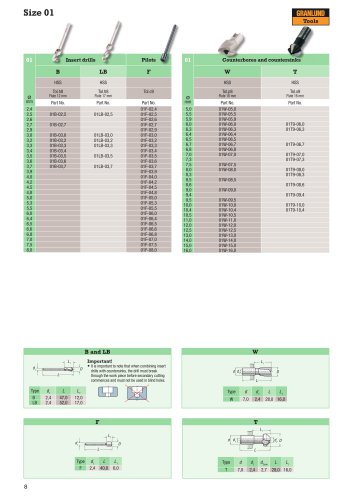 Counterboring System Size 01
2 Pages
 carbide reamer
2 Pages
 Countersinks
2 Pages
 granlund Machinery
24 Pages
 Main Catalogue EN
42 Pages
 Original UNIMETER
5 Pages
Archived catalogs
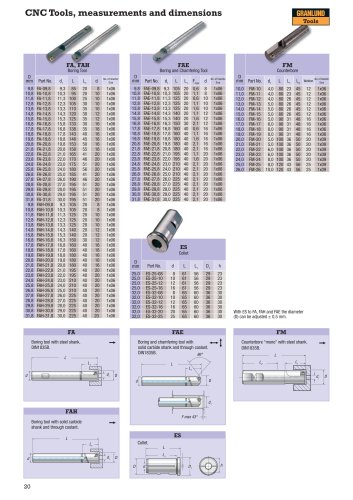 CNC Tools
3 Pages
 Counterboring System
2 Pages
- Milling tool
- Chuck
- Measuring device
- Solid milling cutter
- Drilling tool
- Steel milling cutter
- Milling tool with replaceable insert
- Solid drill bit
- Metal milling cutter
- Clamping milling cutter
- Milling cutter with cylindrical shank
- End mill
- Face milling cutter
- Solid carbide milling cutter
- Indexable insert milling cutter
- Ball nose milling cutter
- Multi-purpose drilling tool
- High-performance milling cutter
- Tungsten carbide drill bit
- Twist drill bit