
- Catalogs
- GOSSEN METRAWATT GmbH
- WHITEBOOK FOR ELECTRICIANS


WHITEBOOK FOR ELECTRICIANS

WHITEBOOK FOR ELECTRICIANS
- Permanently Installed Equipment: Every 4 years.
- Special Installations: Annually.
- Portable Equipment: Every 6 months, with potential extension based on fault rate.
- Construction Site Equipment: Every 3 months, with potential extension based on fault rate.
- Earth-Moving and Construction Machines: Annually.
- Industrial Trucks and Platform Lifts: Annually.
- Visual Inspection: Checking for correct equipment selection, damage, protection against direct contact, and proper labeling.
- Functional Testing: Ensures correct operation of safety and monitoring devices, power installations, and bus systems.
- Measurement: Involves continuity, insulation resistance, voltage polarity, and phase sequence tests.
Catalog excerpts

GOSSEN METRAWATT Testing of Electrical Devices, Medical Devices and Machines Whitebook, Part 1 Initial and Periodic Testing in Low-Voltage Systems with up to 1000 V AC, 1500 V DC Part 2 WHITEBOOK FOR ELECTRICIANS GOSSEN METRAWATT
Open the catalog to page 1
Our test instruments are manufactured in accordance with the state-of-the-art and comply with the requirements of German occupational safety law concerning the provision of safe work equipment. Equipment should nevertheless be tested at regular intervals for safe condition in accordance with German occupational safety law (BetrSichV) and TRBS1201. Measuring functions should also be tested at regular intervals because reproducibility of measurement results is required by the inspector. Our company is accredited to do this. Our service center would be happy to provide you with quotations for your...
Open the catalog to page 2
Initial and Periodic Testing in Low-Voltage Installations with up to 1000 V Residual Current Circuit Breaker (RCD) Mixed Frequency Symbol (RCD) Type F Initial and Periodic Testing in Low-Voltage Installations (1000 V AC / 1500 V DC) 3
Open the catalog to page 3
Initial and Periodic Testing in Low-Voltage Installations with up to 1000 V ProfiScan - the App for the Profitest Mxtra / Mtech+ • Select and connect to a PROFITEST MXTRA / MTECH+ • Read out the system structure with measured values and send via e-mail • Load the system structure and receive it via e-mail • Keyboard mode - when the PROFITEST is set to the on-screen keyboard mode • Creation of a complete system structure • Management and renaming of ETC files • Creation of screenshots and transmission via e-mail
Open the catalog to page 4
Initial and Periodic Testing in Low-Voltage Installations with up to 1000 V
Open the catalog to page 5
Initial and Periodic Testing in Low-Voltage Installations with up to 1000 V GEOHM C Battery Powered Earth Tester
Open the catalog to page 6
Initial and Periodic Testing in Low-Voltage Installations with up to 1000 V Public Statutory Provisions for Low-Voltage Installations In order to avoid dangerous states resulting from systems and operating equipment, manufacturers must always provide for technical safety measures whose effectiveness must be assured during production as well as operation for the entire service life of the equipment by means of appropriate maintenance. Maintenance also includes inspections (tests) as a subcategory (see also DIN 31051). Knowledge of applicable public statutory provisions and there safety requirements...
Open the catalog to page 7
Initial and Periodic Testing in Low-Voltage Installations with up to 1000 V For low voltage systems, this involves implementation of the IEC 60364 series of standards; part 6 of EN 50110-1 applies to tests. There are also requirements for safety testing for residential buildings, for which periodic testing after no more than 10 years, or in the event of a new renter, is recommended in accordance with EN 50110-1. Electrical systems are also subject to construction regulations. In addition to fitness for use, the German model building regulation (MBO) specifies proper maintenance (§1), which also...
Open the catalog to page 8
Initial and Periodic Testing in Low-Voltage Installations with up to 1000 V The state of the art is defined in the officially recognized technical rules (TRBSn, ASRn, TRGS). Legally, trade association rules and regulations are based on the German code of social law, VII (§15), and to a great extent have already been superseded by German occupational safety law, subsequent ordinances and state technical rules, which have precedence. As opposed to DGUV rules, state technical rules demonstrate presumption of conformity when applied. This little whitebook is intended to provide you with support in...
Open the catalog to page 9
Initial and Periodic Testing in Low-Voltage Installations with up to 1000 V is a recognized seal of approval for electrical installations and devices in private homes, as well as in commercial and public buildings. Five good reasons why you should have your electrical installation tested at regular intervals: Reason 1 – Protection E-CHECK provides you with the assurance that the tested electrical installation and devices are adequate with regard to all safety aspects. You provide your family and your company with protection as a result. Reason 2 - Claims for Compensation of Damage As a rule,...
Open the catalog to page 10
Initial and Periodic Testing in Low-Voltage Installations with up to 1000 V Testing Ordinance in Accordance with ArbStättV and BetrSichV The German working reliability regulation created uniform legislation for operating equipment in 2002. When the new occupational safety law came into effect on 1 June 2015, 3 additional regulations for systems which require monitoring were summarized in section 3. With regard to the hazard assessment in accordance with §3, special emphasis is placed on the particular obligations of the employee with regard to test preparation. Reasons for testing are specified...
Open the catalog to page 11
Initial and Periodic Testing in Low-Voltage Installations with up to 1000 V Important Public Regulations for Low-Voltage Installations German product safety law (ProdSG) and subordinate “CE” ordinances, for example: The so-called low-voltage directive (1st ordinance in ProdSG -1. ProdSV) The machinery directive (9th ordinance in ProdSG (1. ProdSV) Law on electromagnetic compatibility of devices (EMCG) (requirement for permanent installation, see §§4,12, mandatory documentation German building products act – BauPG (in the future: EU building products ordinance) amongst other things, also regulates...
Open the catalog to page 12
MX. Initial and Periodic Testing in Low-Voltage Installations with up to 1000 V German Working Reliability Regulation (BetrSichV) with state technical rules including presumption of conformity. Examples: TRBS 1111 Hazard Assessments TRBS 1112 Maintenance TRBS 1201 Testing of Work Equipment and Systems which Require Monitoring TRBS 1203 Authorized Persons German ordinance on workplaces (ArbStattV) with state technical rules including presumption of conformity. Examples: ASR A3.4 - Lighting ASR A3.4/3 - Safety Lighting, Optical Safety Guidance Systems Important, generally recognized good engineering...
Open the catalog to page 13All GOSSEN METRAWATT GmbH catalogs and technical brochures
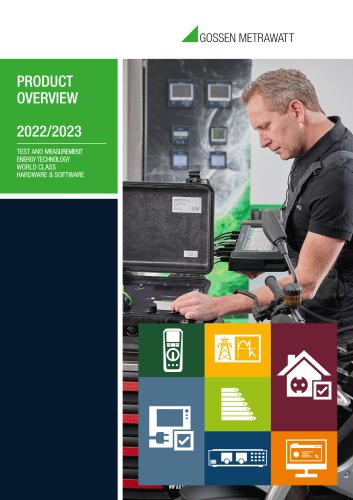 PRODUCT OVERVIEW 2022/2023
24 Pages
 ENERGYMID LPWAN
2 Pages
 data sheet ENERGYMID
11 Pages
 METRALINE VT SENSE
2 Pages
 METRALINE EVSE IT
2 Pages
 METRAOHM 10
3 Pages
 COIL ADAPTER XTRA
8 Pages
 PROFITEST MF Series
24 Pages
 PROFITEST MF XTRA
8 Pages
 SECUTEST Lemongreen (M708E)
11 Pages
 PROFITEST H+E EXPERT CHECK
3 Pages
 ENERGY METER
4 Pages
 PROFITEST H+E EASY CHECK
3 Pages


- Power supply unit
- DC power supply
- AC/DC power supply
- Transformer
- Automation software solution
- Management software solution
- Dry transformer
- Data logger
- Analysis software solution
- Real-time software
- Windows software
- CE power supply
- Calibration system
- Cloud-based software
- Single-output power supply
- Gossen Metrawatt portable tester
- Power supply for industrial applications
- Monitoring software solution
- Switched-mode power supply