
- Catalogs
- Göttfert Werkstoff-Prüfmaschinen
- Rheotens and Haul-Off

Rheotens and Haul-Off
Rheotens and Haul-Off
- Figure 1: Shows the relationship between maximum draw-off speed and melt strength.
- Figure 2: Introduces the 'Super-Master-Curve' for simplifying RHEOTENS curves based on extrusion history.
- Figure 3: Describes the 'Grand-Master-Curve' for further integration, focusing solely on polymer characteristics.
- Figure 4: Details the determination of effective elongational viscosity using an analytical model.
Catalog excerpts
ELONGATIONAL TESTING
Open the catalog to page 1
ELONGATIONAL TESTING Elongational Rheometer for Polymer Melts It is well known that the elongational flow behavior which dominates many processing techniques can not be determined from shear experiments. The patented RHEOTENS melt elongation testing technique has proven to be highly reproducible and sensitive and will differentiate even polymer melts showing small differences in molecular structure which can not be detected with analytical methods. The RHEOTENS 71.97 offers the following new features: Tandem pulley system Patented) An additional pair of pull-off wheels have been integrated to...
Open the catalog to page 2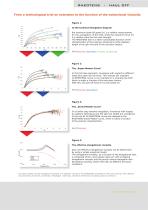
From a technological trial on extension to the function of the extensional viscosity In the technical elongation diagram the maximum draw-off speed (v) is a relative measurement for the „elongation" of the melt, while the maximum force (F) is a relative value for the melt strength. The RHEOTENS test is a rather complicated function of the characteristics of the polymer, dimensions of the capillary, length of the spin line and of the extrusion history. F=F (Polymer, Geometry, Process conditions) In the first step approach, invariance with respect to different mass flow rates can be found. This...
Open the catalog to page 3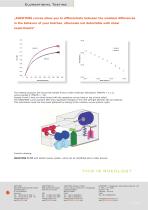
ELONGATIONAL TESTING „RHEOTENS curves allow you to differentiate between the smallest differences in the behavior of your batches, otherwise not detectable with shear The material producer has found that sample B has a wider molecular distribution (MW/Mn = 11.1), versus sample E (MW/Mn = 10). Sample B and E were run three times (with the respective curves lying on top of each other). The RHEOTENS curves (picture left) show significant changes in the melt strength between the two batches. This information could not have been gathered by looking at the viscosity curves (picture right). Function...
Open the catalog to page 4All Göttfert Werkstoff-Prüfmaschinen catalogs and technical brochures
 RubberView network
1 Page
 Meltindex
12 Pages
 At-Line Station
12 Pages
 MINI BYPASS RHEOGRAPH MBR
12 Pages
 Elastomer-Testing
12 Pages
 TRICO-Ram
2 Pages
 Elastomer Testing
12 Pages
 Software -WinRheo2
1 Page
 Extrusiometer - X-TRUDE series
12 Pages
 Melt Indexer MI - series
12 Pages
 RHEOGRAPH 20 / 25 / 75 / 120
8 Pages
 RemoteNet
1 Page
 Extrusiometer
12 Pages
 MI-Cleaning Boy
1 Page
 Online Rheometer
12 Pages
 Rheograph 25E
1 Page
 TRICO RAM
2 Pages
 Capillary Rheometers
8 Pages
 GÖTTFERT
8 Pages
 ELASTOGRAPH
12 Pages
Archived catalogs
 MI-Series
12 Pages
 rheometer
4 Pages
 fully automatic rheometer
3 Pages


- Test machine
- Measuring device
- Analysis software solution
- Windows software
- Control software
- Measurement software
- Visualization software solution
- Extrusion line
- Tensile testing machine
- Thermoplastic extrusion line
- Bending test machine
- Electromechanical testing machine
- Mechanical testing machine
- Laboratory software
- Instrument software
- Blown film extrusion line
- Plastometric indices tester
- Parameterization software
- Compact extrusion line