
- Catalogs
- Göttfert Werkstoff-Prüfmaschinen
- Elastomer Testing

Elastomer Testing

Elastomer Testing
This document provides a detailed overview of elastomer testing, focusing on the dynamic-mechanical and rheological characterization of natural and synthetic rubber compounds. The testing is essential for ensuring the quality and consistency of rubber products by characterizing the raw compound during processing.
- Mooney Viscosimeter: Determines Mooney Viscosity and scorch characteristics of unvulcanized rubber compounds, adhering to standards like ISO 289, ASTM D1646, and DIN 53523.
- Elastograph: A rotorless shear stress vulcameter system optimized for fast release tests and R&D of elastomers, measuring elastic material properties during pre-vulcanization and vulcanized states.
- Visco-Elastograph: A dynamic rheometer for analyzing viscoelastic material properties, offering comprehensive characterization of rubber compounds and aiding in quality testing and processability checks.
- Rubber Capillary Rheometer (RCR): Simulates production processes with elastomers, offering modes for extrusion and injection molding, and providing insights into flow behavior and viscosity.
- Rheograph 120: Suitable for high polymers and elastomers, it determines flow and viscosity functions and aids in optimizing new blends.
- RubberView Software: A database software for parameterization, control, and evaluation of testing procedures, offering user-friendly handling and extensive application possibilities.
- Evaluation Methods: Includes variable time, temperature sweep, frequency sweep, and amplitude sweep tests, providing detailed insights into material properties and behaviors.
- Visco-Elastograph: Assesses the damping behavior of compounds by analyzing the phase angle trend, measuring the memory and loss modulus of NBR compounds.
- Mooney-Viscometer: Characterizes the scorching behavior of test samples at elevated temperatures by detecting the time at which viscosity increases by a specified value.
- Rubber Capillary Rheometer (RCR): Used for process-near machining tests, such as extrusion and injection molding, by measuring the extrusion through a die and injection into a tool.
The document includes graphs illustrating the relationship between strain, modulus, frequency, and other parameters. Key observations include:
- The memory and loss modulus comparison between different NBR compounds.
- The relaxation time measurement, crucial for understanding viscoelastic material behavior.
- Mooney-Scorch data indicating the vulcanization behavior at higher temperatures.
The document emphasizes the importance of precise measurement and analysis in understanding material properties, focusing on maintaining the integrity of instruments and measurements.
GÖTTFERT Werkstoff-Prüfmaschinen GmbH and its global subsidiaries provide contact details for further inquiries and support.
Catalog excerpts

ELASTOMER TESTING Dynamic-mechanical and rheological characterization of natural and synthetic rubber compounds
Open the catalog to page 1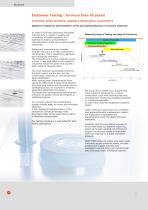
Basics Elastomer Testing - for more than 45 years! Viscosity, Rheo-Kinetics, Capillary Rheometry, Vulcametry Elastomer testing for determination of the processing behaviour of reactive materials In order to fulfil the continuous increasing requirements in regard to quality and consistency of rubber products, it is essential to make a comprehensive characterisation of the raw compound while processing. Elastomeric compounds are complex multiple mixture out of main components like polymers, fillers, plasticizers, additives and vulcanizing chemicals. The interactions of various materials cause a...
Open the catalog to page 2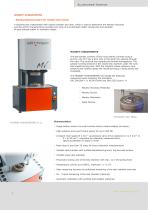
Elastomer Testing MOONEY-VISKOSIMETER - Standardized procedure for reliable test results A shearing disk viskosimeter with closed chamber and rotor, which is used to determine the Mooney Viscosity and the scorch characteristics recorded over time of unvulcanised rubber compounds and samples of pure natural rubber or synthetic rubber. MOONEY-VISKOSIMETER The test sample consists of two round blanks (formed using a punch), one of it has a bore hole in the centre for passing through the rotor. The punched test samples are formed homogenous. The sample is being sheared in the closed test chamber...
Open the catalog to page 3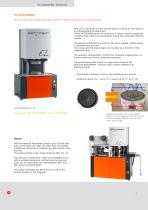
Elastomer Testing The ELASTOGRAPH The rotorless shear stress Vulcameter system for determining the cross linking kinetics This unit is optimized for fast release tests as well as for the research and development of elastomers. The ELASTOGRAPH serves for definition of elastic material properties in plastic state while pre-vulcanization and at the vulcanized material sample. The sample is affected to torsion via the sinus-shaped rotation swing in the lower test die half. The torque and the phase angle are recorded as a function of the measuring time. The Software „RubberView“ controls the complete...
Open the catalog to page 4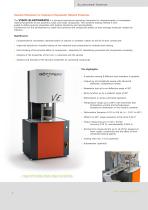
Elastomer Testing Dynamic Rheometer for Analysis of Viscoelastic Material Properties The VISCO-ELASTOGRAPH is a dynamic/mechanical operating rheometer for characterization of viscoelastic material properties of raw polymers, basic and ready compounds. This sensitive testing method is well suited to define polymer properties with highest sensitivity and reproducibility. Furthermore for the development to typify raw polymers and compounds based on their average molecular weight distribution. Significance: • Comprehensive viscoelastic characterization of natural or synthetic rubber as well as of...
Open the catalog to page 5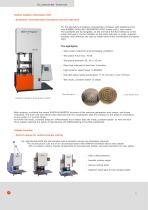
Elastomer Testing Rubber Capillary Rheometer RCR - production accompanying rheological process inspection For the laboratory simulation of production processes with elastomers the new RUBBER CAPILLARY RHEOMETER (RCR) comes with 2 test modes. The capillaries are exchangable, on the one hand the flow behaviour in the mode „Extrusion“ can be handled, on the other side also in mode „injection molding“ with different and easy to install mold forms (ramification and spiral tool). The Highlights: • Tests under production and processing conditions • Test piston force max. 75 kN • Test piston diameter...
Open the catalog to page 6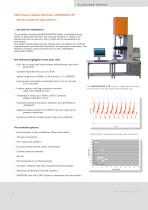
Elastomer Testing High Pressure Capillary Rheometer „RHEOGRAPH 120“ - not only suitable for high polymers... ... but also for elastomers! The complete multifunctional RHEOGRAPH family is suitable among others to determine the flow and viscosity function on rubber compounds and can be used as a tool to optimize the development on new blends. The system allows extensive and process near simulations for material characterization and delivers information for expressive evaluations, like Mooney correction (wall slip behaviour) or flow instabilities (Shark Skin Effect). The technical highlights of...
Open the catalog to page 7
Software Software „RubberView“ - only a short view into the possibilities... RubberView is the database Software for the ELASTOGRAPH, VISCO-ELASTOGRAPH, for MOONEY-VISKOSIMETER and the RHEOVULKAMETER (RCR). The easy and user friendly handling, the wide range of application possibilities and the work with databases were the basic ideas when developing the program in a completely new way. The program is used for parameterization, for control of the measuring procedure as well as for evaluation under a simple to use and clearly represented desktop. Special applications are allowed to implement very...
Open the catalog to page 8
Evaluation Methods Extractions of the capability... Variable Time Comparable with the usualVulkameter test here the module and the viscosity via the time are being captured at constant amplitude and frequency. > ELASTOGRAPH and VISCO-ELASTOGRAPH Via an integrated temperature program definable temperature steps can be individually realized. The example here shows a non-isothermal vulcanization. The swinging deformation of the lower chamber half can be controlled exactly between 0.1 to 50 Hz. Torque, module and viscosity are being measured at preselected amplitude. Classic test to determine the...
Open the catalog to page 9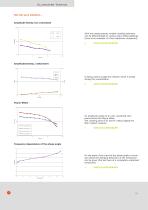
Elastomer Testing Not only pure statistics... Amplitude Sweep non vulcanized 10000 With this measurement variable ramified polymers can be differentiated to various active filling additives (here at an example of a fluor elastomer compound). Is being used to judge the network which is arised during the vulcanization. > VISCO-ELASTOGRAPH An amplitude sweep at an non vulcanized compound shows the Payne effect. The crossing point of G‘ and G‘‘ helps judging the filler medium network. VISCO-ELASTOGRAPH G´ VISCO-ELASTOGRAPH G´´ VISCO-ELASTOGRAPH G´´ 10 1 Frequency dependance of the phase angle 6 On...
Open the catalog to page 10
Material Characterization There is more to it than that... Memory and loss modulus The diagram shows the memory and the loss modulus of 2 NBR compounds with different raw polmers. This evaluation serves a comparison between the elastic and the viscous material behaviour G´ProbeB G" Probe B G´Probe B G" Probe B G´Probe A G" Probe A 10 0,001 The measurement of the relaxing time is being determined out of a disturbance test. It characterize the visco elastic material behaviour and is important for process near properties. The Mooney-Scorch mode characterize the scorching (vulcanizing) behaviour...
Open the catalog to page 11All Göttfert Werkstoff-Prüfmaschinen catalogs and technical brochures
 RubberView network
1 Page
 Meltindex
12 Pages
 At-Line Station
12 Pages
 MINI BYPASS RHEOGRAPH MBR
12 Pages
 Elastomer-Testing
12 Pages
 TRICO-Ram
2 Pages
 Software -WinRheo2
1 Page
 Extrusiometer - X-TRUDE series
12 Pages
 Melt Indexer MI - series
12 Pages
 RHEOGRAPH 20 / 25 / 75 / 120
8 Pages
 RemoteNet
1 Page
 Extrusiometer
12 Pages
 Rheotens and Haul-Off
4 Pages
 MI-Cleaning Boy
1 Page
 Online Rheometer
12 Pages
 Rheograph 25E
1 Page
 TRICO RAM
2 Pages
 Capillary Rheometers
8 Pages
 GÖTTFERT
8 Pages
 ELASTOGRAPH
12 Pages
Archived catalogs
 MI-Series
12 Pages
 rheometer
4 Pages
 fully automatic rheometer
3 Pages


- Test machine
- Measuring device
- Analysis software solution
- Windows software
- Control software
- Measurement software
- Visualization software solution
- Extrusion line
- Tensile testing machine
- Thermoplastic extrusion line
- Bending test machine
- Electromechanical testing machine
- Mechanical testing machine
- Laboratory software
- Instrument software
- Blown film extrusion line
- Plastometric indices tester
- Parameterization software
- Compact extrusion line