
- Catalogs
- GM International S.p.A.
- EX Poster


- Company
- Products
- Catalogs
- News & Trends
- Exhibitions
EX Poster
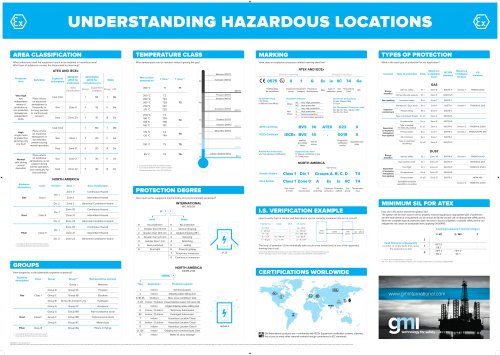
EX Poster
This document provides educational information on safety standards and classifications for hazardous locations, focusing on explosive atmospheres and the necessary equipment protection levels.
Specifications
The document outlines the intrinsic safety (I.S.) parameters for field devices and cables, ensuring compatibility with I.S. barriers. Key parameters include voltage (Ui = 30 V, Uo = 28 V), current (Ii = 120 mA, Io = 93 mA), power (Pi = 1 W, Po = 650 mW), capacitance (Ci = 3 nF + Cc = 80 nF ≤ Co = 83 nF), and inductance (Li = 10 µH + Lc = 1 mH ≤ Lo = 4.2 mH).
Area Classification
Explosive atmospheres are classified by class, group, and zone, with distinctions between gas, dust, and fiber hazards. The classification system includes North American divisions and IEC zones, detailing continuous, intermittent, and abnormal condition hazards.
Protection Levels
Protection levels are defined by the ATEX and IECEx standards, with categories for very high, high, and normal protection. Equipment categories and groups are specified for different zones and conditions.
Temperature and Protection Degree
The document details temperature classes and protection degrees, indicating maximum surface temperatures that equipment can reach without igniting gases. It compares North American (NEMA) and international (IEC) protection standards.
Certifications
Information on ATEX and IECEx certifications is provided, explaining marking systems and equipment protection levels (EPL) for gas and dust atmospheres. The document also covers the significance of explosion protection markings.
Types of Protection
Various protection methods are outlined, including intrinsic safety, flameproof, encapsulation, and pressurization. The document discusses the minimum Safety Integrity Level (SIL) required for ATEX compliance and how SIL devices can reduce ignition risks.
Conclusion
The document emphasizes the importance of selecting appropriate protection types and verifying the compatibility of I.S. barriers and field devices. It encourages the use of GM International's online tools for further guidance.
Catalog excerpts
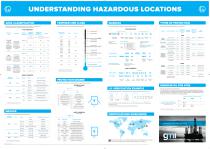
AREA CLASSIFICATION TEMPERATURE CLASS MARKIN TYPES OF PROTECTION What safety level shall the equipment reach to be installed in hazardous area? What type of substance creates the hazard and for how long? What temperature can be reached without igniting the gas? Protection Explosive level atmosphere Very high „ . Coal mine What does an explosion protection related marking stand for? Directive marking What is the best type of protection for my application? Standard marking d 0575 ® II 1 G Ex ia IIC T4 Ga Maximum Concept Type of protection Code installation IEC/EN standard Maximum installation Notified Body for surveillance Equipment Equipment Hazardous group category atmospheres „„ , Type of Gas Temperature Mark EPL protection group class Equipment Group II different from Mines Equipment Category M1 Very High protection Intrinsic safety Intrinsically safe systems Ex i ATEX Certificate Very high protection High protection Normal protection ( ) for associated apparatus Hazardous Atmospheres G: Gas, Vapour, Mist D: Dust EPL (Equipment Protection Level) Ga, Gb, Gc: Gas, Vapour, Mist Da, Db, Dc: Dust Increased safety Flameproof / Expl. proof Ex d Powder filling Type n (enclosed break) Ex nC IECEx Certificate IECEx BVS 14 100 °C Separation of explosive atmosphere from ignition Type n (sealed/ hermetically sealed) Type n (restricted breathing) according to North America Divisions system according to IEC/North America Zones system Temperature data taken from IEC 60079-20-1 Notified/Accredited Body Supplementary letter X: Special conditions of use U: Component Intrinsic safety Division System NORTH AMERICA Gas Group Dust ignition proof Ex t Zone 20 T4 Separation of explosive atmosphere from ignition Dust tight NORTH AMERICA Division * Zone ** Zone System Class 1 Zone 0 A Ex ia IIC T4 Area classification Continuous Hazard PROTECTION DEGREE Gas, Vapor Area US Explosion Protection Gas Temperature or Fiber classification conformity protection method group class Intermittent Hazard Abnormal Conditions Hazard How much is the equipment mechanically and environmentally protected? MINIMUM SIL FOR ATEX Zone 20 Continuous Hazard IP I.S. VERIFICATION EXAMPLE Dust Intermittent Hazard Abnormal Conditions Hazard Continuous Hazard Intermittent Hazard Abnormal Conditions Hazard according to North America Divisions system according to lEC/North America Zones system How to verify that I.S. barrier and field device can be correctly combined into an I.S. circuit? Field device Cable Ok if I.S. barrier The level of protetion of the intrinsically safe circuit is the lowest level of any of the apparatus forming that circuit. Concerning GM International products, try our online tool on our website www.gminternational.com. Further information about more complex cases is provided in IEC 60079-14 and IEC 60079-25. How can a SIL device reduce the ignition risk? The ignition risk for each source can be properly reduced applying an appropriate type of protection and the fault tolerance of equipment can be enhanced by the control with an appropriate safety device. When the complete type of protection does not cover a source of ignition, a suitable safety device can mitigate the risk under an acceptable level, applying EN 50495. Combined equipment desired category1 / M1 2 / M2 32 Fault Tolerance of Equipment (number of single faults that cause 1 the apparatus to fail) - “-” means that no safety device is required. “SIL 1” or “SIL 2” is required Safety Integrity Level of safety related device according to EN/IEC 61508. How dangerous is the potentially explosive substance? Class Group * Group Explosive atmosphere NEMA NORTH AMERICA (NEMA 250) CERTIFICATIONS WORLDWIDE Group I Representative element Methane Type Application 1 Indoor Protection against General purpose Dripping water, falling dust Rain, snow, windblown dust Group B Group IIC (except C2H2) 4, 4X Indoor / Outdoor Hose-Directed water, Corrosion (X) Angled dripping water, settling dust Group IIIB Non-conductive dusts Temporary Submersion Prolonged Submersion Group IIIB Carbonaceous dusts Hazardous Location Class I Group IIIC Metal dusts Hazardous Location Class I Group IIIA Hazardous Location Class II Dripping non-corrosive liquid, Dust according to North America Divisions system according to IEC/North America Zones system Water, oil, dust, seepage GM International products are in conformity with IECEx Equipment certification scheme, allowing the access to many other national markets through compliance to IEC standards. Information presented in this poster is for the general education of the reader. GM International does not have control over the use of the information by the readers therefore GM International disclaims any and all liability of any kind arising out of such use. Examples are provided as simple illustrations of the topics and, as such, are not intended as a guide to manage plant safety. The readers should use and apply only the guidance provided in the standards pertaining to their applications. The reproduction by any means, partial or total, of the poster and its content is prohibited without making a clear reference to the original source.
Open the catalog to page 1
Understanding Hazardous Locations MSD0018-00 © G.M. International s.r.l. Information presented in this poster is for the general education of the reader. GM International does not have control over the use of the information by the readers therefore GM International disclaims any and all liability of any kind arising out of such use. Examples are provided as simple illustrations of the topics and, as such, are not intended as a guide to manage plant safety. The readers should use and apply only the guidance provided in the standards pertaining to their applications. The reproduction by any means,...
Open the catalog to page 2All GM International S.p.A. catalogs and technical brochures
 Product Overview
58 Pages
 X1 SERIES
4 Pages
 GMI D5000-D5200 Datasheets
154 Pages
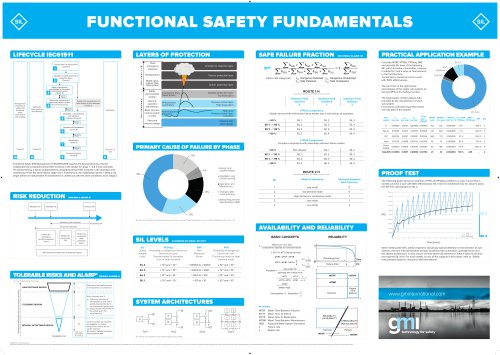 SIL Poster
2 Pages
- Connector
- GM International power supply
- GM International DC power supply
- Data connector
- AC/DC power supply
- Surge protector
- GM International digital I/O
- GM International terminal block
- Socket electrical connector
- Single-output power supply
- DIN rail lightning arrester
- Male connector
- Switched-mode power supply
- Compact power supply
- Signal amplifying integrated circuit
- Tabletop power supply
- DIN rail power supply
- DIN connector
- Variable-output power supply
- Power supply with overload protection