Overview: The document provides a comprehensive overview of Glass Service's integrated solutions for glass production, focusing on sustainable technology and innovative systems for distributors and forehearths. It highlights advancements in cooling and heating systems designed to enhance performance and energy efficiency.
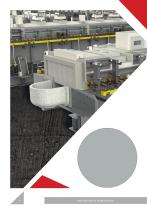
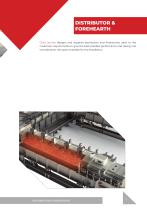
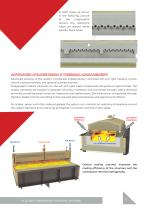
Distributor & Forehearth Systems: Glass Service offers customized distributors and forehearths tailored to customer requirements, emphasizing high thermal homogeneity and low energy consumption. The FH-DC model features direct cooling with high thermal insulation and efficient central cooling, reducing installation costs and space requirements. The design allows for independent control of combustion systems to optimize thermal performance.
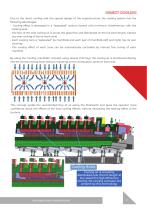
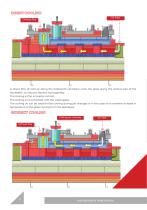
Cooling Technologies: The document details direct and indirect cooling systems. Direct cooling involves a central channel for air distribution, minimizing interference with heating areas. Indirect cooling uses radiant plates for smooth cooling, suitable for low pulling distributors and special glasses. Both systems aim to enhance thermal homogeneity and energy efficiency.
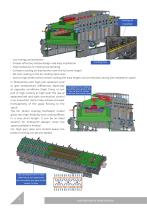
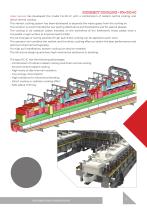
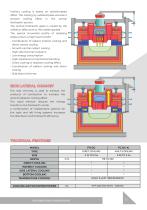
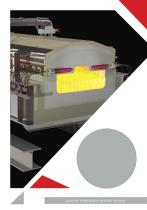
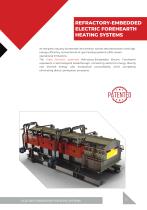
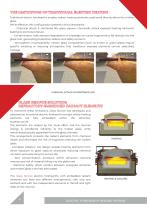
Electric Forehearth Heating Systems: Glass Service's patented refractory-embedded electric forehearths represent a shift towards decarbonization, eliminating direct combustion emissions. The design isolates heating elements from glass vapors, reducing chemical corrosion and contamination risks. Advanced systems offer independent control for left and right heating circuits, supporting demanding glass compositions.
Colouring Forehearths: Developed for producing a wide range of glass colors, these systems allow for short production runs without changing furnace colors. The technology includes automatic frit dosing devices and stirrer machines, designed for flexibility and reliability across various production conditions.
Key Benefits: The systems offer extended durability, process flexibility, enhanced safety, and zero direct emissions. Numerical simulations confirm exceptional thermal homogeneity, supporting the transition to sustainable glass production.
Glass Heating and Colouring Process: The process involves heating glass to 1250-1300°C to melt the colouring frit using a double row of burners. The frit is added through air or water-cooled dosing tubes. The melted frit is mixed into the base glass using refractory stirrers, with designs available in screw and paddle forms. A stirrer mechanism before the spout ensures uniform colour and reduces change time. The glass is conditioned to the correct temperature in the final zone.
Frit Dosing System: Glass Service has developed a frit dosing system with a low-level installation, pneumatically transporting frit to the forehearth. The system includes a main hopper with a sensor for refilling alerts, a PLC-controlled dosing system, and a pneumatic transport system with a high-pressure air blower. The system allows easy access for maintenance and operation, maintaining electronic device temperatures below 40/45°C.
Technical Features: The system is controlled by a PLC with a touch screen, managing dosing, alarms, and settings. It includes thermocouples for temperature control, easy maintenance access, and a strong steel structure. The dosing flow ranges from 5 to 140 kg/h, with a main hopper volume of 600 litres.
Oxy-Gas Combustion System: Oxy-fuel combustion systems are used for glass melting, offering reduced energy consumption, increased glass pull, and reduced pollution. The system includes gas and oxygen flow control, compressed air cooling, and burners. It operates with various oxygen sources and features high temperature operation, low momentum burners, and easy maintenance.
Forehearths & Distributors Combustion System: This system ensures consistent quality production with good control, especially for special or coloured glasses. It uses a premix gas/air type system, offering stable ratio conditions and easy manual gas/air ratio settings. The GADP system maintains a constant ratio between air and gas, recommended for medium and high burner flow applications.
Construction Details: The zero governor pressure tapping increases the gas/air ratio range, reducing gas leakage risks. The system is recommended for container industries, offering stability across a full range of pressures and flows. It includes pressure indicators, transmitters, and explosion relief valves for each zone.
Burner Specifications: Glass Service has developed specialized burners for the glass industry, focusing on control and efficiency in melting technology. These burners feature low momentum flame paths to prevent peak temperatures and enhance energy transmission through visible spectrum radiation. Specifications include low momentum flame path, high flame radiation in the visible spectrum (500-2000 nm), continuous external regulation of flame length, compatibility with natural gas or LPG, and availability in various sizes with outputs from 145 to 1600 kW.
Burner Accessories: Glass Service provides a complete burner solution, including air and gas valves, flexible joints, orifice plates for flow balance, and thermally insulated pipework.
Venturi Mixer Features: The Venturi mixer is easy to install and requires specific pressure ratios to ensure proper function. It is recommended to avoid elbows at the mixer exit and maintain a minimum distance between the mixer and burner. Features include low pressure loss, multiple size combinations, flange connection for easy inspection and maintenance, orientation-free installation with built-in gas adjustment
valve, and constant combustion ratio.
Motorized Venturi Mixer: For enhanced precision and automated control, the Venturi mixer can be upgraded to an electronic air/gas regulation system, offering benefits such as stable combustion ratios, reduced energy consumption, and improved glass color stability.
Software and Connectivity: The Venturi system supports multiple communication methods, including Bluetooth and RS-232, for configuration and monitoring. It allows for real-time adjustment and storage of multiple operating profiles.
Adjustable Port Air Valve Mod. VV: The adjustable port air valve is designed for controlling air flow at variable pressures in burners or systems. It features a cast iron shell with internal components made of anticorodal aluminum and self-lubricating bronze bushing, complemented by NBR gaskets. The valve is not intended for use as a shutoff valve. Flow control can be manual or automatic, achieved by adjusting the curtain knob and core control shaft. The valve can be installed in any orientation and allows for easy maintenance without removal from the pipeline.
Distributor & Forehearth Oxy-Gas Technology: This technology significantly reduces natural gas energy consumption and CO2 emissions compared to air-gas technology, with a 60% reduction in energy use and an 80% reduction in NOx emissions. Features include separated oxy-gas fluid burners with nozzle mix to prevent backfire, low power burners for thermal homogeneity, special burner design for easy maintenance and low carbon deposit, and potential for hydrogen-oxygen combustion to achieve zero CO2 emissions.
Melting Booster Technology: Electric boosting is used to increase furnace output, improve glass quality, and enhance the efficiency of fossil fuel systems. It is particularly recommended for colored glass production. Types of boosters include melting end booster for output increase, thermal barrier booster to stabilize convection currents, and throat booster for heating and temperature maintenance. Boosters are custom-designed based on furnace type and customer requirements, with power ranging from 400 to 1200 kVA. They use molybdenum electrodes with water-cooled holders and can be integrated into existing furnace systems.
Overview of OLTC Transformer Technology: Glass Service has developed a robust and reliable On Load Tap Changer (OLTC) transformer technology, widely used in electrical power stations for voltage adjustment. Key features include voltage input range: 4000 to 20000 Volt, power range: 400-1200 kVA, three-phase or mono-phase options, voltage output regulation: 21 to 29 steps, cooling options: ONAN or ONWF, and safety features: Bucholz relay, temperature controls. Advantages include high energy efficiency, long operational life, and reduced field cabling.
Thyristor Unit (TU) Technology: The Thyristor Unit (TU) is a cost-effective solution for low power boosters, offering energy savings and enhanced safety. Features include voltage input range: 220 to 600 Vac, power range: 20 to 600 kVA, continuous power regulation, and special control system for booster technology.
Electrode Holder Technology: Glass Service has developed a high-reliability electrode holder for molybdenum electrodes, featuring a dual cooling system (water and emergency air). Key specifications include max head temperature: 1000°C, cooling water consumption: 5 l/min, and installation: vertical or horizontal. Accessories include cooling water tubes and mechanical supports.
Electric Molybdenum Distributor and Forehearth Heating: This technology reduces energy consumption and CO2 emissions by up to 60% compared to traditional methods. Features include low voltage for safety, dry air-cooled electrodes, and short circuit protection with dedicated fuses.
Process Control Board: The process control board by Glass Service ensures high reliability and safety, with features such as automatic process control, real-time data and historical database, and remote control capabilities. Controllers used include Honeywell DCS HC900 and Siemens PLC S7-1500, offering advanced features like hot software upgrades and CPU redundancy.
Overview: The document provides a detailed technical description of various control systems and equipment used in industrial processes, particularly focusing on Siemens S7-1500 controllers, process control boards, and batch chargers. It outlines specifications, redundancy strategies, safety integration levels, and human-machine interface (HMI) features.
Siemens S7-1500 Performance: Available in SIL2-SIL3 versions. Remote control I/O connected via Profinet standard. Touch screen directly connected to the CPU. Options for CPU redundancy and power supply redundancy.
Process Control Board: Standard architecture includes a PLC/DCS with one CPU, various I/O boards, and an HMI touch screen. Redundancy strategies ensure control continuity, with examples provided for single loop controllers and redundancy CPU setups. Compliance with safety integrity levels (SIL2-SIL3) is mandatory for combustion processes.
Redundancy Strategies: Redundancy is crucial for 24/7 operation, ensuring service continuity during failures or maintenance. Solutions include single loop controllers with electromechanical redundancy and redundancy CPU with HMI.
Safety Integration Level: Compliance with EN746/2 (EU) and ANSI/NFPA86 (USA) regulations. SIL2-SIL3 capability is required for various combustion processes and electrical power booster safety.
Human Machine Interface (HMI): Designed for ease of use, stability, and reliability. Collects data for historical analysis and manages alarms. Developed in two main families: PC SCADA and Touch Screen HMI.
Remote Control: Features remote software assistance, troubleshooting, and data safety via EWON VPN. Ensures high data speed connection worldwide.
Batch Chargers: Influence furnace performance significantly. Available in fixed and oscillating scoop types, designed for continuous use with easy maintenance. Features include low NOx formation, low energy losses, and better furnace pressure control. Technical specifications provided for different models, including scoop width, speed range, and cooling requirements.
Control Board: Offers continuous and ON-OFF cycle modes. Allows manual or automatic control of charging speed. Equipped with alarms management and remote control capabilities.
Overview: The document provides a detailed description of batch chargers used in glass production, focusing on their design, technical features, and operational benefits. It covers both screw batch chargers and cold top electric furnace batch chargers, highlighting their components, specifications, and safety features.
Screw Batch Charger: This system is designed for efficient batch loading into furnaces. Key components include rails, a supporting frame, a feeding hopper, a specially coated screw, a feed tube, and a drive system with an AC motor. The screw is driven by a motor controlled by an inverter, ensuring smooth regulation of the charging rate. Technical specifications include a screw diameter of 250 mm, a flow rate of 7.5 to 37 kg/min, and a motor power of 1.5 kW.
Cold Top Electric Furnace Batch Chargers: These chargers are designed for modern electric furnaces and come in two types: XY type for square or rectangular furnaces and radial type for hexagonal or dodecagonal sections. They offer energy savings, adjustable charging capacity, and advanced safety systems. The XY type features a main structure moving on the X-axis and a motorized boom on the Y-axis, while the radial type includes a rotational oscillating movement.
High Precision Software Control: The batch charger system uses software to optimize batch distribution across the furnace surface, enhancing energy efficiency and glass quality. The system is managed by PLCs, ensuring precise control and mobility for uniform material distribution.
Dynamic Safety Features: The system includes laser scanners for intelligent protection, allowing safe maintenance access. Additional safety features include laser control of safety areas and boom movement, ensuring maximum protection and operational efficiency.
Glass Level Control: Accurate glass level control is crucial for production quality and furnace efficiency. The system uses a platinum tip to measure glass levels, with parameters programmable via a touch screen PLC. It operates reliably in high-temperature environments and includes features like auto calibration and programmable alarms.
Radar Control Machine: This advanced system uses radar technology for precise glass level measurement. It features a compact antenna, high-frequency sampling, and a cooling system, offering improved accuracy and reliability. The control system includes configurable outputs, communication links, and a touch screen interface for monitoring and managing parameters.
Specifications and Characteristics: The document outlines the specifications of a radar control machine used for measuring glass levels in production halls. Key advantages include non-contact measuring, zero maintenance demand, no moving parts, and a reading precision of 0.05 mm. The radar technology is compact, with negligible thermal deformation and does not require water cooling.
Measuring Precision and Environmental Factors: For accurate glass level measurement, the precision of the measuring sensor and the stability of the sensor support are crucial. The document emphasizes that the precision of the support must be at least 10 times higher than the required measurement precision. Environmental factors such as temperature and furnace radiation can affect measurement accuracy due to mechanical support deformation.
Glass Level Control and Stability: A stable glass level is essential for efficient furnace operation, leading to stable charging processes, gas savings, and increased production efficiency. The radar control machine is highlighted for its ability to maintain a stable glass level when coupled with a well-dimensioned speed-controlled batch charger.
Comparison of Glass Level Control Technologies: The document compares three different glass level control technologies: optical, radar, and mechanical. Radar technology is noted for its outstanding reading accuracy, low maintenance demand, and minimal environmental impact.
Stirrer Mechanism: The stirrer mechanism is designed to homogenize glass in the forehearth, with applications including the removal of cat scratches and cords. It features a strong steel structure, quick release coupling for refractory screws or paddles, and a bearing cooling system. The document describes both standard flag-type and X-Y stirring machines, emphasizing ease of maintenance and installation.
Bottom Drain Technology: The bottom drain technology addresses the issue of zircon cords in glass manufacturing. It uses a refractory design bottom zirconium trap block, direct heating technology, and air cooling systems to effectively separate high-quality glass from zircon-enriched glass. The system typically consumes 2 to 10 kW of electrical power and can drain between 300 and 1500 kg of glass per day.
Bottom Drain System: The Bottom Drain System is designed to enhance glass quality by effectively removing zircon-enriched glass, ensuring compliance with strict cord-free glass standards. It operates continuously, with power adjustments synchronized with temperature to stabilize glass flow. The system includes a specialized borosilicate glass application for high corrosion resistance, with a drain flow of 40 Kg/h and ZrO2 content increase from 0.1% to 2%.
Problem Solution: The system captures zirconium streams using a special bottom refractory design and controls glass drain flow with an electrical heating Pt/Rd plate and thermocouple for temperature reading. It features air cooling instead of water, ensuring long life and stable flow.
Water-Cooled Bubbling System: This system improves glass and temperature homogeneity, particularly beneficial for colored glasses. It uses air or oxygen to regulate bubble size and frequency, with a working pressure range of 0.5 to 2 bar. The system includes a new water-cooled bubbler injector with features like reduced bottom wear and the ability to be hot replaced.
Reversal Valve: The reversal valve is designed for end port glass furnaces, featuring a high resistance steel frame and cast iron gate. It allows for easy maintenance and emergency operation with a pneumatic clutch and compressed air tank.
Heat Recuperators: Glass Service offers metal recuperators for energy recovery in glass melting furnaces. Two types are available: double shell and tube bundle, with preheat temperatures up to 800°C. These recuperators are designed for long life and significant fuel savings.



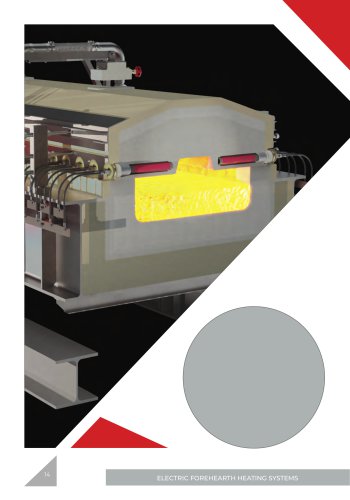 ELECTRIC FOREHEARTH
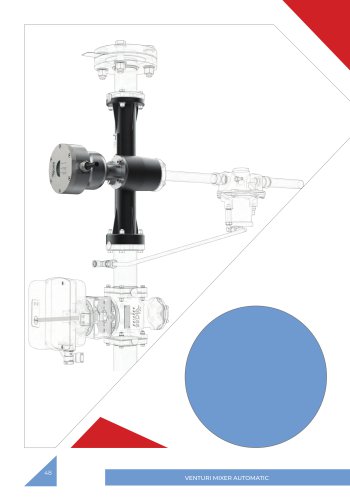 VENTURI MOTORIZED