
- Catalogs
- Glass Service
- ELECTRIC FOREHEARTH


ELECTRIC FOREHEARTH
ELECTRIC FOREHEARTH
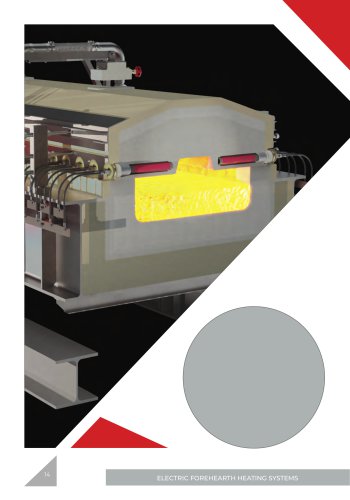
The document discusses the transition of the glass industry towards decarbonization and energy efficiency, highlighting the limitations of conventional air-gas heating systems. It introduces Glass Service's patented Refractory-Embedded Electric Forehearth as a solution that converts electrical energy into thermal energy with high controllability and eliminates direct combustion emissions.
Limitations of Traditional Electric Heating
Traditional electric forehearths have radiant heating elements directly above the molten glass, leading to chemical attacks, contamination risks, and atmospheric incompatibility. Glass Service's innovative design embeds heating elements within the refractory superstructure, protecting them from chemical attack and eliminating contamination risks.
Refractory-Embedded Radiant Elements
The embedded design isolates heating elements from glass vapors, reducing corrosion and extending service life. It ensures zero contamination and enhances electrical safety by eliminating direct contact between energized elements and molten glass. The system can have one or two independent elements for better temperature management.
Advanced Atmospheric & Thermal Management
Advanced systems feature independently controlled heating circuits, central cooling channels, and optional auxiliary burners. This setup compensates for temperature asymmetries and maintains specific atmospheric conditions for different glass compositions. Electrical power is regulated through thyristor-based controls.
Key Benefits & Performance Evaluation
The system offers extended durability, process flexibility, enhanced safety, and zero direct emissions. Numerical simulations confirm exceptional thermal homogeneity and a nearly linear relationship between element and glass temperatures.
Electric Heating vs Air/Gas Heating
The document includes a comparison chart showing the energy efficiency of electric heating over traditional air/gas heating systems.
Catalog excerpts
ELECTRIC FOREHEARTH HEATING SYSTEMS
Open the catalog to page 1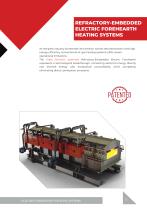
REFRACTORY-EMBEDDED ELECTRIC FOREHEARTH HEATING SYSTEMS As the glass industry accelerates its transition toward decarbonization and high energy efficiency, conventional air-gas heating systems suffer severe operational limitations. The Glass Service's patented Refractory-Embedded Electric Forehearth represents a technological breakthrough, converting electrical energy directly into thermal energy with exceptional controllability while completely eliminating direct combustion emissions. ELECTRIC FOREHEARTH HEATING SYSTEMS
Open the catalog to page 2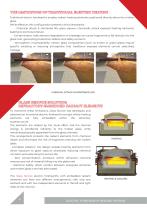
THE LIMITATIONS OF TRADITIONAL ELECTRIC HEATING Traditional electric forehearths employ radiant heating elements positioned directly above the molten glass. While effective, this configuration presents critical drawbacks: • Chemical attack & shortened life: glass vapours chemically attack exposed heating elements, leading to premature failure. • Contamination risks: element degradation or breakage can cause fragments to fall directly into the glass melt, generating production defects and safety concerns. • Atmospheric incompatibility: certain glass compositions (such as amber or green glass) require...
Open the catalog to page 3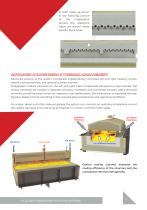
In both cases, as shown in the following picture of the longitudinal section, the resistance tubes are placed inside specific block holes. ADVANCED ATMOSPHERIC & THERMAL MANAGEMENT Advanced versions of the system incorporate independently controlled left and right heating circuits, central cooling channels, and optional auxiliary burners. Independent radiant elements for the left and right sides compensate temperature asymmetries. The radiant elements are housed in separate refractory chambers and connected through lateral electrical terminals, providing easier access for inspection and replacement....
Open the catalog to page 4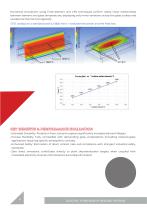
Numerical simulations using finite-element and CFD techniques confirm nearly linear relationships between element and glass temperatures, displaying only minor variations across the glass surface and exceptional thermal homogeneity CFD analsys on a standard zone (L=2820 mm) → evalutate the power and the heat loss KEY BENEFITS & PERFORMANCE EVALUATION • Extended Durability: Protection from corrosive vapours significantly increases element lifespan. • Process Flexibility: Fully compatible with demanding glass compositions (including reduced-glass applications requiring specific atmospheric controls)....
Open the catalog to page 5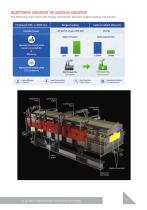
ELECTRING HEATING VS AIR/GAS HEATING The following chart shows the energy comparison between air/gas heating and electric. ELECTRIC FOREHEARTH HEATING SYSTEMS
Open the catalog to page 6All Glass Service catalogs and technical brochures
 VENTURI MOTORIZED
10 Pages
 MAIN PRODUCTS PORTFOLIO
160 Pages