
- Catalogs
- Gill Sensors & Controls
- Wear Debris Monitoring on Low Speed Drives

Wear Debris Monitoring on Low Speed Drives

Wear Debris Monitoring on Low Speed Drives
This document discusses the importance of real-time ferrous wear detection in machinery, focusing on the use of oil debris sensors for monitoring wear in low-speed drives. It highlights the challenges and solutions in detecting machinery failures faster.
Vibration and Its Challenges
Vibration is described as a series of pressure waves caused by conditions like imbalance in rotating devices. Vibration sensors convert these waves into digital signals, allowing for the creation of a 'normal' vibration profile. However, detecting changes in vibration profiles at low speeds is challenging due to reduced amplitude and frequency of vibrations.
Condition-Based Monitoring (CBM)
The document outlines the evolution of CBM technologies, emphasizing the need for effective monitoring solutions for machines operating below 600rpm. Traditional vibration monitoring is affordable and widely used but may not be reliable for low-speed applications.
Low-Speed Challenges
At low speeds, vibration sensors struggle to detect changes due to lower vibration levels. The document uses a pothole analogy to explain how gear deterioration can be misinterpreted if relying solely on vibration data.
Wear Debris Monitoring
Wear debris monitoring is presented as a viable alternative for low-speed applications. It involves collecting metallic debris from lubricating oil, which indicates wear and tear. This method is independent of speed and load, making it suitable for gearboxes operating below 600rpm.
Comparison of Monitoring Methods
The document compares vibration sensing and wear debris sensing, highlighting the advantages of each. Vibration sensing is ideal for high-speed applications and electric motors, while wear debris sensing is better suited for low-speed gearboxes and does not require specialized training.
Conclusion
For operators of low-speed drives, wear debris monitoring is recommended as it provides a reliable indication of machinery condition without the need for extensive training or additional sensors.
Additional Resources
The document offers further reading through a free eBook and technical datasheets for those interested in wear debris monitoring.
Catalog excerpts

Oil Debris Sensor Real-time ferrous wear detection – discover machinery failures faster Wear Debris Monitoring on Low Speed Drives gillsc.com Issue 3 © 2022 Gill Sensors & Controls Limited
Open the catalog to page 1
A modern solution to an age old problem The condition based monitoring (CBM) market is awash with new technologies and new ways to monitor problems that are as old as the industrial revolution. I am sure that the French inventors of the first modern automotive transmission had issues with shaft alignment, poor lubrication, excessive vibration and surface pitting. Panhard and Levassor, working over 125 years ago, would have loved to get their hands on some of the technology that today we take for granted. But faced with so many choices, what sets different technologies apart from one another and...
Open the catalog to page 2
Other variables Troubles at low speed In our analogy we said that the faster your car is going the bigger the jolt. Conversely, slowly driving over a pothole will cause little jolt at all. In the equation if you travel over the same pothole at ever increasing speeds the jolt you will feel becomes stronger the faster you travel. F = MA What this means for a vibration sensor is that there is a whole load of vibration to pick up at high speed, but it gets harder to measure reliably at low speeds. If we can’t determine a reliable ‘normal’ how can we compare and be confident when an ‘abnormal’ condition...
Open the catalog to page 3
WearDetect Summary For higher speed applications the industry standard vibration monitoring system is often sufficient, especially for electric motors. However, for operators of low speed drives who have gearboxes absolutely critical to their processes (and bottom-line profits) wear debris monitoring just makes sense (excuse the pun). Want to find out more? Vibration Sensing High rotating speed Other sensors already installed CAT trained vibration engineer Best for electric motors Wear Debris Sensing Low rotating speed Variable speed or load No training required Best for gearboxes If you are...
Open the catalog to page 4All Gill Sensors & Controls catalogs and technical brochures
 WearDetect Oil Debris Sensor
5 Pages
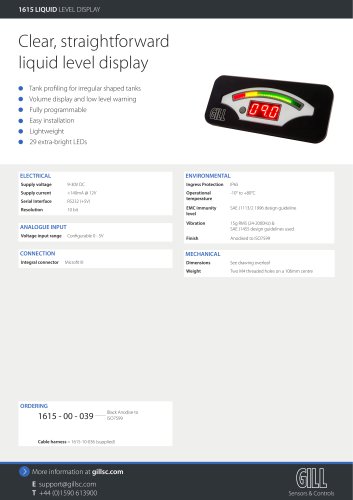 1615 LIQUID LEVEL DISPLAY
2 Pages
 GS12 IGNITION MODULE
2 Pages
 GT6 IGNITION MODULE
2 Pages
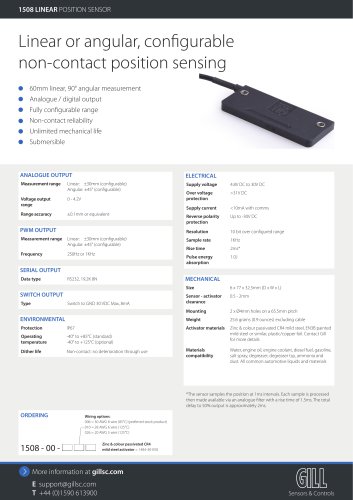 1508 LINEAR POSITION SENSOR
2 Pages
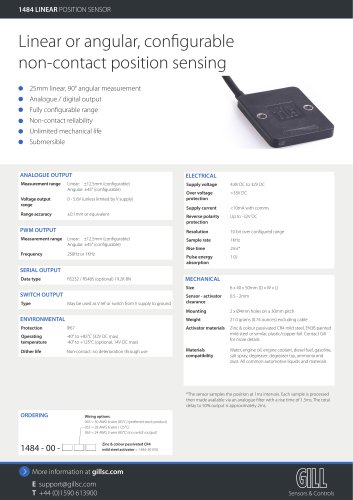 1484 LINEAR POSITION SENSOR
2 Pages
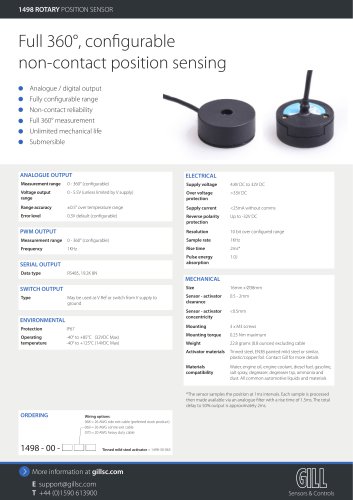 1498 ROTARY POSITION SENSOR
2 Pages
 LevelDefend
3 Pages
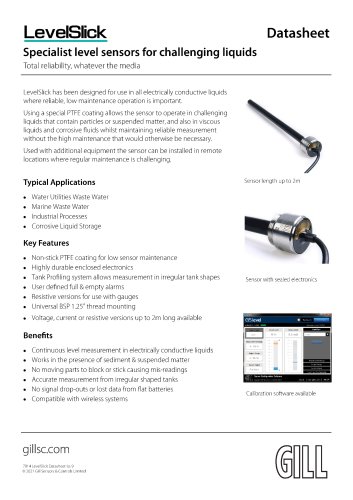 LevelSlick
3 Pages
 LevelLite
3 Pages
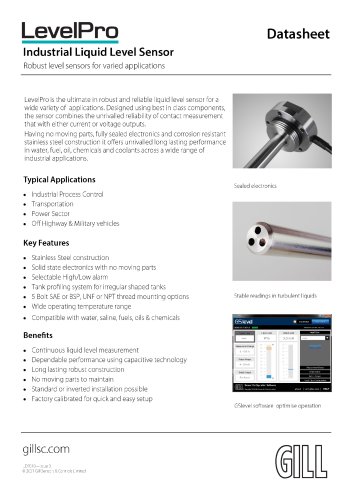 LevelPro
3 Pages
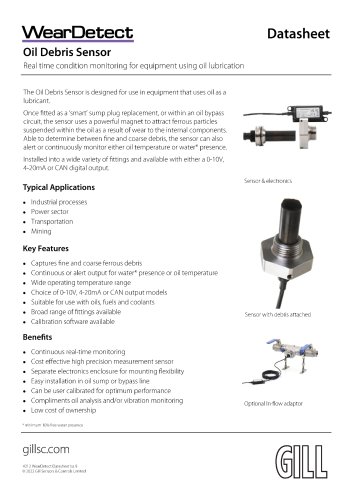 Oil Debris Sensor Real time
3 Pages
 Lightweight Liquid Level Sensor
11 Pages





- Level probe
- Liquid level sensor
- Position transducer
- Analog level sensor
- Linear position transmitter
- Digital output level sensor
- Analog position transducer
- No-contact position sensor
- IP68 level sensor
- Detector with digital display
- IP67 level sensor
- Metal position sensor
- IP67 position sensor
- Compact position sensor
- Angular position sensor
- Compact level sensor
- Capacitive level sensor
- Precision position sensor
- Level sensor for industrial applications
- Rugged position sensor