
- Catalogs
- Gill Sensors & Controls
- An introduction to Wear Debris Monitoring in the industrial marketplace

An introduction to Wear Debris Monitoring in the industrial marketplace

An introduction to Wear Debris Monitoring in the industrial marketplace
Wear debris monitoring is a critical component of modern condition-based monitoring (CBM) systems, particularly in the industrial marketplace. Historically dominated by vibration monitoring, the field is now seeing a significant shift towards oil sensing technologies, including wear debris monitoring systems. This shift is driven by the need for multiple data points to accurately diagnose equipment faults, especially in low-speed rotating assets where vibration monitoring is less effective.
Wear debris monitoring technology emerged in the 1970s and 1980s, gaining prominence in the 1990s. Modern advancements have led to smaller, low-power sensors becoming industry standards. The operational theory is based on the inevitable breakdown of contacting metal surfaces due to friction, fatigue, and other factors. While ideal analysis would involve examining all oil particles, practical approaches involve sampling and lab analysis.
Offline analysis involves sending small lubricant samples to labs for detailed examination, which can be costly and impractical for frequent sampling. Online analysis, using real-time sensors, provides continuous monitoring of metal particles in oil systems, allowing operators to detect potential failures early. These sensors are crucial for identifying critical wear trends and scheduling timely maintenance.
A case study involving the WearDetect Oil Debris Sensor on a steel grinding mill illustrates the benefits of combining oil debris and vibration sensors. The sensor detected early signs of gearbox issues, allowing operators to reject a faulty gearbox before installation, thus avoiding significant downtime and maintenance costs.
Wear debris monitoring is essential for effective CBM programs, with increasing investments in oil sensing technologies. The integration of real-time sensors with traditional methods provides a comprehensive approach to machinery health monitoring, offering significant cost savings and operational efficiency.
Catalog excerpts

WearDetect Oil Debris Sensor Real-time ferrous wear detection – discover machinery failures faster An introduction to Wear Debris Monitoring in the industrial marketplace gillsc.com Issue 2 © 2021 Gill Sensors & Controls Limited
Open the catalog to page 1
An introduction to Wear Debris Monitoring in the industrial marketplace Modern Marketplace Today a modern condition based monitoring (CBM) system may consist of many facets. Historically this space has been dominated by vibration monitoring, although this technology is now dropping market share when compared to other technologies. The largest gain in market share is oil sensing, which includes wear debris monitoring systems. 100% 90% 80% 70% 60% 50% 40% 30% 20% 10% 0% Source – Bureau Veritas SMRP 2019 One possible explanation for this is that operators are waking up to the fact that they need...
Open the catalog to page 2
> Find out how Gill can help improve your Predictive Maintenance Strategy Technology History Wear debris monitoring and wear debris analysis was first developed during the 70’s and early 80’s. The technology came to the fore in the market place in the 1990’s and has been solidly established ever since. Modern processing and sensing techniques have allowed the proliferation of new smaller, low power, sensors which industry is adopting as the new standard, at an ever increasing rate. Operational Theory The principle is simple, contacting metal surfaces will start to break down, even at the most...
Open the catalog to page 3
An introduction to Wear Debris Monitoring in the industrial marketplace Offline Analysis The practical approach is to tap off a small sample of lubricant into a perfectly clean sample bottle, to avoid cross contamination, and send it to a lab for analysis. The drawback is that this sample, usually less than 0.5% of the total system lubricant volume, must contain debris representative of the whole lubrication system and overall condition of the machine. Therefore, the location from which the oil sample is taken, is critical to getting a good result. Your lab will then examine this sample and provide...
Open the catalog to page 4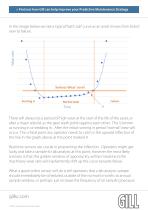
> Find out how Gill can help improve your Predictive Maintenance Strategy Wear rate In the image below we see a typical “bath tub” curve as an asset moves from brand new to failure. There will always be a period of high wear at the start of the life of the asset, or after a major rebuild, as the gear teeth polish against each other. This is known as running in or bedding in. After the initial running in period “normal” wear will occur. The critical point any operator needs to catch is the upward inflection of the line in the graph above, at the point marked A. Real time sensors are crucial in...
Open the catalog to page 5
An introduction to Wear Debris Monitoring in the industrial marketplace the duty cycle on a particular machine has increased. At the very minimum, a good hard look at a piece of equipment should be performed during the next planned shutdown. Approaching maintenance in this way can bring huge cost savings on all types of gearboxes where process is critical. For powerful 2 point, real time analysis we can overlay wear debris and vibration data in a complementary manner. In summary, catch everything, plan actions ahead and hit your uptime targets. Any online/real time sensor is not a whole oil lab...
Open the catalog to page 6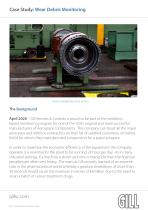
Case Study: Wear Debris Monitoring Motor and gearbox drive system The Background April 2020 – Gill Sensors & Controls is proud to be part of the condition based monitoring program for one of the USA’s original and most successful manufacturers of Aerospace components. This company can boast all the major aerospace and defence contractors on their list of satisfied customers, including NASA for whom they manufactured components for a space program. In order to maximise the economic efficiency of the equipment the company operates it is essential for the plant to be running 24 hour per day. As...
Open the catalog to page 7
Case Study: Wear Debris Monitoring The Application In one particular application, WearDetect Oil Debris Sensor was deployed on a steel grinding mill. This critical part of the manufacturing process operates 24 hours per day, however, the large planetary gearbox that the sensor is installed on is running at 50% duty cycle due to material loading/unloading times. Quite often this piece of equipment will operate for 6 months to 1 year before being stopped for scheduled maintenance tasks. The company has twin machines in order to manage the demand and maintain output, albeit reduced, when either...
Open the catalog to page 8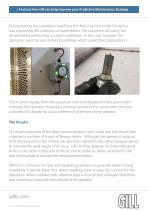
> Find out how Gill can help improve your Predictive Maintenance Strategy During testing, the operators noted that the ‘fine’ channel on the Gill device was registering the collection of some debris. For maximum accuracy, Gill recommends performing a custom calibration. In this case, however, the operators used the out-of-the-box settings which suited their application. The 4-20mA signals from the sensor are read and displayed in the plant room however, the operator chose the premium version of the sensor with the local coloured LED display for a quick reference at the site of the gearbox. The...
Open the catalog to page 9
Case Study: Wear Debris Monitoring The Value Using the combined data from WearDetect Oil Debris Sensor and vibration sensors this operator was able to make the call to reject the gearbox before it was installed onto the main grinding mill. Imagine, if you will, a scenario whereby either of the gearboxes operating the grinding machines fail or require a major service. If the third rotation gearbox had been switched in whilst carrying a fault, the company could very quickly be left with only one operational gearbox out of the three that it owns. The company would also have lost a significant amount...
Open the catalog to page 10All Gill Sensors & Controls catalogs and technical brochures
 WearDetect Oil Debris Sensor
5 Pages
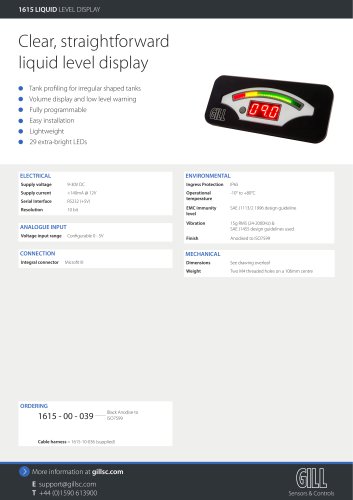 1615 LIQUID LEVEL DISPLAY
2 Pages
 GS12 IGNITION MODULE
2 Pages
 GT6 IGNITION MODULE
2 Pages
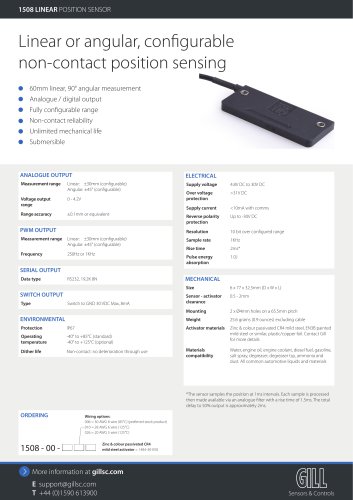 1508 LINEAR POSITION SENSOR
2 Pages
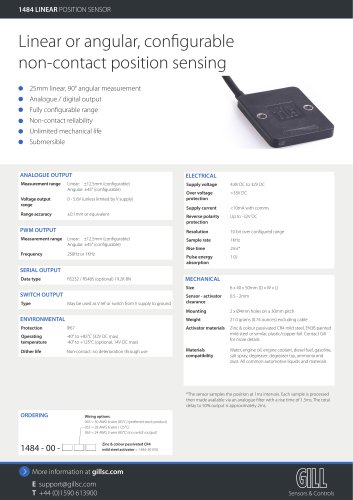 1484 LINEAR POSITION SENSOR
2 Pages
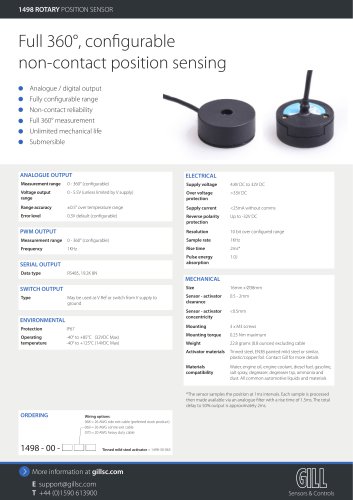 1498 ROTARY POSITION SENSOR
2 Pages
 LevelDefend
3 Pages
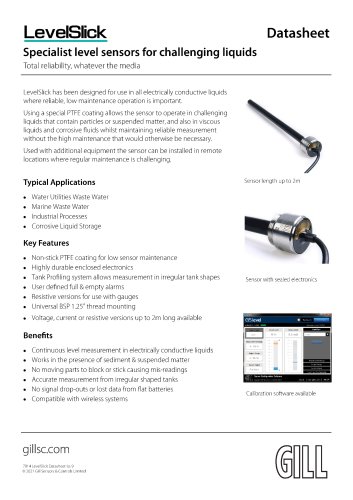 LevelSlick
3 Pages
 LevelLite
3 Pages
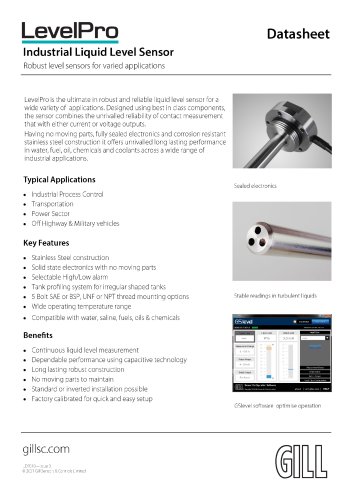 LevelPro
3 Pages
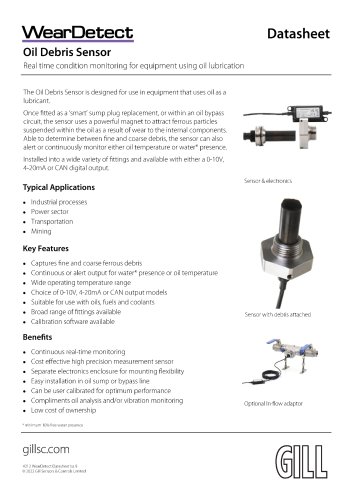 Oil Debris Sensor Real time
3 Pages
 Lightweight Liquid Level Sensor
11 Pages





- Level probe
- Liquid level sensor
- Position transducer
- Analog level sensor
- Linear position transmitter
- Digital output level sensor
- Analog position transducer
- No-contact position sensor
- IP68 level sensor
- Detector with digital display
- IP67 level sensor
- Metal position sensor
- IP67 position sensor
- Compact position sensor
- Angular position sensor
- Compact level sensor
- Capacitive level sensor
- Precision position sensor
- Level sensor for industrial applications
- Rugged position sensor