- Catalogs
- Gilat Satellite Networks
- GLT Network


GLT Network
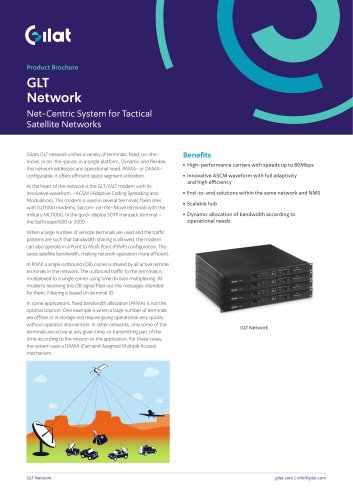
GLT Network
Gilat's GLT network integrates various terminal types—fixed, on-the-move, and on-the-pause—into a single platform. It is designed to be dynamic and flexible, addressing diverse operational needs with efficient space segment utilization through PAMA or DAMA configurations.
The core of the network is the GLT/MLT modem featuring the innovative ACSM waveform, which supports adaptive communication across varying signal conditions. This modem is utilized in different terminals, including fixed sites, Satcom-on-the-Move, and quick-deploy manpack terminals.
The network can operate in a Point to Multi Point (PtMP) configuration, optimizing satellite bandwidth by sharing a single outbound carrier among multiple remote terminals. This setup uses time division multiplexing for outbound traffic, with terminals filtering messages based on terminal ID.
The system supports both fixed bandwidth allocation (PAMA) and demand-based allocation (DAMA), allowing for efficient resource use depending on terminal activity and operational requirements.
- High-performance carriers with speeds up to 80Mbps.
- Innovative ACSM waveform for adaptive and efficient communication.
- Scalable hub and dynamic bandwidth allocation.
The hub, installed in a 19” rack, supports various RF bands and is central to the network's operation. It includes a Network Controller and a Network Management System, managing satellite resource allocation and user traffic.
The network ensures availability with redundant components and scalable network segments, allowing for increased traffic capacity and support for additional terminals.
The system operates in routing mode, supporting static and dynamic routing protocols, TCP acceleration, VLANs, and Quality of Service (QoS) operations.
The GLT network supports small aperture terminals and quick deployment, with robust communication performance even in challenging conditions.
Gilat’s TotalNMS provides centralized management, enhancing operational efficiency with features like FCAPS, a standard northbound interface, and streamlined NOC operations.
- Frequency bands: C, X, Ku, Ka.
- Topology: PtMP, Star.
- Support for up to 65,000 terminals and 200 carriers.
- Redundancy: 1+1 and N+1, with geographical redundancy.
Catalog excerpts
C Ilat Product Brochure Net-Centric System for Tactical Satellite Networks Gilat's GLT network unifies a variety of terminals: fixed, on-the-move, or on-the-pause, in a single platform. Dynamic and flexible, this network addresses any operational need. PAMA- or DAMA-configurable, it offers efficient space segment utilization. At the heart of this network is the GLT/MLT modem with its innovative waveform -ACSM (Adaptive Coding Spreading and Modulation). This modem is used in several terminals: fixed sites with GLT1000 modems, Satcom-on-the-Move terminals with the military MLT1000, or the quick-deploy SOTP manpack terminal -the SatTrooper1500 or 2000. When a large number of remote terminals are used and the traffic patterns are such that bandwidth sharing is allowed, the modem can also operate in a Point to Multi Point (PtMP) configuration. This saves satellite bandwidth, making network operation more efficient. In PtMP, a single outbound (OB) carrier is shared by all active remote terminals in the network. The outbound traffic to the terminals is multiplexed to a single carrier using time division multiplexing. All modems receiving this OB signal filter out the messages intended for them. Filtering is based on terminal ID. In some applications, fixed bandwidth allocation (PAMA) is not the optimal solution. One example is when a large number of terminals are offline or in storage and require going operational very quickly without operator intervention. In other networks, only some of the terminals are active at any given time, or transmitting part of the time according to the mission or the application. For these cases, the system uses a DAMA (Demand Assigned Multiple Access) mechanism. • High-performance carriers with speeds up to 80Mbps • Innovative ASCM waveform with full adaptivity and high efficiency • End-to-end solutions within the same network and NMS • Dynamic allocation of bandwidth according to operational needs GLT Network gilat.com | [email protected]
Open the catalog to page 1
System Features ACSM Waveform The innovative ACSM (patented) waveform was designed to allow an optimal adaptive communication link from poor channel conditions (Signal to Noise (SNR) of -13 dB) to medium and high SNR conditions. It utilizes direct sequence spreading technique to enable operation at very low SNR. The hub is the heart of the network. Installed in a 19” rack and located in an earth station/teleport together with the RFT and the hub antenna, it transmits and receives signals towards the terminals via the satellite. Various RF bands are supported: C-band, Ku-band, Ka-band and X-band....
Open the catalog to page 2
TotalNMS Gilat’s TotalNMS system provides centralized management for monitoring and control of networks, collection of SCPC links, and both. TotalNMS distributed architecture provides increased flexibility, scalability, and reliability. TotalNMS provides secured and customized user administration, standard browser-based user interface with easy access from any location. TotalNMS provides FCAPS (Fault, Configuration, Accounting, Performance, and Security) to improve management functions to maximize operations efficiency, improve troubleshooting, and advanced diagnostic capabilities. TotalNMS also...
Open the catalog to page 3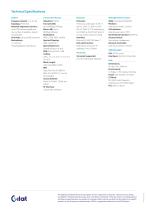
Technical Specifications System Management & Control Frequency bands: C, X, Ku, Ka Topology: PtMP, Star Network Segments/Carriers: Up to 200 carriers spread over any number of satellites, beams, transponders Terminals: Up to 65,000 terminals Redundancy: 1+1 and N+1; Hub geographical redundancy Waveform: ASCM Forward (OB): Up to 80Mbps/30Msps Return (IB): Up to 80Mbps/30Msps Modulation: BPSK, QPSK, 8PSK, 16QAM Spectral Shaping: SRRC, Rolloff=0.2 Spread Spectrum: Spreading factor up to 8 SNR: Minimal SNR -13dB Coding: LDPC, 1/4, 1/3, 2/5, 1/2, 2/3, 3/4, 5/6, 8/9 Block Length: 4032, 6048,8064,12096...
Open the catalog to page 4All Gilat Satellite Networks catalogs and technical brochures
 SkyEdge IV Aquarius Pro
1 Page
 SkyEdge IV Gemini S2X Family
2 Pages
 SkyEdge IV Aquarius-e
2 Pages
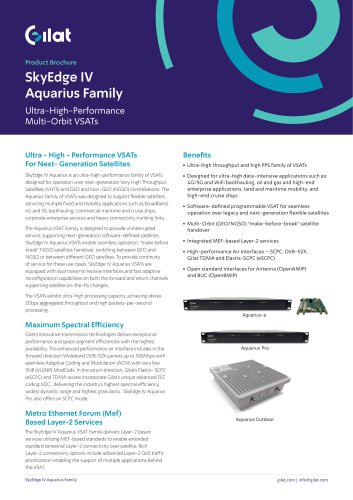 SkyEdge IV Aquarius Family
2 Pages
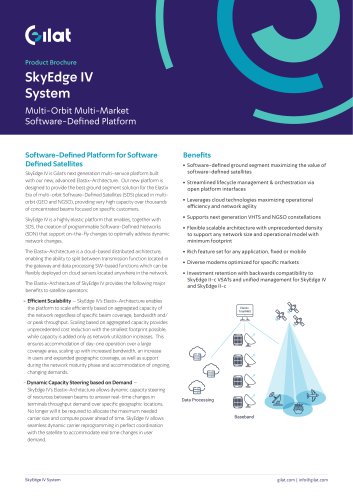 SkyEdge IV System
4 Pages
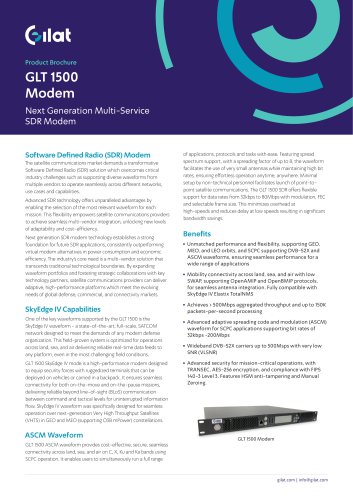 GLT1500
2 Pages
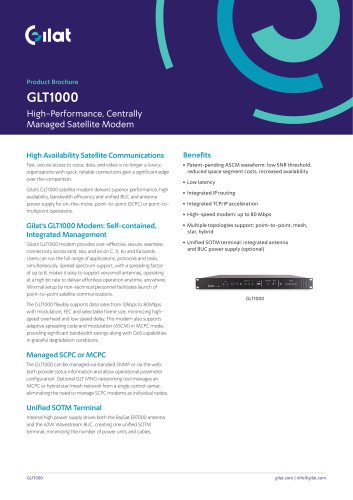 GLT1000
2 Pages
 RaySat M3
2 Pages