
- Catalogs
- Gigahertz Optik GmbH
- BTS2048-UV-S


BTS2048-UV-S

BTS2048-UV-S
- BiTec Sensor: Combines a photodiode with a back-thinned CCD diode array for precise radiometric and spectral-radiometric measurements over a large dynamic range.
- CCD Detector: Utilizes a 2048-pixel back-thinned CCD detector with a spectral responsivity range of 190 nm to 430 nm, offering high sensitivity and a 0.7 nm optical bandwidth.
- Flash Spectral Radiometer: Equipped with an electronic shutter for measurements within a light flash, supporting integration times from 2µs to 60000ms.
- Stray Light Correction: Features a remote-controlled filter wheel and smart measurement routines for high-quality measurements comparable to double monochromators.
- Input Optics: Includes a diffuser window with a cosine-corrected field of view, enhancing sensitivity and calibration stability.
- Interfaces: Offers USB 2.0 and Ethernet interfaces for fast data transfer, with an independent microprocessor for data preparation.
- User Software: The S-BTS2048 software provides a flexible desktop structure for customizable graphical and numerical displays.
- Applications: Suitable for spectral irradiance, erythema, and radiant power measurements.
- Calibration Uncertainty: Varies from ±12% to ±4% depending on the wavelength range.
- Measurement Modes: Includes standard, out-of-range stray light corrected, and bandpass modes for solar measurements.
- Microprocessor: 32-bit for device control, 16-bit for CCD array control, and 8-bit for photodiode control.
- Power Supply: Operates with a DC input of 5V or via USB bus.
- Dimensions and Weight: Measures 103 mm x 107 mm x 52 mm and weighs 500 g.
Catalog excerpts

Gigahertz-OptikBTS2048-UV-S http://www.gigahertz-optik.de/en-us/product/BTS2048-UV-SProduct tags: UV Gigahertz-Optik GmbH
Open the catalog to page 1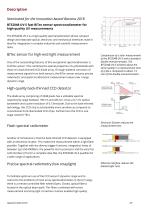
Nominated for the Innovation Award Bavaria 2018 BTS2048-UV-S fast BiTec sensor spectroradiometer for high-quality UV measurements The BTS2048-UV-S is a high-quality spectralradiometer whose compact design and elaborate optical, electronic and mechanical interfaces make it ideal for integration in complex industrial and scientific measurement tasks. BiTec sensor for high-end light measurement One of the outstanding features of this exceptional spectroradiometer is its BiTec sensor. This combines the special properties of a photodiode with those of a back-thinned CCD diode array. Through bilateral...
Open the catalog to page 2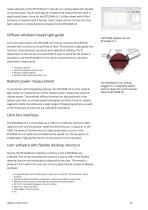
measurements of the BTS2048-UV-S. Results are compareable with double monochromator results (see figure). However the measurements time is significantly lower. Since for the BTS2048-UV-S a filter wheel with 8 filter positions is implemented a furhter smart measurement routine for stray light reduction is implemented compared to the BTS2048-UV. Diffuser window instead light guide As for the input optics, the BTS2048-UV-S has an incorporated diffuser window with a cosine corrected field of view. The fact that a light guide has not been used improves sensitivity and calibration stability. The f2...
Open the catalog to page 3
Calibration of the BTS2048-UV-S, including its accessories, is performed by Gigahertz-Optik calibration laboratory for optical measurands with reference to national and international calibration standards. Specifications Gigahertz-Optik GmbH
Open the catalog to page 4
spectral responsivity Gigahertz-Optik GmbH
Open the catalog to page 5
Software User software S-BTS2048 Optional software development kit S-SDK-BTS2048 for user software set-ups based on .dll's in C, C++,C# or in LabView. Gigahertz-Optik GmbH
Open the catalog to page 6
Info *1 It is recommended to perform a new dark signal measurement for every change in the integration time *2 typical value, the uncertainty of the dominant wavelength depends on the spectral distribution of the LED *3 typical value, measured 100 nm left of the peak of a cold white broadband LED with and deep blue LED peak *4 *5 typical value measured without averaging for a 4ms measurement time and full scale control of the array. Averaging results in quadratic rise of the S/N i.e. quadratic fall of the base noise e.g. averaging to a factor 100 improves the S/N by a factor 10 *6 Minimum 500/1...
Open the catalog to page 7
Gigahertz-Optik GmbH
Open the catalog to page 8All Gigahertz Optik GmbH catalogs and technical brochures
 LIGHT MEASUREMENT SOLUTIONS
11 Pages
 UV MEASUREMENT SOLUTIONS
2 Pages
 SphereSpectro 150H
11 Pages
 Image Brochure
17 Pages
 ISD-5-Si
5 Pages
 XD-9510
4 Pages
 XD-9509
4 Pages
 X1-UV-3727
6 Pages
 X1
X117 Pages
 BN-LHSF-2P-20
5 Pages
 BTS256-LED Plus Concept
7 Pages
 ISS-30-VA
5 Pages
 ISS-8P-RVA-ROD
6 Pages
 ISS-8P-VAHP
5 Pages
 LCRT-2005-S+850
6 Pages
 PLL-1701
5 Pages
 TPI21-TH
5 Pages
 UPB-150-ART
9 Pages
 UPB-150-ARTA
10 Pages
 UPG-150-ART
9 Pages
 VL-3704
5 Pages
 BN-9101
5 Pages
 BTS2048-UV-S-WP
8 Pages
 CSS-45
7 Pages
 ISS-17-VA
5 Pages
 X1-1-RCH-116-4
3 Pages
 TFCT25
4 Pages
 UV-37 with SRT-M37-L-UV
5 Pages
 P-9802
12 Pages
 LDM-9811
6 Pages
 PS-3702
4 Pages
 TP-4501
4 Pages
 UV-3709
5 Pages
 XD-45-ERYC
5 Pages
 XD-45-HUV
4 Pages
 ISD-0.8-SiLP
4 Pages
 ISD-30-Si
5 Pages
 ISD-3P-Si
7 Pages
 ISD-5P-SiUV
5 Pages
 RW-37 with SRT-M37-L
5 Pages
 XD-9506
5 Pages
 RCH-005
6 Pages
 RCH-014
6 Pages
 RCH-115
6 Pages
 RCH-116
6 Pages
 RW-3708
6 Pages
 UV-3711-308
5 Pages
 UV-3725
6 Pages
 ISD-15P-VL
6 Pages
 ISD-5-VL
5 Pages
 LDM-9901
7 Pages
 PD-9310A
6 Pages
 VL-3701
6 Pages
 CT-4501
5 Pages
 P-9202-6
6 Pages
 P-9801
15 Pages
 P-2000
17 Pages
 P-9710
17 Pages
 X1-4
X1-47 Pages
 X1-PCBC
10 Pages
 X1-RM
X1-RM10 Pages
 X1-3
X1-36 Pages
 BTS2048-VL
11 Pages
 BTS256-EF
9 Pages
 BTS256-E
8 Pages
 MSC15
MSC157 Pages
 LS-OK30
4 Pages
 LP-9910
4 Pages
 LH-xxF
4 Pages
 ISD-10-VL
7 Pages
 Catalogue complete
198 Pages

Archived catalogs
 2019 BTS256-PAR
8 Pages
 2016 BTS256-PAR
9 Pages
- DC power supply
- AC/DC power supply
- Measuring device
- Measuring machine
- Single-output power supply
- Electronic housing
- Variable-output power supply
- Modular housing
- Rack-mount power supply
- Spectrophotometer
- Test set
- Instrumentation enclosure
- DC/DC power supply
- Gigahertz Optik compact detector
- Visible spectrophotometer
- Digital power supply
- Benchtop spectrophotometer
- Process detector
- UV spectrophotometer