
- Catalogs
- GeoSIG Ltd
- SMS / SAS

SMS / SAS

SMS / SAS
The SMS/SAS Seismic Monitoring/Alarm System is designed for recording, advanced analysis, and annunciation of seismic events according to project-specific or international regulations. It features automatic exceedance evaluation, reporting, and alerting through various means, and supports up to 36 triaxial analog sensors with unlimited seismic field recorder stations.
The core of the system is a Central Processing Unit (CPU) with a multi-channel digital recorder, housed in an industrial cabinet. Detection/Recording Units (DRUs) such as accelerometers and seismometers are placed remotely and connected to the CPU. The system supports both centralized and decentralized topologies, offering modularity and flexibility for upgrades and redundancy.
- Sensor Connectivity: Flexible options for various sensor types.
- Digitizer: 24 to 32 bit ADC, dynamic range of 137 dB to 150 dB.
- Data Recording: Adjustable pre-event and post-event times.
- Triggering: Level or STA/LTA triggers, with user-configurable filtering.
- Data Storage: 2-128 GByte per 3 channels, with HDD/SSD options.
- Data Analysis: Utilizes GeoDAS software for various analysis functions.
- Timing: GPS system accuracy < 1 μsec.
- Indicators: LED, push button, and flat-screen indicators.
- Self Test/State of Health: Continuous monitoring and periodic system tests.
- Communication: Ethernet, GSM, and other options.
- Power Supply: AC/DC with external battery options.
- Housing: 19’’ cabinet, floor standing or wall mounted.
The system complies with NRC RG 1.12 Rev. 3 of 2017.
Catalog excerpts

swiss made to measure 8952 Schlieren E-mail: [email protected] □ Recording, advanced analysis and annunciation according to project specific or international regulations □ Automatic exceedance evaluation □ Reporting and alerting via relays, visual and audible tools as well as printed matter □ Project specific Automatic Event Processing (AEP), Nuclear (NPP) or other features □ Up to 36 triaxial analog sensors and unlimited number of seismic field recorder stations □ 24 or 32 bit event-based and/or continuous recording □ Common timing and triggering within the system □ Completely over-voltage protected □ Continuous system-wide SOH monitoring □ Seismically and EMC proven design □ Comprehensive configuration of the whole system via the enhanced computer interface *The information provided is a typical overview. For each project a specific description is provided outlining the relevant system. The core of the SMS / SAS is a Central Processing Unit (CPU) with a multi-channel digital recorder system rack mounted in an industrial cabinet together with an industrial computer and relevant peripherals. Accelerometers, seismometers, complete seismic stations or sensor packages, which are referred to as Detection / Recording Units (DRUs), are placed at remote locations and can be connected to the CPU. The system has been designed in a way that it is not bound to a single topology. There could be only the sensors or both sensors and data acquisition out in the field. Advantages of these topologies are briefly explained in the specifications section. The system has great modularity and flexibility to simplify an instrumentation upgrade and enable existing elements to be reused as much as possible. Built-in redundancy of the recorders and power supply are key features. The CPU monitors all DRUs in parallel, as a result of the dedicated communication links that are provided by the system hardware. By monitoring continuously the DRUs, the CPU detects seismic events, generates associated alarms and automatically processes the recorded data. Also it performs periodical tests on the system and monitors the system-wide state of the health as well as analyses the detailed cause of any malfunction. The result of the data processing is provided in a report a few minutes after the occurrence of an event. State-of-the-art GeoDAS software is utilised in the CPU. For each measuring channel the recording threshold and the alarm limit values can be set individually. Detailed project limits can be fully defined along with other parameters as required by relevant regulations or customised user requirements.
Open the catalog to page 1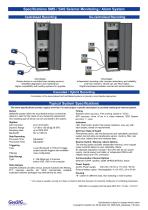
De-centralised Recording Advantages: Simple devices in controlled area (analog sensors). Simplified diagnostics and maintenance. Higher compatibility with existing systems for upgrade. Advantages: Independent recording units increase redundancy and reliability. Link from remote to central can use Fiber Optics. Digital transmission between remote and central locations. Combination of the decentralised and centralised systems to provide a more flexible deployment. The below specifications provide a typical overview. For each project a specific description is provided outlining the relevant system....
Open the catalog to page 2All GeoSIG Ltd catalogs and technical brochures
 GeoSwitch - Seismic Switch
2 Pages
 GMSplus - GMSplus6
2 Pages
 AC-4x Accelerometer
2 Pages
 AC-2x Accelerometer
2 Pages
 GeoDAS
1 Page
 Digital Sensor System
4 Pages
 VE-5x-DH Seismometer
2 Pages
 GMS NetQuakes Recorder
2 Pages
 ETH-FLAN Ethernet Module
1 Page
 GeoSIG Company Brochure
1 Page


Archived catalogs
 AC-4x-DH Accelerometer
2 Pages
 AC-2x-DH Accelerometer
2 Pages
 ETH-LLAN Ethernet Module
1 Page
 GXX-3GUX Series 3G Modem
1 Page
 AC-7x Accelerometer
2 Pages
 VE-1x Velocity Sensor
2 Pages
 AC-7x-DH Accelerometer
2 Pages
 VE-3x Velocity Sensor
2 Pages
 VE-5x Seismometer
2 Pages


- Analysis software solution
- Windows software
- Cloud-based software
- Monitoring software solution
- 3D software solution
- Measurement software
- Single-axis accelerometer
- Triaxial acceleration sensor
- Engineering software
- 2D software
- Modeling software
- Data acquisition software
- Acceleration sensor with analog output
- Data acquisition unit
- Communication module
- Industrial accelerometer
- Calculation software
- Data analysis software
- MEMS accelerometer