
- Catalogs
- GEORGIN S.A.
- P series - Pressure switches and Temperature switches

P series - Pressure switches and Temperature switches

P series - Pressure switches and Temperature switches
The document details the P Series pressure and temperature switches by Georgin, designed for industrial use in harsh conditions, offering precision and reliability.
The switches are available for gauge, absolute, or differential pressure control, and temperature control via direct bulb or capillary. They provide electrical or pneumatic outputs and are ATEX certified for explosion-risk areas.
These switches are used in industries such as energy, metallurgy, chemicals, petrochemicals, and shipbuilding.
Switches feature various housings, including explosion-proof options, made from materials like zamak and aluminium, with sensing elements like bellows and diaphragms.
Operating temperature ranges from -40 to +150°C for stainless steel components, with ambient temperatures from -20 to +70°C.
Safety features for explosive atmospheres include intrinsic safety, increased safety, and explosion-proof safety, with specific certifications.
Electrical contact configurations include SPDT type, with fixed or adjustable dead bands. Pneumatic functions offer normally open or closed configurations.
Certified for explosive atmospheres, with CE type examination statements for different safety categories.
- Bellows-Actuated Absolute Pressure Switch: Suitable for absolute pressure applications.
- Diaphragm-Actuated Gauge Pressure Switch: For gauge pressure measurement with specific diaphragm materials.
- Bourdon Tube Gauge Pressure Switch: Offers a range of pressure settings.
- Bellows-Actuated Differential Pressure Switch: For differential pressure applications.
- Direct Bulb Temperature Switch: Measures temperature with a direct bulb.
- Bulb and Capillary Temperature Switch: Uses a bulb and capillary system with adjustable dead bands.
- Single Fixed Dead Band: Fixed operational range for electrical contacts.
- Single Adjustable Dead Band: Adjustable operational range.
- Electrical Operation with Two Offset Contacts: Dual contact operation with offset settings.
Details SPDT configurations and maximum dead bands.
- Connector types, diaphragm materials, and treatments like degreasing or passivation.
- Correct mounting orientation for diaphragm instruments is crucial.
Guidelines for calculating dead bands to ensure accurate switch operation.
- Diaphragm instruments must be mounted vertically.
- MPB instruments are not recommended for water applications.
- Explosion-proof housings require dead band calculation adjustments.
Temperature switches become non-operational below +6°C but resume normal function above this threshold. Probes should be installed vertically or at a 45° angle.
Details on bulb design and capillary lengths, emphasizing proper installation for accurate measurement.
Specifications for immersion pockets and capillary cable glands, advising on thermal bridge creation for gaseous fluids.
Dimensional drawings are available, with emphasis on following assembly manuals, especially for ATEX-certified products.
Complies with Directive 2014/34/EU, PED 2014/68/EC, TR CU, marine certification, and NACE standards.
Includes NATO Accreditation Code F3363, Electricité de France Accreditation No. 82, and compliance with nuclear island electrical equipment design rules.
Catalog excerpts

Industrial Range P Series Pressure switches and Temperature switches Characteristics* Gauge, absolute or differential pressure control Temperature control: direct bulb or through capillary Electrical contact or pneumatic signal output Protection for areas involving an explosion risk (ATEX) Explosion-proof enclosure Intrinsic safety Increased safety Explosion-proof contact Protection of pressure equipment against exceeding allowable limits (PED) Applications Industrial model Homogeneous, proven range Numerous qualifications (marine, energy, etc.) Extremely adaptable Made in France Temperature * depending on the models
Open the catalog to page 1
Contents Introduction Applications Working principle Type of housing Type of sensing element and connection Operating temperature limits Ambient operating temperature limits Storage temperature Reproducibility Recommendations Equipment designed for EXplosive ATmospheres (ATEX) Intrinsic safety Increased safety Explosion-proof safety Electrical or pneumatic functions Electrical contact Electrical function Pneumatic function Code numbers Gauge pressure switches: ranges and dead bands Diaphragm-actuated gauge pressure switches Bellows-actuated gauge pressure switches Gauge (continued) and differential...
Open the catalog to page 2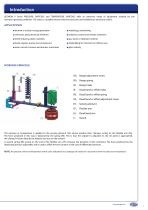
GEORGIN P Series PRESSURE SWITCHES and TEMPERATURE SWITCHES offer an extensive range of equipment suitable for the harshest operating conditions. The series is a justified choice whenever precision and reliability are necessary criteria. APPLICATIONS thermal or nuclear energy generation chemicals, petrochemicals, fertilisers textile industry, plastic materials diesel engines, pumps and compressors steam circuits, furnaces and burners, autoclaves metallurgy, steelmaking ambience control and climatic treatment gas, steam or hydraulic turbines shipbuilding for merchant or military navy glass industry...
Open the catalog to page 3
TYPES OF HOUSINGS Standard housing: zamak, epoxy paint coating Explosion-proof housing (RTPE): AS7G aluminium, epoxy paint coating 316 stainless steel external screws and fittings IP 66 (IP68 available as an option) IP 56 (IP66 available as an option) for diaphragm-actuated gauge pressure switch in ML, MPB, MABV, MJBV type standard housing as per EN 60 529 (IEC 529) External earth terminal Inner graduated scale with viewing window A stainless steel identification plate is fitted on an all stainless steel explosion-proof type instruments and on increased safety instruments. Options: External lead...
Open the catalog to page 4
ELECTRICAL CONTACT The electrical contacts used by Georgin are SPDT type. At rest, contact is established between C-NC. According to the type of action (opening or closure of the electrical circuit), the electrical connection is made on the terminal block between C-NC or C-NO. (1). Single fixed dead band electrical operation: Microswitch "only". Each type of microswitch has its own characteristics, as indicated in the catalogue. Models: 4, 4D, 10, 10D, 16, 16D, 98, 60, 60C, ... (2). Single adjustable dead band electrical operation: Microswitch combined with a spring (RE) to increase the microswitch...
Open the catalog to page 6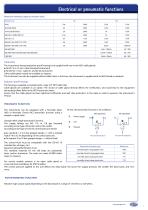
Maximum breaking capacity (resistive load) Pneumatic function type The control fluid must be compatible with the ISO-VG 10 standard (air, nitrogen, etc.). Maximum allowable filtration 5 pm. The standard materials for the cell body are polyamide, brass, and/or aluminium. The seals are made of NBR (other types on request). For certain models, exhaust is via open cable gland or screw terminal (mandatory for ATEX models). The control pressure applied to the unit affects the dead band: the lower the supply pressure, the smaller the dead band, and vice-versa. POTENTIOMETRIC FUNCTION Resistive-type...
Open the catalog to page 7
Instrument type pages 5 to 7 Electrical function type pages 3 and 4 DEAD BAND TABLE READING GUIDE Applicable to tables on pages 10/11/12 Example on P . PX type pressure switch A P . PX denotes a P series gauge pressure switch. For the sensitive element of P . PX with stainless steel bellows, the maximum pressure is 15 bar Its scale is 0.5 to 10 bar, which means that a setpoint can be adjusted when the pressure drops to between 0.5 and 10 bar. Please note that the setting range for a pressure rise setpoint is dependent on the associated microswitch. Note: the adjustment plate is indicative (accuracy...
Open the catalog to page 8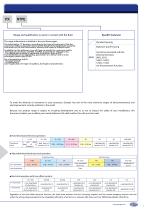
px RTPE enotes, according to the type,of instrument, on tube andThe flange of the diaphragi tatic element are made ofstainless lows, Boyrdon tube a the the thermostatic e Inaddition to the referenc&.yoy still have to specify for a pressure - The type, ofconnector. (1/2“GM, ’A.InPIE mounting on separator, etc.) -The diaphragm material ifapplicable (Perbunan, viton or E.R). If a treatmenrsuch as degreasing, passivation or a helium test is to be envisaged, please specify this. For a temperature switch: - Tgedme ofbulb and ffapplicaBie, the type of capillary, its length and protection. that the m-actuated...
Open the catalog to page 9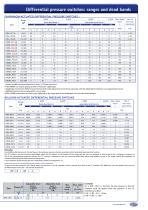
▲ Certain models can be produced for P static < 0. Please consult us. ♦ The DMKBV can only be produced with a "Perbunan" diaphragm. Diaphragm instruments MUST be mounted vertically (with adjustment screw facing upwards), with the diaphragm horizontal, on an appropriate mount. DMPB instruments are not advised for use on water. ♦ DML, DMPB instruments can have a very slight leak in the upper part of the diaphragm every time the state changes. BELLOWS-ACTUATED DIFFERENTIAL PRESSURE SWITCHES Example: For a DPB . QX11 in function 96, the pressure in the HP chamber must be greater than the pressure...
Open the catalog to page 11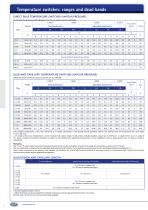
Standard capillary length: 2 metres ▲ Other dimensions can be envisaged if the ambient temperature and the adjusted temperature do not overlap. In WX range, 14.150 mm is the one and only length available
Open the catalog to page 12
Important remark on probe installation Thermostatic probes must be installed facing down, with the capillary outlet at the top. The measurement probe must not be placed in a horizontal position. The position of the probe can affect the operation of the temperature switch. This type of probe is intended for vertical use, and is placed lower than the housing. Any deviation from these conditions can affect the response time and operation of the device. By design, our temperature switches are filled to allow probe inclination of 45° without affecting operation. Beyond this value, operation is dependent...
Open the catalog to page 13All GEORGIN S.A. catalogs and technical brochures
 S5UI
S5UI2 Pages
 GP Serie
2 Pages
 GR/GA - Pressure transmitter
2 Pages
 BZG - Zener Barrier
2 Pages
 FKG - Pressure transmitter
8 Pages
 FKE - Level transmitter
8 Pages
 GS/GSX
2 Pages
 SR2 series
2 Pages
 TR/TA.02
2 Pages
 TR/TA.01
2 Pages
 GR/GA
GR/GA2 Pages
 (D)MLFK
2 Pages
 AIRGAS
2 Pages
 U series
2 Pages
 Pressostat - Thermostat série F
16 Pages
 P Series
16 Pages
 SG
SG2 Pages
 BVL/M/NT(I)
2 Pages
 BEKA's range
182 Pages
 GN 25000
2 Pages
 GN 21000
2 Pages
 GH 11000
2 Pages
 GC 52500
2 Pages
 GC 52100
2 Pages
 GB 64000
2 Pages
 fc-pn
fc-pn48 Pages
 fc-gc6rfbg
2 Pages
 fc-fm
fc-fm39 Pages
 process transmitter FKC series
10 Pages
 A3300-31/51
2 Pages


Archived catalogs

- Power supply unit
- DC power supply
- AC/DC power supply
- Temperature probe
- Resistance temperature sensor
- Pressure transmitter
- Pressure gauge
- Analog pressure transmitter
- Switching relay
- Digital indicator
- Analog pressure gauge
- Switched-mode power supply
- Waterproof pressure transmitter
- Membrane pressure transmitter
- Stainless steel pressure transmitter
- Panel panel meter
- Industrial thermometer
- Relative pressure transmitter
- Pt100 temperature transducer