
- Catalogs
- General Photonics
- Polarization Diversity Detector

Polarization Diversity Detector

Polarization Diversity Detector
- Detection Sensitivity: 0.95 A/W at 1550 nm, 0.90 A/W at 1310 nm
- Operation Wavelengths: 1310 nm, 1550 nm, with a range of ± 75 nm
- Extinction Ratio: > 40 dB
- Return Loss: 55 dB min
- Fiber Type: SM or PM
- Maximum Optical Power: 20 mW
- Detector Rise/Fall Time: < 10 ns
- Detector Capacitance: 18 pf typical
- Detector Dark Current: < 0.20 nA at 23 °C, < 20 nA at 70 °C
- Bias Voltage: 15 volts max.
- Max. Reverse/Forward Current: 5 mA/45 mA
- NEP: 8.42E-15 W/√Hz
- Detector Package: TO-46
- Operating Temperature: -20 ~ 70 °C
- Storage Temperature: -40 ~ 80 °C
- Dimensions: 13 x 12 x 8 mm
- Low Cost
- High Extinction Ratio
- High Detection Sensitivity
- Easy to Use
- Compact
- Sensor
- Performance Monitoring
- Polarization Analysis
- Instruments
Catalog excerpts
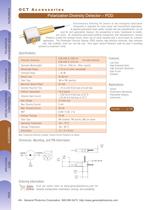
INSTRUMENTS SPECIAL POLARIZATION ACCESSORIES COMPONENTS APPLICATION FAQS GUIDE TIMING/DELAY MANAGEMENT MODULES POLARIZATION MANAGEMENT MODULES - 84- General Photonics Corporation 909.590.5473 http://www.generalphotonics.com Simultaneously detecting the powers of two orthogonal polarization components is important for many sensor and measurement applications. A pigtailed polarization beam splitter coupled with two photodetectors can be used for such applications; however, this arrangement is bulky, troublesome to handle, and costly. By integrating polarization-splitting components with photodetectors, General Photonics created this compact device, which can be easily mounted onto a circuit board for customer applications. This Polarization Diversity Detector (PDD) features high detection sensitivity, high extinction ratio, high reliability, small size, and low cost. Once again, General Photonics leads the pack in providing solutions to customers’ needs. Specifications: Detection Sensitivity 0.95 A/W at 1550 nm } for both channels 0.90 A/W at 1310 nm Operation Wavelengths 1310 nm, 1550 nm. Other: specify Wavelength Range ± 75 nm of center wavelength Extinction Ratio > 40 dB Return Loss 55 dB min Fiber Type SM or PM (specify) Maximum Optical Power 20 mW Detector Rise/Fall Time < 10 ns with 50 Ù load at 5-volt bias Detector Capacitance 18 pf typical Detector Dark Current < 0.20 nA at 5-Volt bias at 23 °C < 20 nA at 5-Volt bias at 70 °C Bias Voltage 15 volts max. Max. Reverse Current 5 mA Max. Forward Current 45 mA NEP 8.42E-15 W/ ã Hz Detector Package TO-46 Fiber Type SM standard, PM specify, 900 ìm jacket Operating Temperature -20 ~ 70 °C Storage Temperature -40 ~ 80 °C Dimensions 13 x 12 x 8 mm Features: . Low Cost . High Extinction Ratio . High Detection Sensitivity . Easy to Use . Compact Applications: . Sensor . Performance Monitoring . Polarization Analysis . Instruments Dimension, Mounting, and PIN Information: Ordering Information: Polarization Diversity Detector – PDD OCT Accessories Note: Customized detectors available. Contact General Photonics for details. Tech Info: p. 152 Visit our online store at www.generalphotonics.com for detailed configuration information, pricing, and availability.
Open the catalog to page 1All General Photonics catalogs and technical brochures
 Drop In Coupler, NoTail
1 Page
 Fiber Phase Shifter
1 Page
 Polarization Switch
1 Page
 TimeRITE
1 Page
 MPC-201
2 Pages
 ERM-202
1 Page
 PXA-1000
2 Pages
 MPC-202
2 Pages
 WSL-1000
1 Page
 PolaMIX?
1 Page




Archived catalogs
 3 Port Circulator, NoTail
1 Page
 Detector, USB Powered
1 Page
 Bare Fiber Adapter
1 Page
 Fiber Optic Depolarizer
2 Pages
 In Line Isolator, NoTail
1 Page
 Fiber Stretcher
1 Page




- Measuring machine
- Generator
- Coupler
- LED illumination
- Communication adapter
- Interferometer
- Polarimeter
- Programmable generator
- Optical coupler
- Optical polarimeter
- Fiber optic coupler
- USB light source
- Colored light source
- Polarization measuring system
- Optical isolator
- Delay generator
- Delay line
- White light interferometer
- High-speed polarimeter
- Polarization detector