
- Catalogs
- General Photonics
- 3 Port Circulator, NoTail

3 Port Circulator, NoTail

3 Port Circulator, NoTail
Catalog excerpts

General Photonics Corp. 5228 Edison Ave. Chino, CA 91710 Tel: 909.590.5473 Fax: 909.902.5536 Email: [email protected] Website: www.generalphotonics.com NoTailTM 3-Port Devices What do fiber optical labs & animal farms have in common? Answer: They both have pigtails. Sounds odd, right? Back in 1996, General Photonics launched a serious mission to cut the pigtails by introducing a family of NoTailTM products. Today, in response to high customer demand, we are pleased to add 4 new members to the NoTailTM family: NoTailTM circulators, NoTailTM PM couplers, NoTailTM PBS/PBC, and NoTailTM high -speed fiber optic switches. These new products come to you with assurance of being easy-to-use, easy-tohandle and easy-to-store. No more worries about breaking the fiber pigtails and no more headaches of having to manage the untamed fiber leads! Additionally, with 4 strong magnets mounted on the back, these devices can also be temporarily, yet securely, placed on optical tables. Preliminary Specifications Operating wavelength Same as the corresponding pigtailed device PDL Same as the corresponding pigtailed device, excluding the connectors PMD Same as the corresponding pigtailed device Insertion loss < 0.1 dB higher than the corresponding pigtailed device, excluding the connectors Cross talk Same as the corresponding pigtailed device Return loss Same as the corresponding pigtailed device, excluding the connectors Repeatability Same as the corresponding pigtailed device Optical power handling Same as the corresponding pigtailed device Operating temperature Same as the corresponding pigtailed device Storage temperature Same as the corresponding pigtailed device Other specifications Same as the corresponding pigtailed device Dimensions 3.5” (L) x 1.5 (W) x 5/8” (H) Applications: Laboratory Bench top Prototype Polarization maintaining Instrumentation Unique Features: No pigtails Solid construction Easy to use Easy to handle Easy for storage and re-use Ordering Information: NoTail Switch NSW – 001 – xxxx xxxx = FCPC for FC/PC connectors xxxx = FCAPC for FC/APC connectors NoTail Circulator NCIR – x – xx– xxx – xx Follow the ordering instruction of pigtailed circulator data sheet for options NoTail PM Coupler NPMC – 001 – x – xx – xxx Follow the ordering instruction of pigtailed PM coupler for options NoTail PBS/PBC NPBC – 001 – x – xx – xx – xxx Follow the ordering instruction of pigtailed PM coupler for options
Open the catalog to page 1All General Photonics catalogs and technical brochures
 Drop In Coupler, NoTail
1 Page
 Fiber Phase Shifter
1 Page
 Polarization Switch
1 Page
 TimeRITE
1 Page
 MPC-201
2 Pages
 ERM-202
1 Page
 PXA-1000
2 Pages
 MPC-202
2 Pages
 WSL-1000
1 Page
 PolaMIX?
1 Page




Archived catalogs
 Detector, USB Powered
1 Page
 Bare Fiber Adapter
1 Page
 Fiber Optic Depolarizer
2 Pages
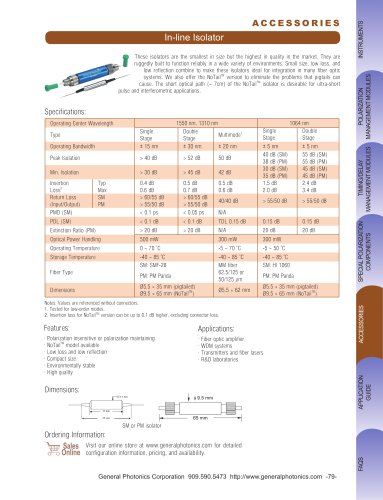 In Line Isolator, NoTail
1 Page
 Fiber Stretcher
1 Page




- Measuring machine
- Generator
- LED illumination
- Communication adapter
- Interferometer
- Polarimeter
- Programmable generator
- Optical coupler
- Optical polarimeter
- Fiber optic coupler
- USB light source
- Colored light source
- Polarization measuring system
- Optical isolator
- Delay generator
- Delay line
- White light interferometer
- High-speed polarimeter
- Polarization detector