
- Catalogs
- General Electric
- APM SAFETY


APM SAFETY
APM SAFETY
APM Safety aims to enhance industrial facility safety by assessing, managing, and proof testing instrumentation and equipment risk. It emphasizes the importance of compliance and safety alignment to prevent incidents and promote a strong safety culture within organizations.
The Need for Compliance & Safety Alignment
Industrial organizations must remain vigilant about potential incidents, as past safety does not guarantee future security. A strong safety culture is crucial, especially amidst industry changes like mergers, restructuring, and outsourcing, which can lead to inconsistent standards and reduced expertise. Compliance with international safety standards IEC 61508 and IEC 61511 is necessary to avoid increased safety-related events and insurance costs.
Holistic Safety Risk Management
Organizations require a centralized solution to assess, manage, and test safety risks, aligning with existing APM programs. This involves comprehensive risk assessments, Safety Instrumented Systems (SIS) management, digital proof testing technologies, and effective change management processes.
Key Modules for Industrial Organizations
APM Safety, part of GE Vernova’s suite, integrates tools to identify and mitigate process safety hazards, manage critical safety instrumentation, and support equipment and process changes.
- Hazard Analysis: Regular hazard analyses uncover potential dangers, document safeguards, and recommend process modifications. The Hazard and Operability (HAZOP) and "What-If" analyses help identify and mitigate equipment risks.
- SIS Management: Focuses on maintaining and managing the reliability of critical process instrumentation and safety systems, adhering to standards like ISA 84/IEC 61511 and IEC 61508. Key features include revision tracking, proof test templates, and integration with exida for safety equipment reliability.
- Management of Change (MOC): Systematic approach to managing changes, ensuring accountability and compliance with Process Safety Management (PSM) requirements.
SIS Lifecycle Phases
GE Vernova’s SIS encompasses three safety lifecycle phases:
- SIL Assessment: Utilizes methodologies like Risk Matrix, Process Hazard Analysis (PHA), and Layer of Protection Analysis (LOPA) to determine SIL requirements.
- SIL Verification: Determines the probabilistic failure rate of protective loops, leveraging exida’s SERH and custom devices for accurate calculations.
- SIL Validation: Integrates proof testing with strategy management tools, ensuring a "closed loop" approach.
Customer Value/Benefits
APM Safety offers benefits such as improved reliability, reduced maintenance costs, risk mitigation, and continuous improvement. It helps reveal hidden safety issues and optimize maintenance strategies.
Conclusion
APM Safety provides a comprehensive approach to managing industrial safety risks, ensuring compliance, and enhancing operational safety and efficiency.
Catalog excerpts

CONFINED SPACE ENTER 8Y PERMIT ONLY Improve industrial facility safety by assessing, managing, and proof testing instrumentation and equipment risk.
Open the catalog to page 1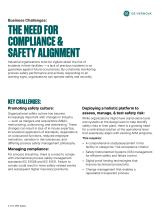
Business Challenges:THE NEED FOR COMPLIANCE &SAFETY ALIGNMENT Industrial organizations must be vigilant about the risk of incidents in their facilities — a lack of previous incidents is no guarantee against future occurrences. By constantly monitoring process safety performance and actively responding to all warning signs, organizations can operate safely and securely. Organizational safety culture has become increasingly important with changes in industry — such as mergers and acquisitions (M&A), restructuring, outsourcing, and downsizing. These changes can result in loss of in-house expertise,...
Open the catalog to page 2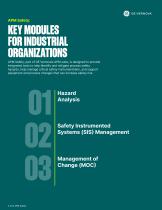
KEY MODULES FOR INDUSTRIAL ORGANIZATIONS APM Safety, part of GE Vernova’s APM suite, is designed to provide integrated tools to help identify and mitigate process safety hazards, help manage critical safety instrumentation, and support equipment and process changes that can increase safety risk. Hazard Analysis Safety Instrumented Systems (SIS) Management
Open the catalog to page 3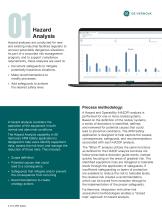
Hazard analyses are conducted for new and existing industrial facilities regularly to uncover potentially dangerous situations. As part of a corporate risk management program, and to support compliance requirements, these analyses are used to: • Document safeguards to mitigate potentially hazardous situations. • Make recommendations to modify processes. • Add safeguards to achieve the desired safety level. A hazard analysis considers the operation of the equipment in both normal and abnormal conditions. The Hazard Analysis capability in GE Vernova's APM Safety application is designed to help...
Open the catalog to page 4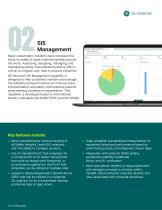
02 Major catastrophic incidents have increased the focus on safety in asset intensive facilities around the world. Assessing, designing, managing, and maintaining Safety Instrumented Systems (SIS) is critical to mitigate such risks in process industries. GE Vernova's SIS Management capability is designed to help customers maintain and manage the reliability and performance of critical process instrumentation and safety instrumented systems while meeting compliance requirements. This capability is developed based on international industry standards ISA 84/IEC 61511 and IEC 61508. Key features...
Open the catalog to page 5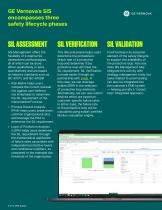
GE Vernova's SIS encompasses three safety lifecycle phases SIS Management offers the flexibility of 3 internal SIL Assessment methodologies, all of which can be done either qualitatively or semi quantitatively and are based on industry standards such as IEC-61511, and IEC-61508: • Risk Matrix helps users compare the current residual risk against user-defined risk thresholds to determine the SIL requirement of the Instrumented Function. • Process Hazard Analysis (PHA) helps users break down common organizational silos and leverage the PHA to determine the SIL requirement. • Layer of Protection...
Open the catalog to page 6
03 Management of Change Management of Change (MOC) follows a systematic approach to delivering change, taking into consideration aspects of operations that could be impacted because of that change. Using MOC, changes are undertaken as change projects. In the change project, changes are formally introduced, approved, and implemented as tasks. MOC, in the APM Safety application, is a flexible solution engineered to: • Create and manage change projects. • Communicate changes to team members. • Enforce an approval system to provide accountability for the change. When a change is being implemented,...
Open the catalog to page 7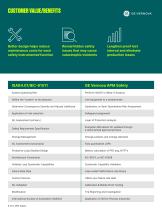
CUSTOMER VALUE/BENEFITS Better design helps reduce maintenance costs for each safety instrumented function Reveal hidden safety issues that may cause catastrophic incidents Lengthen proof test interval and eliminate production losses Assess Operating Risk Perform HAZOP or What-If Analysis Define the "system" to be analyzed Link equipment to a system/node Determine Consequence Severity and Hazard Likelihood Qualitative, or Semi-Quantitative Risk Assessment Application of risk reduction Safeguard assignment Layer of Protection Analysis Safety Requirement Specification Evergreen SRS allows for updates...
Open the catalog to page 8
EXPLORE THE BENEFITS OF APM • Improve reliability, availability, • Optimize maintenance costs and productmty • Mitigate risk • Maintain technical expertise• Deliver continuous improvement (industry and organizational © 2025 GE Vernova and/or its affiliates. All rights reserved. GE and the GE Monogram are trademarks of General Electric Company used under trademark license.
Open the catalog to page 9All General Electric catalogs and technical brochures
 RELIABILITY ANALYTICS
12 Pages
 M&D+SMARTSIGNAL
7 Pages
Archived catalogs
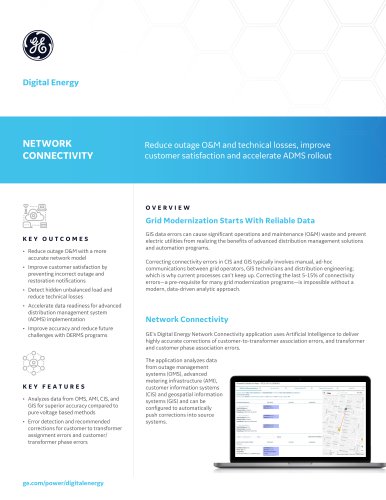 Grid
Grid2 Pages
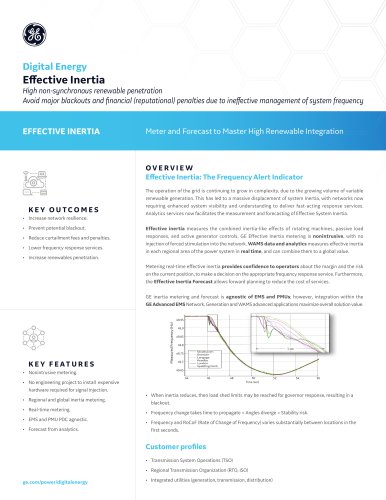 inertia
2 Pages
 iFix
iFix3 Pages
 cimplicity
3 Pages
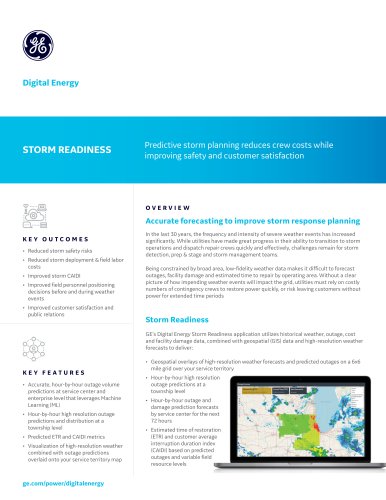 storm
storm2 Pages
- Automation software solution
- Management software solution
- Analysis software solution
- Process software
- Real-time software
- Computer-aided design software
- Cloud-based software
- Control software
- Design software solution
- Monitoring software solution
- Industrial software
- Measurement software
- Interface software
- Visualization software solution
- Quality software
- Simulation software solution
- Programming software
- Automated software
- Development software
- Network software