
- Catalogs
- GEA Wiegand
- Evaporation Technology 2009


Evaporation Technology 2009

Evaporation Technology 2009
GEA Wiegand GmbH operates a Research and Development Centre with laboratory and pilot plants for testing evaporation and distillation processes. The centre focuses on key physical characteristics like boiling point elevation and solubility. Mobile pilot plants can be deployed at customer sites, and data is analyzed using advanced computer programs. Over 3,000 product categories have been tested.
Evaporation plants are used for concentrating or separating liquid solutions, suspensions, and emulsions. GEA Wiegand has a long history of innovation in evaporation technology, developing various evaporator types to meet diverse requirements.
- Falling Film Evaporators: Use a vertical shell-and-tube heat exchanger, suitable for temperature-sensitive products.
- Forced Circulation Evaporators: Use a circulation pump to minimize fouling, ideal for high fouling liquids.
- Plate Evaporators: Compact and easy to maintain, suitable for low to medium evaporation rates.
- Circulation Evaporators: Used for products insensitive to high temperatures.
- Special Evaporator Types: Designed for specific applications like temperature-sensitive, non-aqueous solutions.
GEA Wiegand evaporation plants are used in industries such as chemical, pharmaceutical, food and beverage, and organic natural products.
Evaporation plants are designed for high energy efficiency, often using multiple-effect arrangements or vapour recompression. Design criteria focus on optimizing heat exchange surfaces and minimizing fouling.
GEA Wiegand provides comprehensive services from manufacture to after-sales, ensuring optimal performance and longevity of evaporation plants.
- Fluidized Bed Calandria: Suitable for high fouling liquids.
- Counterflow-Trickle Evaporators: Suitable for special cases requiring chemical reactions.
- Rising Film Evaporators: Ideal for high viscosity products with a tendency to foul.
- Spiral Tube Evaporators: For high concentration and viscosity applications.
- Stirrer Evaporators: Suitable for highly viscous products.
- Multiple-Effect Evaporation: Reduces energy consumption by using vapour from one effect as heating steam for the next.
- Thermal Vapour Recompression: Recompresses vapour to higher pressure for reuse.
- Mechanical Vapour Recompression: Recycles all vapour using electrical energy.
Emphasizes selecting appropriate components such as condensers, preheaters, and vacuum systems for optimal plant operation.
- Capacity and Operating Data: Includes quantities, concentrations, temperatures, and automation needs.
- Product Properties: Considers temperature sensitivity, viscosity, and flow properties.
- Utility Requirements: Involves steam, cooling water, electricity, and cleaning agents.
- Material Selection: Based on corrosion behavior and customer requirements.
- Cost Considerations: Includes capital and personnel costs.
- Site Conditions: Space availability, climate, and energy connections.
- Legislative Framework: Health and safety, environmental protection, and other regulations.
- Preheaters and Heaters: Used to preheat the product to boiling temperature.
- Evaporators: Selection depends on application and product properties.
- Separators: Separate vapors from liquids.
- Condensers: Condense residual vapors not used for heating.
- Deaeration/Vacuum Systems: Maintain vacuum and discharge gases.
- Pumps: Chosen based on product properties and flow conditions.
- Cleaning Systems: Use chemical cleaning to remove scaling and fouling.
- Vapour Scrubbers: Clean vapors before entering the heating chamber.
- Condensate Polishing Systems: Further purify condensate if needed.
- Manual Control: Operated by manually operated valves.
- Semi-automated Control: Uses hardware controllers for key parameters.
- PLC-based Control: Software controllers with data monitoring.
- Automated Control: PLC system for program sequences and self-monitoring.
- Process Control System: Suitable for multiple product and batch processes.
GEA Wiegand provides comprehensive services from manufacturing to after-sales support, with a manufacturing workshop located in Beckum, Westphalia.
- Evaporation Plants: For concentrating fluids and industrial waste water.
- Membrane Filtration: For processing fluid food and waste water.
- Distillation/Rectification Plants: For separating mixtures and recovering solvents.
- Alcohol Production Lines: For potable and dehydrated alcohol.
- Condensation Plants: For condensing vapors and steam/gas mixtures.
- Vacuum/Steam Jet Cooling Plants: For producing cold water and cooling liquids.
- Jet Pumps: For conveying and mixing gases, liquids, and solids.
- Steam Jet Vacuum Pumps: Used in various industries for vacuum applications.
- Heat Recovery Plants: Utilize residual heat from exhaust gases.
- Vacuum Degassing Plants: Remove dissolved gases from liquids.
- Heating and Cooling Plants: For operating reactors and driers.
- Gas Scrubbers: Clean and dedust exhaust air and separate aerosols.
Catalog excerpts

Evaporation Technology
Open the catalog to page 1
Evaporation Technology Evaporation plants are used as a thermal separation technology, for the concentration or separation of liquid solutions, velopment work spanning many decades, and the experience of A liquid concentrate that can still be pumped is generally the several thousand installed refer- desired final product. Evaporation may however also aim ences, GEA Wiegand continues to at separating the volatile constituents, or distillate, as would provide the broadest technical ex- be the case in a solvent separation system. During these pro- pertise and the respected ability cesses, it is...
Open the catalog to page 2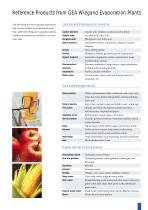
Reference Products from GEA Wiegand Evaporation Plants The following list shows groups of products Chemical and Pharmaceutical Industries that are successfully concentrated in more than 4.000 GEA Wiegand evaporation plants. Caustic solutions Caustic soda solution, caustic potash solution Additional products are detailed in our refe- Organic acids Ascorbic acid, citric acid rence lists. Inorganic acids Phosphoric acid, nitric acid Saline solutions Ammonium nitrate, ammonium sulphate, sodium sulphate Urea, diethyl amine Methanol, ethanol, glycerine, glycol, isopropanol Organic products Aromatic...
Open the catalog to page 3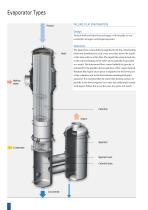
Evaporator Types FALLING FILM EVAPORATORS Design Vertical shell-and-tube heat exchanger, with laterally or concentrically arranged centrifugal separator. Operation The liquid to be concentrated is supplied to the top of the heating tubes and distributed in such a way as to flow down the inside of the tube walls as a thin film. The liquid film starts to boil due to the external heating of the tubes and is partially evaporated as a result. The downward flow, caused initially by gravity, is enhanced by the parallel, downward flow of the vapour formed. Residual film liquid and vapour is separated...
Open the catalog to page 4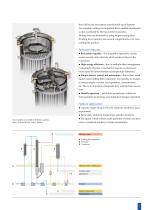
that will lead to incrustation and the build-up of deposits. For complete wetting it is important that a suitable distribution system is selected for the head of the evaporator. Wetting rates are increased by using longer heating tubes, dividing the evaporator into several compartments or by recirculating the product. Particular features Best product quality – due to gentle evaporation, mostly under vacuum, and extremely short residence times in the evaporator. High energy efficiency – due to multiple-effect arrangement or heating by thermal or mechanical vapour recompressor, based upon the lowest...
Open the catalog to page 5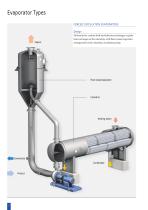
Evaporator Types FORCED CIRCULATION EVAPORATORS Design Horizontal or vertical shell-and-tube heat exchanger or plate heat exchanger as the calandria, with flash vessel/separator arranged above the calandria, circulation pump. Flash vessel/separator Heating steam Concentrate Condensate
Open the catalog to page 6
Operation The liquid is circulated through the calandria by means of a circulation pump, where it is superheated at an elevated pressure, higher than its normal boiling pressure. Upon entering the separator, the pressure in the liquid is rapidly reduced resulting in some of the liquid being flashed, or rapidly boiled off. Since liquid circulation is maintained, the flow velocity in the tubes and the liquid temperature can be controlled to suit the product requirements independently of the pre-selected temperature difference. Particular features Long operating periods – boiling/evaporation does...
Open the catalog to page 7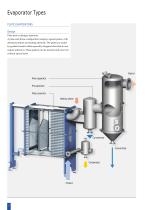
Evaporator Types PLATE EVAPORATORS Design Plate heat exchanger, separator. A plate-and-frame configuration employs special plates, with alternate product and heating channels. The plates are sealed by gaskets located within specially designed slots that do not require adhesives. These gaskets can be inserted and removed without special tools. Vapour Main separator Pre-separator Plate calandria Heating steam
Open the catalog to page 8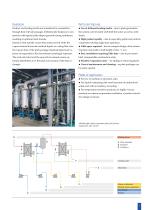
Particular features Product and heating media are transferred in counterflow Use of different heating media – due to plate geometries, through their relevant passages. Defined plate distances in con- the system can be heated with both hot water as well as with junction with special plate shapes generate strong turbulence, resulting in optimum heat transfer. High product quality – due to especially gentle and uniform Intensive heat transfer causes the product to boil while the evaporation during single-pass operation. vapour formed drives the residual liquid, as a rising film, into Little space...
Open the catalog to page 9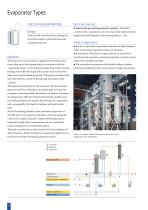
Evaporator Types CIRCULATION EVAPORATORS Particular features content of the evaporator is very low due to the relatively short Vertical shell-and-tube heat exchanger of length and small diameter of the heating tubes (1- 3 m). Quick start-up and large specific capacity – the liquid short tube length, with lateral separator arranged at the top. Fields of application For the evaporation of products insensitive to high temperatures, where large evaporation ratios are required. For products which have a high tendency to foul and for non-Newtonian products, where the apparent viscosity may be The liquid...
Open the catalog to page 10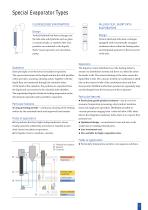
Special Evaporator Types FLUIDISIED BED EVAPORATORS FALLING FILM, SHORT PATH EVAPORATORS Design Vertical fluidised bed heat exchanger (on the tube side solid particles such as glass Vertical shell-and-tube heat exchanger or ceramic beads, or stainless steel wire equipped with concentrically arranged particles are entrained in the liquid), condenser tubes within the heating tubes flash/vessel separator and circulation and integrated separator in the lower part Operation Operation The liquid is evenly distributed over the heating tubes by Same principle as for the forced circulation evaporator....
Open the catalog to page 11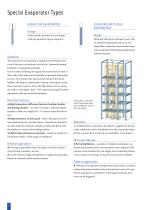
Special Evaporator Types RISING FILM EVAPORATORS COUNTERFLOW-TRICKLE EVAPORATORS Design Vertical shell-and-tube heat exchanger with top-mounted vapour separator. Shell-and-tube heat exchanger, lower part of calandria larger than that of e.g. the rising film evaporator, top-mounted separator equipped with integrated liquid distribution system. Operation The liquid to be concentrated is supplied to the bottom and rises to the top in accordance with to the “mammoth pump” principle, or rising film principle. Due to external heating, the liquid film starts to boil on the inside walls of the tubes...
Open the catalog to page 12All GEA Wiegand catalogs and technical brochures
 GEA POWDEREYE® 2025
4 Pages
 VARINLINE®
296 Pages
 GEA LYOPLUS™
6 Pages
 Wiegand Steam Jet Cooling Plants
16 Pages
 Jet Vacuum Systems
8 Pages
 Membrane Filtration
12 Pages
 Ethanol production
2 Pages
 perfect brewing solutions
6 Pages
 GEA Wiegand Company Brochure
24 Pages
 Bioethanol Technology
16 Pages
 Distillation Technology
16 Pages


Archived catalogs
 GEA Wiegand Services
4 Pages
 GEA in brewing
6 Pages
 GEA ProductGuide Brewing
24 Pages


- Industrial pump
- Pump with electric motor
- Stationary pump
- Seawater pump
- Compressor stage
- Stainless steel pump
- Air compressor
- Positive-displacement compressor
- Stationary compressor
- Dynamic agitator
- Suction pump
- Transfer pump
- Industrial compressor
- Chiller
- Electrically-powered compressor
- Grinding mill
- Reciprocating piston compressor
- Pressure gauge
- Drying system