
- Catalogs
- GEA Wiegand
- Distillation Technology


Distillation Technology

Distillation Technology
Distillation and rectification are essential processes for separating substances from liquid mixtures, widely applied in industries such as Chemical, Pharmaceutical, Food and Beverage, and Environmental Technology. A notable application is the production of bioethanol as an eco-friendly fuel.
GEA Wiegand's Research and Development Centre is equipped with laboratory and pilot plants for testing distillation and evaporation processes. The centre focuses on determining physical characteristics and modeling plant operations using advanced computer programs.
Distillation plants are utilized for producing alternative fuels like bioethanol, refining alcohols, and treating process water across various industries. They also contribute to solvent recovery and environmental technology.
Key components include columns, falling film reboilers, and forced circulation reboilers, designed for specific applications to ensure efficient energy use and adaptability to different operational conditions.
Investment decisions for distillation plants consider purchase price, performance, and operating costs. GEA Wiegand offers high-efficiency systems tailored to specific feed and product requirements.
GEA Wiegand provides comprehensive systems integrating upstream and downstream operations like fermentation, drying, and membrane filtration, ensuring efficient and reliable solutions.
Distillation plants are used for solvent recovery and recycling, reducing energy and waste disposal costs. They are designed for high performance and efficiency in various industrial applications.
GEA Wiegand offers complete engineering solutions, from basic to detailed packages, using advanced simulation programs for mass and energy balance calculations. Plants are equipped with control systems tailored to technical and customer requirements.
Manufacturing facilities are located in Beckum, with additional sites in South America and China. Plants are assembled on-site or as compact units. Experienced specialists handle commissioning and training, while after-sales service ensures optimal plant performance with maintenance and spare parts support.
Catalog excerpts
Distillation Technology GEA Wiegand GmbH 15007_brs_destillation_Umschl_en.indd 1 18.02.2009 13:54:11 Uhr
Open the catalog to page 1
Distillation Technology Research and Development The separation or extraction of individual substances from liquid mixtures has been practised for centuries, most notably for the production of alcohol. Distillation and rectification technologies are consequently applied as follows: Ongoing research and development combined with the experience of many installed refer- Distillation is the separation of the constituents of a liquid mixture ences enables GEA Wiegand to by partial vaporization and subsequent condensation, taking ad- provide wide-ranging technical vantage of differences in volatility....
Open the catalog to page 2
Applications for GEA Wiegand Distillation Plants The following list shows typical applications Alternative Fuels for GEA Wiegand distillation plants. New applications are investigated and ana- Production of bioethanol as a fuel additive lysed on an ongoing basis at our Research Dehydration of ethanol by means of molecular sieves and Development Centre. or entrainer distillation Refining of regeneration alcohol/entrainers from the dehydration process Refining of glycerine and methanol from biodiesel production Beverage Alcohol Complete plants and plant components for the production of raw alcohol...
Open the catalog to page 3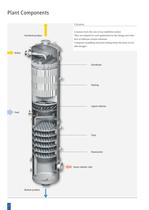
Plant Components Columns Columns form the core of any distillation plant. Overhead product They are adapted to each application by the design and selection of different column internals. Computer modelling and pilot testing forms the basis of reliable designs. Reflux Distributor Packing Liquid collector Feed Trays Downcomer Steam reboiler inlet Bottom product 4
Open the catalog to page 4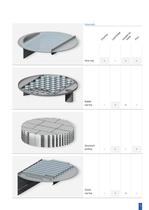
Pr ice + – + + Bubble cap tray – + o – Structured packing – + – + Tunnel cap tray – + o – Lo ad Sieve tray Cl ea nin g Su ita So ble lid fo s r Ra ng e Internals 5
Open the catalog to page 5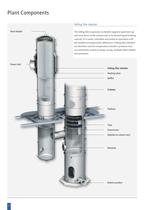
Plant Components Falling film reboiler Feed reboiler The falling film evaporator as reboiler supports rapid start-up and shut-down of the column due to its limited liquid holding capacity. It is easily controlled and suited to operation with the smallest of temperature differences. Falling film reboilers are therefore used for temperature-sensitive products and are particularly suited to energy saving, multiple-effect distillation processes. Steam inlet Falling film reboiler Heating tubes Baffles Column Platform Trays Downcomer Reboiler-to-column duct Manhole Bottom product 6
Open the catalog to page 6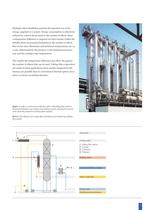
Multiple-effect distillation permits the repeated use of the energy supplied to a system. Energy consumption is effectively reduced by a factor about equal to the number of effects. Since a temperature difference is required for heat transfer within the reboiler, there are practical limitations to the number of effects that can be used. Maximum and minimum temperatures are, as a rule, determined by the product, or the heating steam pressure and the cooling water temperature. The smaller the temperature difference per effect, the greater the number of effects that can be used. Falling film evaporators...
Open the catalog to page 7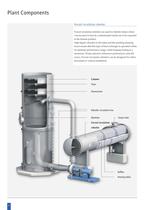
Plant Components Forced circulation reboiler Forced circulation reboilers are used for reboiler duties where viscous and/or heavily contaminated media are to be expected in the bottom product. High liquid velocities in the tubes and the resulting shearing forces ensure that this type of heat exchanger is operated within its optimum performance range, while keeping fouling to a minimum. Pump selection influences performance and efficiency. Forced circulation reboilers can be designed for either horizontal or vertical installation. Column Trays Downcomer Reboiler circulation line Manhole Steam...
Open the catalog to page 8
A single-effect ethanol distillation plant, shown during construction The arrangement shown above, is of a forced circulation re- process wastewater from a starch process. GEA Wiegand also boiler, mounted below the heads condenser and preheater. This provided the complete continuous fermentation plant. plant produces ethanol following the fermentation of the Specification of Distillation Plants units. GEA Wiegand thus offers fermentation lines, complemenThe key criteria to investment decision making includes the plant ting the core distillation process. The complete range of inno- purchase price,...
Open the catalog to page 9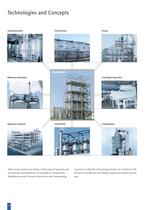
Technologies and Concepts Cleaning-in-place Fermentation Drying Distillation Molecular Adsorption Membrane Filtration Centrifugal Separation Evaporation Crystallization Tailor-made systems providing a wide range of upstream and experience within the GEA group provides our customers with downstream unit operations are available to complete the the best, most efficient and reliably engineered solution in each distillation system. Extensive know-how and long-standing case. 10
Open the catalog to page 10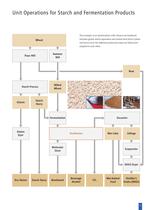
Unit Operations for Starch and Fermentation Products The example of an alcohol plant with wheat as its feedstock, includes gluten starch separation and animal feed dryer system and shows how the different production steps are linked and adapted to each other. Flour Mill Dry Gluten Starch Slurry Bioethanol Feed Grains (DDGS)
Open the catalog to page 11
Applications in the Chemical, Pharmaceutical and Food Industries Solvents and precipitants are frequently recovered from process The recovery of solvents and precipitants for their recycling and wastewaters, separated as high-purity substances or re- within a process is most efficiently achieved where the energy cycled. This is often of benefit to the environment and results requirement is very low, or where the energy can effectively be in reductions to energy, utility, feedstock and waste disposal re-employed in other applications. costs. Within this range of applications, the number of solvents...
Open the catalog to page 12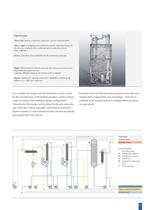
Opposite page: Above left: Solvent rectification system for a pectin extraction plant Above right: A stripping and rectification column, indirectly heated, for the recovery of solvents from a pharmaceutical production process Feed: 3,000 l/hr Below: Flow sheet of an installation for the treatment of miscella Right: Multi-purpose production plant for the recovery of various active ingredients from plant extracts Capacity: 490 kg/hr based on the recovery of 92 % ethanol Below: Example of a capacity increase for a distillation column by the addition of a 2-effect pre-evaporator For example, the...
Open the catalog to page 13All GEA Wiegand catalogs and technical brochures
 GEA POWDEREYE® 2025
4 Pages
 VARINLINE®
296 Pages
 GEA LYOPLUS™
6 Pages
 Evaporation Technology 2009
24 Pages
 Wiegand Steam Jet Cooling Plants
16 Pages
 Jet Vacuum Systems
8 Pages
 Membrane Filtration
12 Pages
 Ethanol production
2 Pages
 perfect brewing solutions
6 Pages
 GEA Wiegand Company Brochure
24 Pages
 Bioethanol Technology
16 Pages


Archived catalogs
 GEA Wiegand Services
4 Pages
 GEA in brewing
6 Pages
 GEA ProductGuide Brewing
24 Pages


- Industrial pump
- Pump with electric motor
- Stationary pump
- Seawater pump
- Compressor stage
- Stainless steel pump
- Air compressor
- Positive-displacement compressor
- Stationary compressor
- Dynamic agitator
- Suction pump
- Transfer pump
- Industrial compressor
- Chiller
- Electrically-powered compressor
- Reciprocating piston compressor
- Pressure gauge