
- Catalogs
- GEA Tuchenhagen
- Cleaning Technology

Cleaning Technology

Cleaning Technology
This catalog from GEA Breconcherry, a part of GEA Mechanical Equipment, details the cleaning technology solutions offered by the company. It highlights the necessity of verifying product suitability for specific applications, as specifications may change without notice.
The catalog includes detailed product selection tables and technical specifications for various cleaning technologies, such as orbital and rotating cleaners, static cleaners, and retractors. Each product is tailored for specific applications and industries, including brewing, dairy, pharmaceuticals, and chemicals.
- Orbital Cleaners: Utilize two rotating axes for intensive cleaning with targeted jets, are compact, easy to maintain, and driven by the cleaning medium.
- Rotating Jet Cleaners: Known for powerful cleaning with minimal drive pressure, using fluid transmission and various spray patterns.
- Static Cleaners (Spray Balls): Designed for flush cleaning with high flow rates, cost-effective with no wearing parts.
- Retractors: Include In-Line Sprayer and MR1/MR2 models with extendable spray heads for targeted cleaning, especially useful in tanks with moving fixtures.
GEA Breconcherry's cleaning solutions are applicable in industries such as brewing, dairy, pharmaceuticals, and chemicals, suitable for cleaning process vessels, storage tanks, silos, mixers, and more.
The catalog provides technical data on sealing materials, detailing their resistance to different chemicals and temperatures, and offers guidance on selecting appropriate sealing materials based on the medium conveyed.
GEA Breconcherry offers a range of accessories and engineering support, including digital tools and onsite cleaning tests, to ensure optimal performance and maintenance of their cleaning systems.
The document provides detailed specifications and operational guidelines for various GEA Breconcherry orbital and rotating cleaners, including models like Typhoon, Tempest, Tornado, TMC 45/85, Torrent, and Rotating Jet Cleaner Type 2E. These devices are designed for industrial cleaning applications, offering features such as self-cleaning, high spray dwell time, and compatibility with maintenance procedures.
- Typhoon: Recommended working pressure is 4-10 bar, with a cleaning diameter of up to 17 meters, operating at temperatures up to 95°C, made from stainless steel 316L, C-PTFE, or PTFE.
- Tempest: Similar to Typhoon, but with a larger cleaning diameter of 19 meters and a higher flow rate.
- Tornado: Offers a maximum cleaning diameter of 27 meters, suitable for high flow rates.
- Tornado 4: Features a cleaning diameter of 33 meters, designed for large, powerful jetting applications.
- TMC 45/85: These models offer variable volume flows and working pressures, with a maximum cleaning diameter of 12 meters for TMC 85.
- Torrent: Operates at lower pressures (1.5-3 bar) with a cleaning diameter of 11.6 meters.
- Rotating Jet Cleaner Type 2E: Designed for robust, low-maintenance operation with a maximum cleaning diameter of 10 meters.
- All models are designed for self-cleaning and high spray dwell time, ensuring efficient cleaning cycles.
- Materials used are primarily stainless steel and PTFE variants, ensuring durability and resistance to high temperatures.
- Preferred mounting positions are generally flexible, allowing for versatile installation options.
- Flow rates and cleaning diameters vary across models, with detailed charts provided for pressure versus flow rate and cleaning diameter.
- Cycle times are specified for different pressures, indicating the efficiency of each model under various operational conditions.
- Some models are suitable for use in potentially explosive atmospheres, enhancing their applicability in diverse industrial settings.
- Optional features include built-in sensors for monitoring and compatibility with tank safety systems.
The document outlines specifications for spray balls used in static cleaning systems. The recommended operating pressure at the inlet of the spray ball is between 1.0 to 2.5 bar g. The material used is primarily 316L stainless steel, with surface finishes varying from matt to electropolished, achieving an outside Ra of ≤ 0.5 µm.
Spray balls are designed for cleaning tanks with or without fixtures. The document provides detailed flow rates and spray angles for various types of spray balls, indicating their efficiency at different pressures. The flow rate can vary by 15-20% for electropolished spray balls compared to standard ones.
Threaded connections conform to DIN ISO 228-1, and pipe dimensions follow DIN 11850 series 2, DIN 11866 series B and C, and DIN EN ISO 1127 standards. The document also references ASME-BPE 2005 for external pipe dimensions.
For optimal performance, the document suggests specific operating pressures and provides a conversion formula for calculating other volume flow rates. It also highlights the importance of selecting appropriate seal materials and feedback systems for different applications.
The document includes tables detailing the flow rates, spray angles, and dimensions for various spray ball models. It also provides guidance on the installation and use of retractors and in-line sprayers, specifying the materials and configurations suitable for different cleaning scenarios.
Attention is drawn to the potential variance in flow rates for electropolished spray balls and the importance of adhering to recommended pressures for effective cleaning. The document also emphasizes the need for proper installation and maintenance to ensure process reliability.
Catalog excerpts

GEA Breconcherry Cleaning Technology Business Line Cleaning Technology Catalog 2014 engineering for a better world
Open the catalog to page 1
Publication date: 01 / 01 / 2014 The article numbers and technical specifications are up to date. The publication of specifications, technical data and information in written or electronic form does not release the user from the responsibility of checking for themselves all products delivered by us for suitability for the application(s) intended. These may be subject to change without prior notification. Mistakes and printing errors excepted – we assume no liability for the correctness of specifications given. The general terms and conditions of delivery apply. All rights reserved - copyright...
Open the catalog to page 2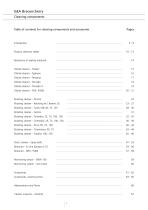
Cleaning components Table of contents for cleaning components and accessories Pages Resistance of sealing materials 14 Orbital cleaner - Twister 15 Orbital cleaner - Typhoon 16 Orbital cleaner - Tempest 17 Orbital cleaner - Tornado 18 Rotating cleaner - Torrent 22 Rotating cleaner - Sanitor 31 Monitoring system - Veri-Clean 60 Cleaner inquiries - checklist 67
Open the catalog to page 3
Business Unit GEA Flow Components Whether it's dairy, beer, viscous food-stuffs The GEA Group, with operations worldwide, is divided into or fine-chemical products – product six segments. One of these is GEA Mechanical Equipment, which consists of the three business units: GEA Flow Compoquality and profitability are what counts nents, GEA Homogenizers and GEA Mechanical Separation. in the end. This is precisely what the GEA Flow Components business unit stands The GEA Flow Components business unit for – it's a specialist with many years of As a technology leader, the GEA Flow Components business...
Open the catalog to page 5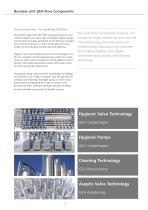
Business Unit GEA Flow Components Four business lines – for everything that flows The product range of the GEA Flow Components business unit includes hygienic and aseptic valve technology, hygienic pumps and cleaning technology, particularly for the brewing, beverages, dairy and food industries, as well as for the pharmaceutical, health care, biotechnology and ne chemicals industries. Hygienic valves and components from GEA Tuchenhagen form the core component of matrix-piped process plants. For aseptic processes, which require components with the highest levels of sterility, GEA Aseptomag produces...
Open the catalog to page 6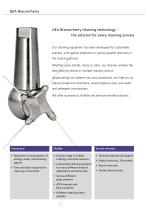
GEA Breconcherry cleaning technology – the solution for every cleaning process Our cleaning equipment has been developed for sustainable practice, with special emphasis on saving valuable resources in the cleaning process. Whether using orbital, rotary or static, our cleaners achieve the best cleaning results in multiple industry sectors. Incorporating our systems into your production can help you to reduce production downtime, waste disposal costs, and water and detergent consumption. We offer economical, flexible and service-oriented solutions: • Reduction in consumption of energy, water, and...
Open the catalog to page 7
Examples of applications and industries: Applications: • Process vessels • Storage tanks • Lauter tuns • Milk tanks • Spray dryers • Fermenters • Silos • Mixers • Batch blenders • Shipping containers • Tanker trucks • IBCs • Container wash tunnels • etc. Industries: • Brewing and beverage industries • Dairy and food industries • Cosmetics industry • Pharmaceuticals industry • Fine chemicals industry • Biotechnology industry • Chemicals industry • Paint industry • etc.
Open the catalog to page 8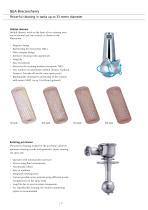
GEA Breconcherry Powerful cleaning in tanks up to 33 meter diameter Orbital cleaners Orbital cleaners work on the basis of two rotating axes, one horizontal and one vertical, as shown in the illustration. • • • • • • • • Hygienic design Ball bearing free (exception TMC) Slim, compact design Intensive cleaning with targeted jets Long life Easy-to-maintain Driven by the cleaning medium (exception TMC) Low number of components (orbital cleaners Typhoon, Tempest, Tornado all use the same spare parts) • Reproducible cleaning by monitoring of the rotation with sensor SMW 100 or Veri-Clean (optional)...
Open the catalog to page 9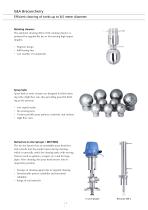
GEA Breconcherry Efficient cleaning of tanks up to 8.5 meter diameter Rotating cleaners The optimum cleaning effect of the rotating cleaners is produced by targeted flat jets or fast moving high impact droplets • Hygienic design • Ball bearing free • Low number of components Spray balls Spray balls as static cleaners are designed for flush cleaning with a high flow rate, thus providing powerful flushing at low pressure. • • • • Low capital outlay No wearing parts Various possible spray patterns, materials, and surfaces High flow rates Retractors In-Line Sprayer / MR1/MR2 The In-Line Sprayer has...
Open the catalog to page 10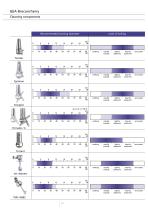
Cleaning components Recommended cleaning diameter wetting readily lightly heavily encrusted soluble adherent adherent wetting readily lightly heavily encrusted soluble adherent adherent wetting readily lightly heavily encrusted soluble adherent adherent wetting readily lightly heavily encrusted soluble adherent adherent wetting readily lightly heavily encrusted soluble adherent adherent wetting readily lightly heavily encrusted soluble adherent adherent wetting readily lightly heavily encrusted soluble adherent adherent
Open the catalog to page 11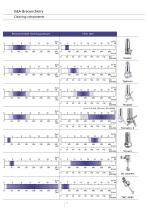
Cleaning components Recommended working pressure Flow rate
Open the catalog to page 12
Cleaning components Recommended cleaning diameter wetting readily lightly heavily encrusted soluble adherent adherent lightly heavily adherent adherent
Open the catalog to page 13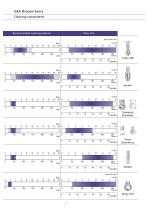
Cleaning components Recommended working pressure Flow rate Spray ball
Open the catalog to page 14
GEA Breconcherry Technical Data Resistance of sealing materials depending on type and temperature of the medium conveyed. General resistance comparsion of product wetted seals Resistance: A = good resistance B = reduced service live C = not resistant Sealing material general operating temperature Medium Caustics more than 5% Anorganic acids up to 3% ** Product with a fat content of max. 35% Product with a fat content more than 35% Other applications on request * = Depending on installation circumstances ** = Anorganic acids such as nitric or sulfid acid This overview of sealing material is based...
Open the catalog to page 15All GEA Tuchenhagen catalogs and technical brochures
 VESTA® Sterile Valves
8 Pages
 Catalog T-smart Butterfly Valves
94 Pages
 VARIVENT®
32 Pages
 Feedback Systems
36 Pages
 STERICOM®
12 Pages
 ECOVENT®
6 Pages
 VARIVENT®
28 Pages
 Catalog 2013
74 Pages
 General Information
15 Pages


Archived catalogs
 Zawory VARIVENT®
16 Pages
 VESTA® Multiport
16 Pages
 24/7 PMO Valve™
8 Pages
 VARIPURE Rotating Cleaner
12 Pages


