
- Catalogs
- GEA Breconcherry
- Ejector and Vacuum Systems Product


Ejector and Vacuum Systems Product
Ejector and Vacuum Systems Product
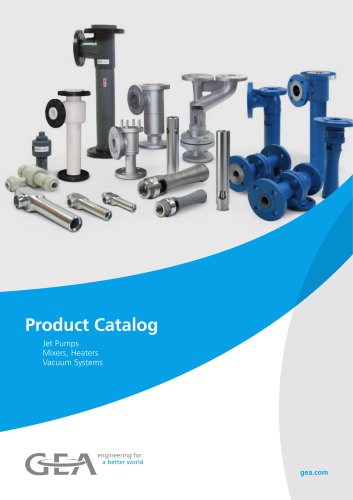
This document is a comprehensive product catalog for jet pumps, mixers, heaters, and vacuum systems. It includes detailed specifications, procedures, and standards for various types of jet pumps and related equipment.
Jet pumps, also known as ejectors, are devices used for conveying, compressing, or mixing gases, vapors, liquids, or solids. They operate by converting pressure energy into velocity using nozzles and consist of three main parts: the motive nozzle, diffuser, and head. The catalog follows DIN 24290 standards for naming jet pumps based on the motive and suction sides.
The catalog outlines two main delivery fields: standard apparatuses and custom-designed special apparatuses and plants. Standard apparatuses are selected for common tasks, while special apparatuses are designed with the help of specialists and modern research facilities.
Key considerations include ensuring correct connections, using appropriate pipe diameters, and maintaining favorable flow characteristics. Steam lines should be insulated, and lines should be cleaned before startup to prevent blockages.
The catalog provides an excerpt of materials used in jet pumps, including their EN, AISI/ASTM/UNS designations.
The catalog adheres to the International System of Units (SI) for measurements, with tables for converting between different units of pressure, energy, and capacity.
Includes tables for converting English-American units to SI units, temperature conversions between Celsius and Fahrenheit, and various pressure and temperature ranges for water vapor in vacuum and pressure conditions.
Detailed specifications are provided for various types of jet pumps, including liquid jet pumps, steam jet pumps, and gas/air jet pumps. Each section includes questionnaires for selecting the appropriate equipment based on specific requirements.
The catalog details multi-stage steam jet vacuum pumps, including those with mixing and surface condensers, and hybrid systems with liquid ring vacuum pumps.
This catalog serves as a detailed guide for selecting and installing jet pumps and related equipment, providing essential information on specifications, materials, and installation practices.
Negative pressure is defined as a condition where the absolute pressure is less than atmospheric pressure. It is used qualitatively, for example, in describing conditions in a suction line. The Latin-derived indices for pressure include 'abs' for absolute, 'amb' for ambient, and 'e' for exceed. The standard unit of pressure is the pascal (Pa), but the bar (1 bar = 105 Pa) is commonly used for practical calculations. The vacuum range refers to pressures below atmospheric pressure, where absolute pressure is always used.
The document provides extensive conversion tables for pressure, energy, capacity, length, area, volume, mass, density, and temperature between English-American units and the International System of Units (SI). For example, 1 Pa equals 1 N/m², and 1 bar equals 1000 mbar. Energy units include conversions such as 1 kJ equals 0.948 Btu. Temperature conversions are provided between Celsius and Fahrenheit.
The document includes detailed tables for water vapor pressure and temperature in both vacuum and pressure ranges. These tables provide values for pressure in mbar, temperature in °C, specific volume in m³/kg, enthalpy in kJ/kg, and enthalpy change (Δhv) in kJ/kg. For example, at a pressure of 0.001 mbar, the temperature is -76.19°C with a specific volume of 909000 m³/kg.
GEA Wiegand GmbH is located at Am Hardtwald 1, 76275 Ettlingen, Germany. They can be contacted via phone at +49 7243 705-0 or email at [email protected].
Liquid jet vacuum pumps are available in various sizes (0 to 8) with different construction materials such as steel, stainless steel, Hastelloy, Titanium, and plastics (PVC, PP, PVDF, PTFE). Standard constructions include steel housing with stainless steel motive nozzles or completely stainless steel designs. Special constructions are available upon request.
Each pump size has specific connections for operating water, suction, and pressure, with dimensions and weights varying accordingly. For example, size 0 has a weight of 0.9 kg, while size 3 weighs 3.1 kg.
These pumps are used for creating vacuums in laboratories, pilot, and production plants, including vacuum distillation and drying. They are also used for evacuating syphon lines, deaerating pressure vessels, and producing negative pressure in filters.
Performance charts provide data on mass suction flow in relation to suction pressure and operating water pressure. For example, a pump size 7 can handle a mass suction flow of 6.8 kg/h at a suction pressure of 100 mbar and a motive water pressure of 5 bar g.
Examples are provided to illustrate how to determine the appropriate pump size and motive water consumption based on specific parameters such as suction pressure and motive water pressure.
Each liquid jet gas compressor is specially designed for optimal efficiency under various operating conditions. The design considers factors like gas reaction with motive liquid and condensation.
Standard constructions include steel housing with stainless steel nozzles, while special constructions can be made from materials like Hastelloy and Titanium. Connections are made according to EN1092-1 standards.
A questionnaire is provided for inquiries, requiring details such as company information, motive medium, flow, pressure, and temperature.
This document provides technical specifications and operational details for liquid jet liquid pumps, which are used for conveying and mixing liquids in various applications such as water and wastewater treatment plants.
- Suction Side: Includes parameters like temperature, density, concentration, required discharge pressure, and mixed flow rate.
- Outlet: Specifies the concentration and flange standards (EN1092-1, ASME, etc.).
- Design Codes: Options include AD-2000, ASME, and others.
- Materials: Pumps are available in materials like stainless steel, PVC, PTFE, and others, depending on the application.
Liquid jet liquid pumps operate by using a motive liquid jet to suck in another liquid, mix the flows, and convey the mixed flow. The motive liquid has the highest pressure, while the suction flow has the lowest. The total conveying pressure must overcome geodetic height, pipeline resistance, and resistance from installed parts.
These pumps are used for diluting acids or lyes to specific concentrations required in water treatment plants. They are also used in ion exchangers for regeneration with acid or caustic solutions.
The performance of the pumps is determined by factors such as pressure ratio, specific liquid consumption, and density ratio. The document includes performance charts and examples to illustrate how to calculate the required motive liquid flow and pump size.
An example is provided where a suction flow of hydrochloric acid is diluted with water to achieve a specific concentration. The calculation involves determining the motive liquid flow and selecting the appropriate pump size.
The document includes detailed charts and diagrams showing the relationship between various parameters such as motive liquid flow, suction liquid flow, and effective motive liquid pressure.
Pumps are available in standard constructions with specified materials and dimensions. Special constructions are available for specific applications and materials not covered by standard designs.
For further inquiries, the document provides contact details for GEA Wiegand GmbH, including telephone, email, and website information.
The document provides detailed specifications for liquid jet pumps and mixers, including their construction, operation, and applications. It outlines the effective motive liquid pressure, suction and discharge pressures, and the necessary flow rates for different pump sizes. The document also includes performance charts and diagrams to assist in selecting the appropriate pump size and configuration.
Liquid jet solids pumps use a motive liquid, typically water, to convey flowable granulate materials. The motive liquid emerges at high velocity, entraining the material in the mixing chamber. The document describes the standard construction materials, such as PTFE and stainless steel, and provides dimensions and weights for various pump sizes.
These pumps are used in various industries to convey materials like sand, gravel, and activated carbon, and to fill and empty reactors in water treatment plants. Liquid jet mixers are used to mix and circulate liquids in vessels and storage tanks, with applications limited by the viscosity of the liquid.
The document specifies the maximum permissible discharge pressure and the required motive liquid flow for different applications. It highlights the importance of maintaining a constant flow and the need for rinse water in certain cases. The document also provides guidelines for selecting the appropriate circulation pump based on the effective motive liquid pressure and flow.
For optimal performance, jet mixers should be installed at the deepest point in a tank to ensure effective mixing. The document advises on the necessary mixing time and the criteria for evaluating the number of mixers required, such as tank geometry and liquid level.
The document includes tables and charts detailing the flow rates, dimensions, and weights of various pump sizes. It also provides performance charts for standard sizes, illustrating the relationship between liquid flow and effective liquid pressure.
- Materials: Options include stainless steel, PVC, PP, and PTFE, with special constructions available upon request.
- Connections: Flanges and threaded connections conform to ISO 228 and EN1092-1 standards.
- Dimensions and Weights: Detailed tables provide measurements and weights for various sizes and materials.
- Installation: Jet mixers are welded to supply pipes, ensuring no seals are necessary. The design facilitates easy cleaning and prevents residue formation.
- Operation: Liquid jet ventilators operate on the jet pump principle, using motive liquid to entrain and convey surrounding gases.
- Mixing in food processing, such as dissolving sugar and mixing syrups.
- Beer fermentation, where jet mixers maintain CO2 bubble columns to enhance fermentation efficiency.
- Ventilators are used for drawing off air, gases, or vapor with low pressure differences.
- Standard constructions are available in various materials, with special constructions available for specific needs.
- For inquiries and custom requirements, a detailed questionnaire is provided to gather necessary specifications.
- Tables provide detailed dimensions and weights for different materials and sizes of jet mixers and ventilators.
- Figures illustrate the operational principles and efficiency of liquid jet ventilators, including pressure and flow characteristics.
This document provides detailed technical specifications and operational guidelines for steam jet vacuum pumps and compressors, primarily used in industrial applications such as evacuation, lifting of liquids, and vacuum production.
The document outlines the specific steam consumption for single-stage steam jet vacuum pumps, detailing the suction pressure and flow rates. It includes diagrams (Fig. 1 and Fig. 2) illustrating the relationship between suction pressure and steam consumption.
Pre-evacuation is necessary when a plant needs to be evacuated quickly. A pre-evacuator or start-up jet pump is used alongside the main vacuum pump to achieve the desired vacuum level within a specified time. The document provides formulas to calculate the evacuation time and determine the need for a pre-evacuator.
Performance charts (Fig. 4 and Fig. 5) are provided to determine the specific motive steam consumption and the nominal diameter of pre-evacuators based on the required evacuation time and pressure levels.
The document explains the operation of steam jet pumps in producing vacuum and lifting liquids. It describes how vacuum is maintained and broken, affecting the lifting process.
Detailed specifications for steam jet vacuum pumps in metal and graphite constructions are provided, including dimensions, weights, and connection types. The document specifies standard and special constructions, with options for customization based on operating conditions.
The operational behavior of steam jet compressors is discussed, emphasizing the importance of matching construction to operating conditions for optimal efficiency. The document explains how changes in motive steam pressure and flow affect discharge pressure and suction flow.
Steam jet compressors are used in various industrial processes such as evaporation, distillation, cooling, and drying under vacuum. They are also used in heat pump applications for heating compressed exhaust vapors.
The document highlights the advantages of steam jet compressors, including handling large vapor volumes, low investment costs, long operational life, and high operational safety due to the absence of moving parts.
This document provides technical specifications and operational guidelines for steam jet liquid pumps and steam jet heaters, primarily used in industrial applications such as the nuclear industry and chemical processing.
Specifications: These pumps are constructed from resistant stainless steel and are designed to meet specific industry standards and tests. They are available in different classes (A and B) based on suction height and discharge pressure requirements.
Class A: Suitable for low suction heights up to 1 m and high discharge pressures. Example calculations are provided for determining pump size and steam consumption based on specific operational parameters.
Class B: Designed for larger suction heights and moderate discharge pressures. The document includes examples and diagrams to assist in selecting the appropriate pump size and steam pressure.
Construction: Standard constructions include various materials like steel and stainless steel, with special constructions available for specific applications, including the nuclear industry.
General Information: These heaters are used for heating liquids by direct steam injection, suitable for applications such as heating water for industrial processes.
Features: They offer low noise operation, simple construction, no moving parts, and high reliability. Heating capacity is adjustable.
Construction Forms: Available in different types for vessel installation or pipe systems, with materials including cast iron and stainless steel.
The document includes performance charts and diagrams illustrating the relationship between steam pressure, suction capacity, and temperature. It emphasizes the importance of considering liquid temperature and specific gravity, as these factors affect pump performance.
Detailed tables provide information on connections, dimensions, and weights for various pump sizes, along with standard and special construction options.
For inquiries, a questionnaire is provided to specify requirements such as motive pressure, suction medium, and construction materials. The document also outlines the application process for steam jet heaters, emphasizing the importance of direct steam condensation for efficient heating.
- Vertical installation is required with steam supply from top to bottom.
- The direction of liquid flow can be adjusted by replacing the condensation nozzle.
- A steam control valve should be installed directly on the steam connection.
- Components include housing, condensation nozzle, and diffuser.
- Key pressures: liquid inlet pressure (pF), steam pressure (pD), and discharge pressure (p).
- The flow rate and pressure loss determine the size of the steam jet heater.
- Temperature differences greater than 10°C between inlet and outlet reduce pressure loss, improving heat transfer.
- Steam consumption is calculated based on flow rate, density, specific heat capacities, temperature difference, and enthalpy of steam.
- For a circulating flow of 50 m³/h heated from 40°C to 80°C with steam at 3 bar, the required liquid inlet pressure is 0.7 bar g.
- Standard construction materials include cast iron, steel, and stainless steel, with special materials available on request.
- Flanges conform to EN1092-1 PN 16 standards.
- Used for evacuating pipelines, vessels, and plants, and for mixing and compressing gases.
- Operate by converting pressure energy into speed energy using gas or compressed air as the motive medium.
- Typical applications include evacuation of siphoning installations and elevation of liquids with gas/air.
- Gas jet compressors can mix natural gas with other gases for combustion in boiler plants.
- Available in materials such as cast iron, steel, stainless steel, and special materials like Titanium and Hastelloy.
- Used when steam is unavailable, providing a vacuum of 40 to 5 mbar.
- Operate using atmospheric air as the motive medium, backed by a liquid ring vacuum pump.
- Total Suction Flow: Approximately 1,050 kg from different pressure levels.
- 2-Stage Steam Jet Vacuum Pump: Suction capacity of 110 kg/h from 35 mbar.
- 3-Stage Steam Jet Vacuum Pump: Suction flow of 13,180 kg/h with a suction pressure of 4.5 kPa abs and discharge pressure of 110 kPa abs.
- Steam jet liquid ring vacuum pumps are suitable for installations with limited height, offering low steam and water consumption.
- Hybrid systems combine steam jet pumps with liquid ring vacuum pumps, reducing operating costs.
- Multi-stage pumps in graphite are used for extracting corrosive gases, especially where halogen compounds are present.
- Graphite is used for constructing surface condensers and jet pumps due to its resistance to corrosion and temperature changes.
- Standard constructions are available for various suction capacities and pressures, with modular units allowing for easy customization.
- Steam jet vacuum pumps are used in synthetic fiber production, distillation, steel degassing, deodorizing, and vacuum drying.
- Laboratory steam jet vacuum pumps are used in chemical laboratories and pilot plants, offering portability and quick connection to vacuum consumers.
- High vacuum capabilities down to 0.05 mbar.
- Re-cooling of operating liquid in liquid ring vacuum pumps.
- Use of surface condensers to prevent contact between process fluids and cooling water.
Catalog excerpts

Product Catalog Jet Pumps Mixers, Heaters Vacuum Systems
Open the catalog to page 1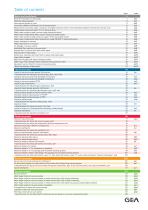
Page Index General information on jet pumps 7 abll Materials table (excerpt) 9 abll International System of Units 11 abl2 Conversion tables for different units of measurement 12 abl2 Measurement conversion table, conversion of english-american units in the International System of Units (SI) and vice versa 13 abl3 Temperature conversion table, °C in °F and vice versa 14 abl3 Water vapor pressure table, vacuum range (saturated steam) 15 abl5 Water vapor temperature table, vacuum range (saturated steam) 16 abl5 Water vapor pressure table, pressure range 1-70 bar (saturated steam) 17 abl6 Water vapor...
Open the catalog to page 3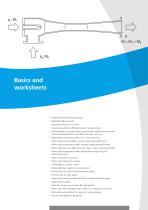
Basics and und Grundlagen worksheets Arbeitsblätter • General information on jet pumps • Materials table (excerpt) • International System of Units • Conversion tables for different units of measurement • Measurement conversion table, conversion of english-american units in the International System of Units (SI) and vice versa • Temperature conversion table, °C in °F and vice versa • Water vapor pressure table, vacuum range (saturated steam) • Water vapor temperature table, vacuum range (saturated steam) • Water vapor pressure table, pressure range 1-70 bar (saturated steam) • Water vapor temperature...
Open the catalog to page 5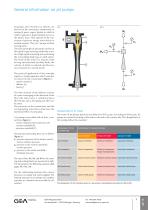
Jet pumps, also referred to as ejectors, are devices for the conveyance, compression or mixing of gases, vapors, liquids or solids in which a gaseous or liquid medium serves as the motive force. They operate by the conversion of pressure energy into velocity in suitable nozzles. They are “pumps without moving parts”. The basic principle of jet pumps consists in the liquid or gas jet being emitted by a nozzle at high speed entraining and accelerating the surrounding liquid, gas or solid matter. The result of this action is a mixture of the driving and entrained (sucked) fluids, the velocity of...
Open the catalog to page 7
The scope of delivery of the jet pumps department of GEA Wiegand is divided into two main fields. 1) DELIVERY OF STANDARD APPARATUSES This catalog gives a wide selection. The types and sizes are selected such that for usual tasks a suitable unit can always be found. Description and capacity curves and the corresponding sheets allow the correct choice. 2) DESIGN, CONSTRUCTION AND DELIVERY OF SPECIAL APPARATUSES AND PLANTS For this purpose our well-trained staff of specialists in jet pumps and vacuum systems is available. In our modern Research Laboratory, the required analyses, research work and...
Open the catalog to page 8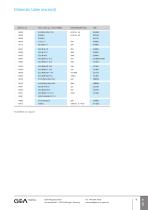
Material no. Short name acc. to EN 10088-2 AISI/ASTM/UNS-Type UNS Availability on request VB M engineering for m a better world Am Hardtwald 1, 76275 Ettlingen, Germany chemical©gea.com, gea.com
Open the catalog to page 9
10 wa Jft engineering for m a better world Am Hardtwald 1, 76275 Ettlingen, Germany chemical©gea.com, gea.com
Open the catalog to page 10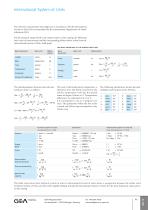
The units for measurement and weight are in accordance with the International System of Units (SI) recommended by the International Organisation of Standardisation (ISO). For the technical range which is the subject matter of this catalog, the following basic units of measurement and the corresponding abbreviations, taken from the International System of Units, shall apply. THE MOST IMPORTANT OF THE DERIVED UNITS ARE: The table Conversion from technical system of units to international system of units shows a comparison between the earlier used Technical System of Units and the newly, legally...
Open the catalog to page 11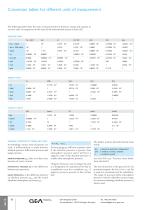
The following tables show the units of measurement for pressure, energy and capacity in use ever since in comparison to the units of the international system of units (SI). PRESSURE UNITS ENERGY UNITS CAPACITY UNITS PRESSURE, DEFINITION OF TERMS AND UNITS In technology, various units of pressure are used. A differentiation is made between absolute pressure, differential pressure and gauge pressure. absolute pressure pabs. takes as its basis zero pressure of a pure vacuum. differential pressure Ap is the difference between two pressures. gauge pressure pe is the difference between an absolute...
Open the catalog to page 12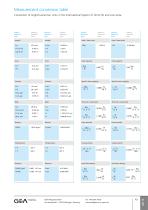
English- Internat. units units Internat. system of units Internat. system of units Internat. system of units Heat / heat units Heat / heat units 1 kJ 0.948 Btu Heat capacity Specific heat capacity Thermal conductivity Heat transfer Fouling factor Heat flux density J wa Jft engineering for m a better world Am Hardtwald 1, 76275 Ettlingen, Germany chemical©gea.com, gea.com
Open the catalog to page 13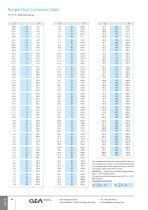
The temperature values to be converted are given in the coloured centre column. The corresponding values in °C are given left of the centre column, the values in °F are given right of the centre column. EXAMPLES: 1. Value to be converted (centre column) 20 °C = + 68 °F (right column) 2. Value to be converted (centre column) 20 °F = - 6.6 °C (left column) CONVERSION EQUATION: abl3 18 14 wa Jft engineering for m a better world Am Hardtwald 1, 76275 Ettlingen, Germany chemical©gea.com, gea.com
Open the catalog to page 14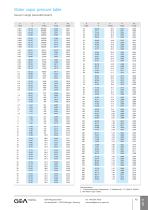
mbar °C m3/kg kJ/kg kJ/kg 1. "Thermodynamische Diagramme" Z. Kaltetechnik, 17. (1965) S. 299-301 2. VDI Water vapor tables VB M engineering for m a better world Am Hardtwald 1, 76275 Ettlingen, Germany chemical©gea.com, gea.com
Open the catalog to page 15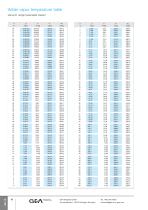
abl5 18 Water vapor temperature tableVacuum range (saturated steam) J 16 wa Jft engineering for m a better world Am Hardtwald 1, 76275 Ettlingen, Germany chemical©gea.com, gea.com
Open the catalog to page 16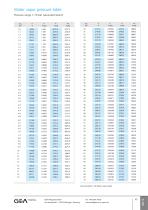
Documentation: VDI Water vapor tables VB M engineering for m a better world Am Hardtwald 1, 76275 Ettlingen, Germany [email protected], gea.com
Open the catalog to page 17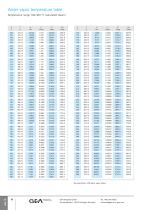
abl6 18 Water vapor temperature tableTemperature range 100-300 °C (saturated steam) J T p v" h" Ahv Documentation: VDI Water vapor tables 18 wa Jft engineering for m a better world Am Hardtwald 1, 76275 Ettlingen, Germany [email protected], gea.com
Open the catalog to page 18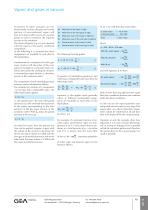
If mixtures of vapors and gases are condensed under vacuum, the gases and certain portions of non-condensed vapors will have to be drawn off by means of a vacuum pump in order to maintain the required vacuum in the condenser. The drawn-off gases (e.g. air) are saturated with the vapors of the partly condensed components. In the following it is assumed that these components are insoluble in each other in the liquid phase. Condensation of a component of such a gas-vapor mixture will take place if this component is brought to a saturated steam condition (dew point) by cooling the mixture. A saturated...
Open the catalog to page 19All GEA Breconcherry catalogs and technical brochures
 GEA Screw Compressors
12 Pages
 GEA BLU CHILLERS
9 Pages
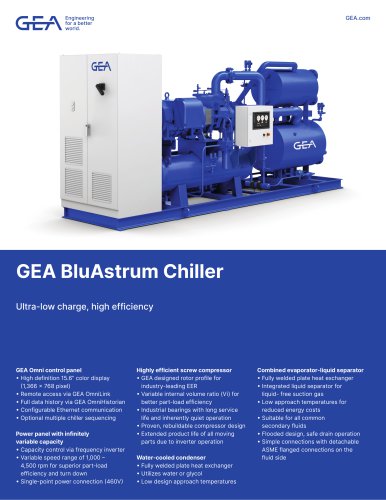 GEA BluAstrum Chiller
2 Pages
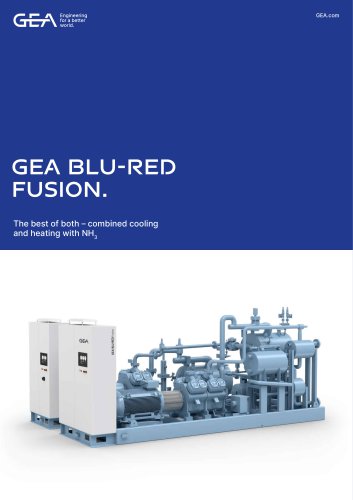 GEA BLU-RED FUSION
12 Pages
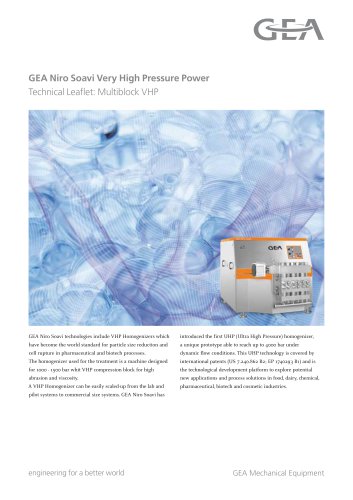 Multiblock VHP
4 Pages
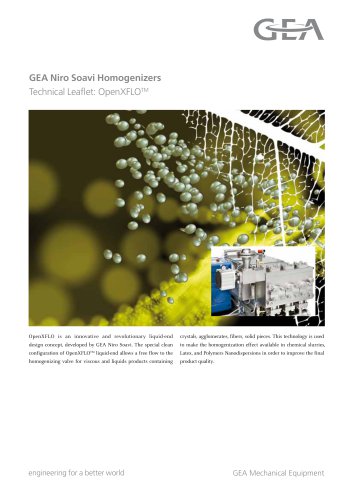 OpenXFLO
4 Pages
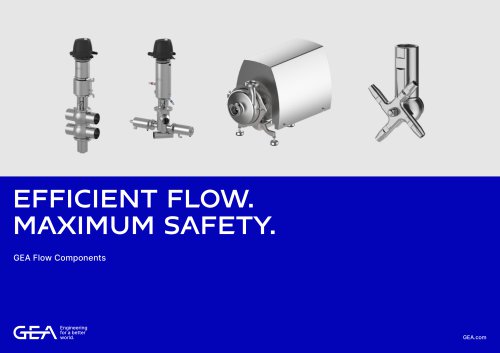 GEA Flow Components
36 Pages
 GEA CLEANING TECHNOLOGY
14 Pages
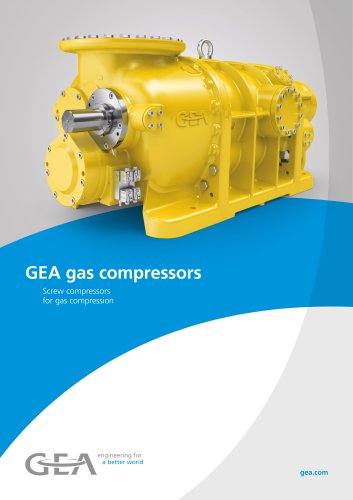 GEA gas compressors
12 Pages
 GEA company presentation
22 Pages
 GEA company brochure
20 Pages
 Cyclone leaflet
2 Pages
 Twister Leaflet
1 Page
 catalog 2013
74 Pages
 Troll Ball
2 Pages
 VARIPURE Orbital Cleaner
9 Pages
 Tornado 4
1 Page
 Turbo SSB 125
2 Pages
 Turbo SSB 75
2 Pages
 VARIPURE Rotating Cleaner
24 Pages
 Rotating Cleaner
16 Pages
 Accessories
7 Pages
 Turbo SSB 40
2 Pages
 Jumbo 6 Technical Data Sheet
2 Pages
 Tornado Technical Data Sheet
2 Pages
 Tempest Technical Data Sheet
2 Pages
 Typhoon Technical Data Sheet
2 Pages
 Sanitor Technical Data Sheet
2 Pages






- Proximity switch
- Cylindrical proximity sensor
- Mobile high-pressure cleaner
- Electric high-pressure cleaner
- PNP proximity sensor
- Hot water high-pressure cleaner
- Stainless steel high-pressure cleaner
- Capacitive proximity sensor
- Stationary high-pressure cleaner
- Clean-in-place unit
- Brewhouse System
- Compact proximity sensor
- Stainless steel Brewhouse System
- Sprayer
- Sterilization unit
- Electric sprayer
- Sterilization unit for the food industry
- Hydraulic high-pressure cleaner
- Clean-in-place unit for the pharmaceutical industry
- Water sprayer