
- Catalogs
- GE Vernova
- Powering the Future with Gas Power Systems gepower.com Offerings I 2018


- Products
- Catalogs
- News & Trends
- Exhibitions
Powering the Future with Gas Power Systems gepower.com Offerings I 2018

Powering the Future with Gas Power Systems gepower.com Offerings I 2018
The global demand for energy is rising due to economic and population growth, with the International Energy Agency projecting a two-thirds increase in electricity demand by 2040. Gas power is highlighted as a key solution due to its efficiency and lower emissions compared to coal and oil.
Natural gas is becoming the preferred choice for power generation due to its abundance, lower emissions, and cost-effectiveness. It is expected to become the leading fossil fuel for power generation by 2040, offering benefits such as flexibility, rapid deployment, and lower land and capital requirements.
GE offers a range of gas power systems tailored to different applications, including various power plant models like 9HA, 7HA, and LMS100, designed for efficient and reliable power generation across diverse environments.
Natural gas power plants produce significantly fewer emissions than coal plants, contributing to improved air quality and compliance with environmental regulations. The levelized cost of electricity (LCOE) for gas is competitive with other energy sources.
Challenges such as transportation and infrastructure development remain, with liquefied natural gas (LNG) presented as a solution for areas without pipeline access. Natural gas complements renewable energy sources, providing stability and flexibility to power grids.
Energy demand is shifting towards emerging markets, with China and India leading the growth, while Europe and the United States are expected to see slower demand growth due to energy efficiency improvements and demographic changes.
Natural gas is positioned as a critical component of the future energy mix, offering a cleaner, more flexible, and cost-effective alternative to traditional fossil fuels. GE's gas power systems are designed to meet the evolving needs of the global energy market.
Gas is the fastest-growing fossil fuel, with renewable energy capacity expected to double that of gas in the next decade. However, gas remains a primary power source due to its load factors, surpassing coal in new power generation capacity.
Significant growth in gas power generation is expected in North America, Asia, and Europe, emphasizing the need for greater efficiency in gas power systems, with H-class technology playing a crucial role.
Infrastructure constraints affect energy access, but natural gas-fired power plants offer reliability and increasing accessibility of LNG supplies. The environmental impact of traditional fuels is addressed through cogeneration and advanced cycle technologies.
Energy efficiency and policy play a crucial role in promoting decarbonization and reduced fossil fuel usage, with high-efficiency thermal power generation technologies offering economic and environmental benefits.
The synergy between renewable energy and natural gas is explored, emphasizing operational flexibility to balance grid reliability. Digital solutions enhance power plant efficiency and reduce emissions.
GE advances gas power systems through innovative technologies, with H-class turbines contributing to global power generation efficiency and reliability.
EDF Energy's power plant in Bouchain, France, achieved world-leading efficiency with GE's 9HA.01 turbine, demonstrating the potential of advanced gas turbine technology in reducing emissions and supporting grid stability.
Cogeneration involves generating electricity and capturing exhaust heat for additional uses, achieving up to 95% efficiency and reducing energy usage by up to 40%. It is favored for its flexibility and cost savings.
GE provides a wide range of gas turbines and engines for cogeneration, with over 10,000 units in operation, supporting various outputs and customer needs.
- TGK-16 in Russia: Upgraded its Kazan CHP-3 plant with a GE 9HA.01 gas turbine, increasing capacity and efficiency.
- Bio-PAPPEL in Mexico: Installed a 30 MW cogeneration plant to support paper production and sustainability goals.
- Hudson Yards in New York: Features a 13.2 MW cogeneration system for efficient power and water heating/cooling.
GE's gas turbines and engines are designed for fuel flexibility, allowing the use of various traditional and non-traditional fuels, enhancing energy stability and security.
GE's HES combines aeroderivative gas turbines with a bottoming cycle for efficient power generation, offering fast deployment and high efficiency.
With increasing global natural gas networks, gas power is becoming a preferred choice for its low cost and environmental benefits, supported by GE's efficient and flexible technology.
GE offers floating power solutions for regions with land constraints, providing mobile and efficient power generation options.
GE's hybrid systems combine multiple power sources and energy storage to optimize performance and integrate renewables effectively.
GE's comprehensive approach to power plant development focuses on efficiency, flexibility, and customer needs, ensuring reduced costs and improved reliability.
1. Topping Cycle: Involves the gas turbine and its systems.
2. Bottoming Cycle: Includes the steam turbine, heat recovery steam generator (HRSG), and heat rejection systems.
3. Electrical Conversion: Systems for power production and export to the grid.
4. Digital & Controls: Systems for protection, control, monitoring, and performance improvement.
GE collaborates with customers to create custom-engineered solutions tailored to specific business and operational needs, offering a global team for economic analysis and off-design performance support.
GE’s Energy Financial Services provides financing solutions, including equity investments and debt options like leasing, with configurations depending on customer-specific requirements.
GE offers equipment from basic to full turnkey solutions, ensuring comprehensive performance and operability guarantees, reducing risks and improving financing and insurance terms.
GE’s modular architecture for gas turbines reduces onsite work, enhances process efficiency, and minimizes risks, offering more room for maintenance and reducing installation time and cost.
GE’s Power Services team provides solutions for competitiveness and profitability, with digital solutions optimizing critical components for changing market conditions.
The 9HA gas turbine offers high efficiency and operational flexibility, while the 7HA gas turbine provides impressive performance with fast ramp-up times and fuel flexibility.
1. Aluminum Bahrain B.S.C. (Alba) Power Station 5: Utilizes H-class technology for efficient power generation.
2. Tambak Lorok Combined Cycle Power Plant Block 3: Provides efficient power generation for Java, Indonesia.
3. Porto de Sergipe Combined Cycle Power Plant: Located in Brazil, focuses on affordable and reliable power generation.
The Kelar power plant in Mejillones, Chile, is designed to achieve around 54% overall plant efficiency, aiming to replace coal-based power generation and reduce CO2 emissions by up to 1.5 million tonnes annually.
Located in Futtsu, Chiba, Japan, this project addresses electricity shortages post-2011 earthquake by upgrading six 9E.04 gas turbines to increase output and improve efficiency.
Known for reliability, the 7E gas turbines offer tri-fuel capability and are used in various applications, enhancing production capacity and steam output.
The LMS100 turbine offers high efficiency and rapid startup, ideal for areas with high renewable penetration, adding significant capacity.
Launched in 2017, the LM9000 turbine is derived from GE's aviation engines, offering fast start and high efficiency, suitable for peaking applications and retrofits.
- Performance: Offers superior performance with 32,000-hour inspection intervals, suitable for harsh environments.
- Applications: Ideal for combined cycle and CHP performance, with high exhaust energy for diverse CHP needs.
- Customer Case Studies: Includes projects like Jeju LNG Combined Cycle Power Plant in Korea and Huaneng Guilin Distributed Energy Project in China.
- Performance: Known for high reliability with over 37 million operating hours.
- Applications: Suitable for peaking to baseload operations, with applications in combined cycle, simple cycle, and cogeneration.
- Customer Case Studies: Highlights include the Glenarm Repowering Project in California and the Ubungo Power Plant Upgrade in Tanzania.
- Performance: Provides rugged and reliable power with the ability to ramp quickly and operate on non-standard fuels.
- Applications: Suitable for industrial power generation and cogeneration, with high steam pressure capabilities.
- Customer Case Studies: Includes the Gibraltar-San Roque Refinery Upgrade in Spain and the Old Harbour Combined Cycle Power Plant in Jamaica.
GE has been a pioneer in gas turbine technology, advancing materials, aerodynamics, and manufacturing to enhance performance and efficiency, with significant milestones achieved across various models.
GE's H-Class turbines have set records for efficiency, with the 9HA.01 model achieving a world record for the most efficient combined cycle power plant at EDF's Bouchain plant in France.
Since the introduction of the F-class turbines in 1987, over 1,500 units have been installed, known for their reliability and flexibility.
The 9F series, introduced in 1991, has sold over 440 units, achieving 18 million fired hours and 260,000 starts by 2018.
Introduced in 1978, the 9E series has over 660 units in service, with 30 million operating hours by 2018.
Since 1970, the 7E series has exceeded 1,100 orders and 800,000 starts.
From 2002 to 2018, the GT13E2 series increased output by 38 MW and efficiency by 1.6%, with over 165 units in operation.
GE's B- and E-class turbines have operated in harsh environments, with over 3,000 units achieving 140 million operating hours.
GE's aeroderivative turbines, derived from aviation engines, have surpassed 100 million operating hours.
GE's gas turbines have a proven track record of reliability and efficiency, with continuous innovation supporting its leadership in the power generation industry.
GE has been actively involved in the development and operation of advanced gas turbines, with significant milestones achieved between 2016 and 2018.
Several plants across the globe have commenced operations using GE's HA turbines, achieving significant operating hours and expansions.
GE's TM2500 mobile gas turbine units provide rapid power solutions, capable of being deployed in less than 11 days.
GE has developed a robust platform for fuel flexibility, allowing its turbines to operate on a wide range of fuels.
GE provides comprehensive solutions for fuel conditioning, ensuring optimal performance and compliance with environmental regulations.
GE offers a comprehensive portfolio of generators and Electrical Balance of Plant (EBoP) solutions, leveraging over a century of experience in high voltage solutions for power generation, transmission, and distribution.
GE's generators are categorized based on cooling methods: air-cooled, hydrogen-cooled, and water-cooled, designed for flexibility, efficiency, and high output.
GE employs advanced technologies for mechanical integrity, optimal thermal performance, and continuous monitoring to manage maintenance and reduce costs.
GE's EBoP solutions ensure efficient connection of power plants to the electrical grid, offering equipment and engineered packages for full EPC implementation.
GE's plant controls optimize performance and operability, integrating turbine and plant controls with real-time strategies.
GE's solutions offer benefits such as reduced maintenance costs, increased asset utilization, and enhanced network security.
GE's reciprocating engines, including Jenbacher and Waukesha models, are versatile and used in various applications such as urban grid support, industrial cogeneration, and emergency power supply.
GE's reciprocating engines are used by municipalities, hospitals, and universities to reduce energy costs and carbon footprints.
Jenbacher gas engines offer a power range up to 10 MW, while Waukesha engines provide up to 3,600 kW, designed for emissions compliance and flexible fuel operation.
GE offers comprehensive service options through a global network, ensuring less downtime and lower operating costs.
GE invests in product validation to ensure reliability and performance, with facilities worldwide supporting testing and validation of gas turbines, steam turbines, and components.
GE operates several test facilities for steam turbines, providing performance testing and validation for turbine components and systems.
Compression pressure ratios range from 18.0 to 24.7 across different models, with air cooling for generators and consistent ramp rates.
Simple Cycle (SC) net output ranges from 21.8 MW to 35.9 MW, with efficiency varying from 33.2% to 36.6%.
Combined Cycle (CC) net output ranges from 32.8 MW to 50.5 MW, with efficiency ranging from 49.1% to 52.9%.
All models use a two-pressure, non-reheat (2PNRH) bottoming cycle with consistent high-pressure throttle settings.
Models include LMS100, LM9000, and LM6000, with efficiencies ranging from 40.0% to 44.7%.
Gas turbines can operate on a variety of gaseous and liquid fuels, with specific configurations available for different fuel types.
Gas turbine ratings are based on specific conditions, and actual performance may vary.
Catalog excerpts

Powering the Future with Gas Power Systems
Open the catalog to page 1
Gas Power Systems I Table of Contents Contents Industry Overview . . . . . . . . . . . . . . . . . . . . . . . . . . . . . . . . . . . . . . . 4 GE’s Gas Power Systems . . . . . . . . . . . . . . . . . . . . . . . . . . . . . . . . 14 Solutions for Every Application . . . . . . . . . . . . . . . . . . . . . . . . . . 16 Power Plants . . . . . . . . . . . . . . . . . . . . . . . . . . . . . . . . . . . . . . . . . . . 24 GE’s Plant Approach . . . . . . . . . . . . . . . . . . . . . . . . . . . . . . . . . . 26 9HA Power Plants . . . . . . . . . . . . . . . . . . . . . . . . . . . . . . ....
Open the catalog to page 2
Gas Power Systems I Industry Overview Industry Overview Global Demand Gas: A Natural Choice for Power Generation Access to affordable, reliable energy is critical to sustaining and growing economies and is fundamental to quality of life in the modern world. According to the International Energy Agency (IEA), by 2020, the global economy’s gross domestic product (GDP) is expected to grow by 3.4 percent annually and the population will increase by about 400 million. In line with these economic and demographic forecasts, the IEA projects that total electricity demand will rise by two-thirds through...
Open the catalog to page 3
Gas Power Systems I industry Overview Powering the Future Abundant and Accessible A combustible, gaseous mixture of simple hydrocarbon compounds, natural gas is the product of thousands of years of decay of prehistoric plant and animal life . Buried deep underground, natural gas consists mostly of methane but also includes small amounts of other gases1 . According to the International Gas Union (IGU), natural gas reserves are geographically diverse and so substantial that the fuel could meet the world’s energy needs for the next 250 years . With such high supply, the price has decreased in several...
Open the catalog to page 4
Gas Power Systems I industry Overview Powering the Future Cleaner Burning Perhaps the biggest environmental benefit of natural gas is that it provides a cleaner alternative to coal and other fossil fuels . Burning natural gas produces 50 percent fewer carbon dioxide (CO2) emissions than coal and significantly less nitrogen oxide (NOx), sulfur oxide (SOx), and fine particulate matter (PM2.5). Fewer greenhouse gas emissions improves air quality, decreases costs, and helps facilities meet increasingly stringent environmental regulations . The Future of Gas Gas is the fastest growing of the fossil...
Open the catalog to page 5
Gas Power Systems I Industry Overview Market Considerations Forecast Demand for Gas Power Over the Next Decade INDIA CHINA SUB-SAHARAN AFRICA SUB-SAHARAN AFRICA LATIN AMERICA Energy Access Many areas face nature-related challenges and infrastructure constraints that act as significant barriers to increasing access to electricity. NORTH AMERICA Nature-Related Challenges MIDDLE EAST/ NORTH AFRICA NORTH AMERICA • uel and gas access F • rid and distribution considerations G • hased construction P LATIN AMERICA MIDDLE EAST/ NORTH AFRICA Natural gas-fired power plants offer a reliable power generating...
Open the catalog to page 6
Gas Power Systems I Industry Overview Energy Efficiency As countries develop, populations swell, new technologies emerge, and demand for energy increases. In the United States, the energy crisis of the 1970s prompted a shift in focus from consumption to efficiency. For governments and individuals, embracing improved total grid efficiency means better economies, better health, a cost-effective way to fight climate change, and reduced energy costs. Industries, utilities, and cogeneration plants however, bear the burden of selecting and implementing the equipment to make that possible. For utilities...
Open the catalog to page 7
Gas Power Systems I GE’s Gas Power Systems GE’s Gas Power Systems Tough challenges need to be met with smart solutions. For 125 years, GE has been delivering innovative products and services that create significant value for power generation customers. Advancing an industry is no easy feat; it takes commitment, knowledge, and above all, an intimate understanding of what customers want and need. GE Gas Power Systems has it all and we are excited to put our global team to work for you. Our focus spans three keys areas. First, we give our customers the capability to meet, and possibly even exceed,...
Open the catalog to page 8
Gas Power Systems I Solutions for Every Application Solutions for Every Application From simple cycle and combined cycle power generation to cogeneration, mechanical drive, gas compression and waste-to-power, GE has the experience, gas turbines, and gas engines to serve your needs. Individual operating schemes are vast and varied, and GE is committed to providing a flexible portfolio of products to support a full spectrum of operating needs. GE’s portfolio of power generation and gas compression products provides a sense of certainty in an uncertain world, delivering the operational flexibility...
Open the catalog to page 9
Gas Power Systems I Solutions for Every Application Fuel Flexible Also known as combined heat and power (CHP), cogeneration is a highly efficient process that generates electricity and heat simultaneously. A gas turbine or gas engine generates electricity while exhaust heat is captured and recycled to generate hot water, steam, or cold water for other uses like heating or cooling. Cogeneration plants can reach up to 95 percent efficiency; their dual use can decrease energy usage by up to 40 percent. A growing global population, constrained fuel sources, and increasing environmental focus is...
Open the catalog to page 10
Gas Power Systems I Solutions for Every Application Small and Intermediate Scale Power An expanding global natural gas network is creating new opportunities that are driving up demand across industries. By 2025, gas consumption is projected to increase by 33 percent (led by the power sector). Low cost, flexible operating characteristics, and environmental advantages position gas as the fuel of choice for power generation. Gas power is fast and affordable, and it’s enabling growth in developing countries. By 2025, 60 percent of global electricity consumption will occur in emerging markets, up...
Open the catalog to page 11All GE Vernova catalogs and technical brochures
 LM6000
1 Page
 STEAM POWER SERVICES CATALOG
94 Pages
 NUCLEAR POWER PRODUCT CATALOG
28 Pages
 STEAM POWER PRODUCT CATALOG
61 Pages
 2018 POWER SERVICES CATALOG
111 Pages
 7E POWER PLANTS
1 Page
 LMS100®
7 Pages
 LMS100 POWER PLANTS
1 Page
 LM2500 POWER PLANTS
1 Page
 LM6000 POWER PLANTS
1 Page
 6B POWER PLANTS
2 Pages
 9E & GT13E2 POWER PLANTS
2 Pages
 6F POWER PLANTS
2 Pages
 9F.04, 9F.05, 9F.06
2 Pages
 1483_1112.indd
1 Page
 1212_1012
12 Pages
 Powering the world 2016
72 Pages
 raising the bar
8 Pages
 Waukesha* gas engines
12 Pages
 6 F. 01 Gas Turbine
4 Pages
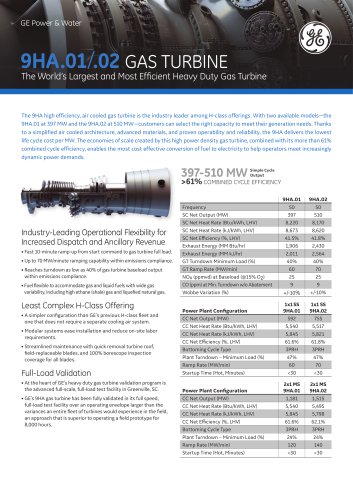 9HA.01 / .02 GAS TURBINE
2 Pages
 Dresser? Turbine Meters
8 Pages
 HSR line
6 Pages
 CNG In A Box? system
16 Pages
 Becker? T-Ball? Anti-Surge Valve
12 Pages
 Becker V0 Control Valves
12 Pages
 Ajax? E-565 Gas Engine
2 Pages
 7E.03 HDGT
15 Pages
 Baghouse Accessories
12 Pages
 Fabric Filter Bags & Cages
2 Pages
 GE10 15 ppm combustor
3 Pages
 GE10-1 Gas Turbine
8 Pages


Archived catalogs
 GE10-2 15 ppm combustor
3 Pages
 Heavy Duty Gas Turbine Products
24 Pages
 Gas Turbines Catalog
31 Pages
 GE10 Gas Turbine
6 Pages
 Frame 6 Gas Turbine
3 Pages
 Product Structuring
5 Pages
 7HA.01 / .02 GAS TURBINE
2 Pages
 18900_5_15
8 Pages
 69663_aftermkt_bro
4 Pages
 66535_reman_bro_redo_FINAL
6 Pages
 Reciprocating Engines
2 Pages
 7F POWER PLANTS
2 Pages
 7HA gas turbine
4 Pages
 9HA Gas turbine
4 Pages
- Liquid/liquid heat exchanger
- Tubular heat exchanger
- Stainless steel heat exchanger
- Three-phase alternator
- GE Vernova power generation turbine
- Condenser
- Water/water heat exchanger
- Cooled condenser
- GE Vernova combined-cycle turbine
- Industrial steam generator
- Vertical steam generator
- Steel condenser
- Gas steam generator
- Single-shaft turbine
- Horizontal steam generator