


- Company
- Products
- Catalogs
- News & Trends
- Exhibitions
Preventive Maintenance Manual

Preventive Maintenance Manual
Catalog excerpts

GATES INDUSTRIAL POWER TRANSMISSION PREVENTIVE MAINTENANCE + SAFETY
Open the catalog to page 1
“CONTINUALLY PUSH THE BOUNDARIES OF MATERIALS SCIENCE TO ADVANCE THE WAY THE WORLD MOVES.
Open the catalog to page 2
GATES INDUSTRIAL POWER TRANSMISSION PREVENTIVE MAINTENANCE + SAFETY GATES. DRIVEN BY POSSIBILITY. If it runs, we can help it run better. Gates is a global leader in power transmission and fluid power products and services. We serve customers across industries, bringing relentless innovation, and uncompromising quality to every product we make. Our reputation is built on over a century of experience, but everything we do is geared towards powering the future. WHERE OTHERS SEE THE UNKNOWN, WE SEE POSSIBILITY. In 1917, John Gates revolutionised industrial machinery with the world’s first rubber...
Open the catalog to page 3
1. WHY YOU SHOULD USE THIS PREVENTIVE MAINTENANCE MANUAL
Open the catalog to page 5
WHY PREVENTIVE MAINTENANCE? COMPONENTS OF A GOOD MAINTENANCE PROGRAMME When properly maintained and used under normal conditions, a well-designed industrial belt drive is capable of operating for several years. The potential for long service life is built into every Gates belt. Gates synchronous belts and premium V-belts like Quad-Power® 4 & Predator® are Service-Free. Standard V-belts require a regular maintenance programme for a long period of trouble free operation. Preventive maintenance helps you to avoid expensive failures and ensures optimum belt drive performance, maximising productivity...
Open the catalog to page 6
WHY PREVENTIVE MAINTENANCE? SOURCES OF DRIVE PROBLEMS When compared to chain drives (with constant lubrication problems), or gear drives (with mechanical problems and high costs), belt drives are the most cost-effective and reliable means of power transmission. This reliability can however only be obtained when belts and drives are properly maintained. The main reason for belt drive problems is improper maintenance: Improper maintenance No retensioning Not replacing worn pulleys Not cleaning guards Not checking for weak drive structure and components. Not checking alignment Poor drive design...
Open the catalog to page 7
2. HOW TO MAINTAIN A SAFE WORKING ENVIRONMENT
Open the catalog to page 8
SAFETY POLICY SAFETY FIRST Warning! Be Safe! Gates belt drive systems are very reliable when used safely and within Gates application recommendations. However, there are specific USES THAT MUST BE AVOIDED due to the risk of serious injury or death. These prohibited misuses include: PRIMARY IN-FLIGHT AIRCRAFT SYSTEMS Do not use Gates belts, pulleys or sprockets on aircraft, propeller or rotor drive systems or in-flight accessory drives. Gates belt drive systems are not intended for aircraft use. LIFT SYSTEMS Do not use Gates belts, pulleys or sprockets in applications that depend solely upon the...
Open the catalog to page 9
A SAFE WORKING ENVIRONMENT ENSURE SAFETY DURING BELT DRIVE INSPECTION AND MAINTENANCE It is common sense to establish a safe working environment in and around your belt drives. Besides making maintenance easier, the following precautions will ensure safety for the operator: 1. TRAINED PERSONNEL Always have trained personnel working on your belt drives. 2. ALWAYS TURN EQUIPMENT OFF 5. MAINTAIN SAFE ACCESS TO THE DRIVES Maintain a safe access to the drives. Floors should be clean and free of oil and debris to ensure good footing and balance of the operator whilst working on the machine. Turn off...
Open the catalog to page 10
A SAFE WORKING ENVIRONMENT ENSURE SAFETY DURING BELT DRIVE INSPECTION AND MAINTENANCE A properly designed guard has following features: it completely encloses the drive; t is equipped with grills or vents for good ventilation; i he size of the openings must be adequate, i.e. small enough to prevent “pinch points”; t t is preferably equipped with an automatic shut-off device which deactivates the drive as soon as the guard is i removed; t has accessible inspection doors or panels; i t can easily be removed and replaced if damaged; i here necessary, it should protect the drive from weather, debris...
Open the catalog to page 11
3. HOW TO PROPERLY INSTALL A BELT DRIVE
Open the catalog to page 12
BELT IDENTIFICATION HOW TO SELECT THE APPROPRIATE BELT TYPE Correct installation is crucial to ensure optimum performance and life span of your belt drives, and this can only be obtained when the belts drives are correctly designed and installed. The information on the following pages will help you become familiar with the belt types used in industry. V-BELTS Narrow section High power capacity V belt used to substantially reduce drive costs and minimize space requirements. Capable across the complete range of drive Kilowatt ratings, with fewer belts required compared to Classical section. Belt...
Open the catalog to page 13
BELT IDENTIFICATION HOW TO SELECT THE APPROPRIATE BELT TYPE PolyFlex® JB™ belts Polyflex® is a unique belt with a distinctive 60° belt angle and ribbed top specifically designed for long life in small diameter sheave drives. Polyflex® JB™ is ideal for compact drives, drives with high speed ratios, and drives requiring especially smooth operation. The “JB” refers to the belt’s configuration: two, three or more belts joined together to provide extra stability and improved performance. This joined belt style should be used instead of matched single belts whenever possible. Polyflex® JB™ belts are...
Open the catalog to page 14
BELT IDENTIFICATION HOW TO SELECT THE APPROPRIATE BELT TYPE POLYURETHANE BELTS STATIC CONDUCTIVE BELTS Gates’ standard Synchro-Power® product range covers a multitude of applications. If your process requires a belt design that meets very specific application needs, Gates offers you a variety of customised polyurethane belt products next to the standard belt range. These polyurethane belt products, tailor-made to fulfil your most challenging requirements, meet the same quality levels as their standard counterparts. Our applications engineers can work with you to design any belt catering to your...
Open the catalog to page 15
DISCOVER THE ENTIRE PRODUCT RANGE IN THE GATES INDUSTRIAL POWER TRANSMISSION CATALOGUE (E2/20211)
Open the catalog to page 16
BELT IDENTIFICATION V-BELTS | BELT SECTIONS & NOMINAL DIMENSIONS Wrapped, narrow section/classical section V-belt Wrapped, classical section V-belt EPDM, raw edge, moulded notch, narrow section V-belt WIDTH mm DELTA CLASSIC™ Wrapped, classical section V-belt WIDTH mm Raw edge, moulded notch, narrow section V-belt DELTA NARROW™ Wrapped, narrow section V-belt WIDTH mm Wrapped, narrow section V-belt PREDATOR® POWERBAND® Wrapped, narrow section multiple V-belt WIDTH mm EPDM, raw edge, moulded notch, classical V-belt WIDTH mm
Open the catalog to page 17All Gates catalogs and technical brochures
 Industrial hose catalogue
92 Pages
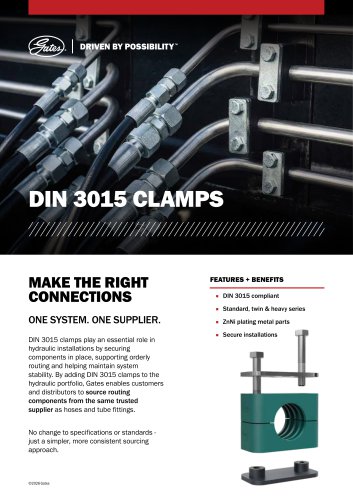 TUBE CLAMPS
2 Pages
 TUBE CLAMPS
39 Pages
 MEGACRIMP™ COUPLINGS
5 Pages
 GATES QUICK-LOK™
24 Pages
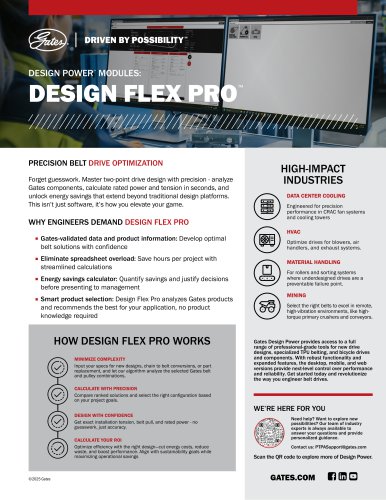 DESIGN FLEX PRO™
1 Page
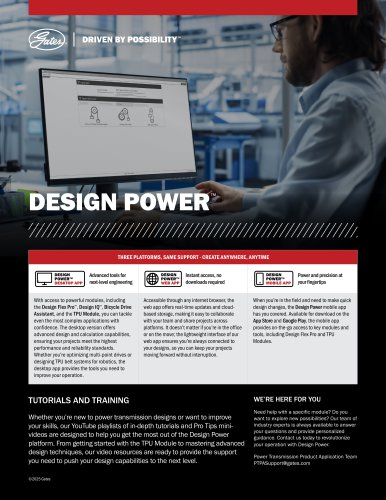 DESIGN POWER
2 Pages
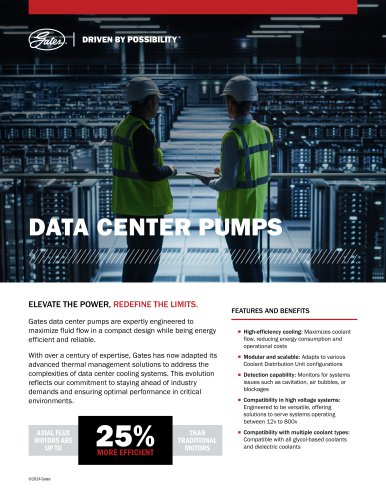 DATA CENTER PUMPS
2 Pages
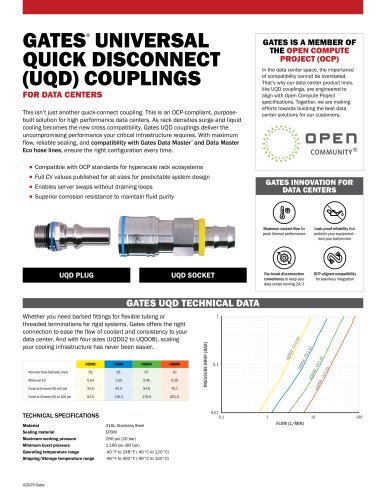
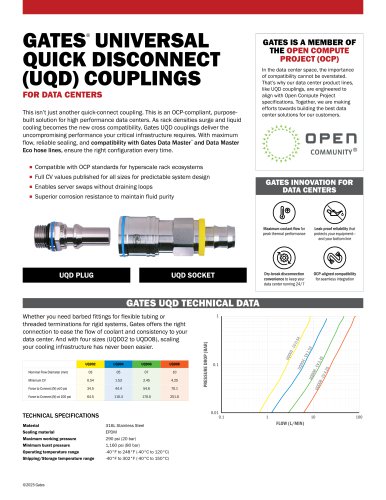
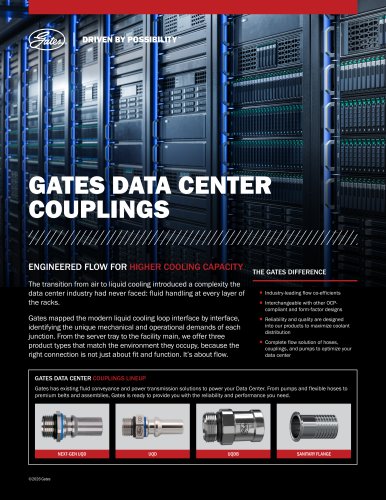 GATES DATA CENTER COUPLINGS
4 Pages
 ProV Hose Sell sheet
2 Pages
 ProSeries IA3K Sell sheet
2 Pages
 MegaSys Sell sheet
2 Pages
 eCrimp APP Flyer
1 Page
 DSO Cutting ring Sell Sheet
3 Pages
 Hydraulic Tube Fittings Brochure
16 Pages
 Machinery Brochure
20 Pages
 Crimper checklist
2 Pages
 MXG 5K Sell sheet
2 Pages
 MXG 4K Sell sheet
2 Pages
 MXT Sell sheet
2 Pages
 M2T Sell sheet
2 Pages
 Tri Power Sell sheet
2 Pages
 GPP Belts Brochure
8 Pages
 AT 1 Laser alignment
2 Pages
 Texrope Catalogue
24 Pages
 Super HC Brochure
22 Pages
 Super HC Sell sheet
2 Pages
 Quad Power 4 Sell sheet
2 Pages
 Quad Power 4 Promo sheet
1 Page
 PowerGrip GT4 Sell Sheet
2 Pages
 Mini Poly Chain Sell sheet
2 Pages
 Design Power
2 Pages
 Chain to belt Promo Sheet
2 Pages
 Chain to belt Sell Sheet
2 Pages
 Boost Sell Sheet
2 Pages
 Boost Catalogue
88 Pages
 Predator sell sheet
2 Pages
 Sonic tension meter 550C
2 Pages
 PRO Series CR1 & CR2
2 Pages
 PRO series
2 Pages
 Coolrunner Belts
2 Pages
 Micro-V Water Pumps
2 Pages
 Electric Water Pumps
2 Pages
 Chain-to-Belt Solutions
2 Pages
 Hydraulic Tube Fittings Catalogue
216 Pages





- Pump
- Industrial pump
- Pump with electric motor
- Stationary pump
- Seawater pump
- Centrifugal pump
- GATES piping
- GATES fitting
- Chemical pump
- GATES hydraulic fitting
- Screw-in fitting
- Metal fitting
- GATES plastic hose
- Compact pump
- Quick coupling
- Stainless fitting
- GATES structure hose
- Impeller pump
- GATES flexible hose
- Elbow fitting