


Oilfield Products Catalog

Oilfield Products Catalog
1. Connections: Use a standard hammer union connection on the swivel gooseneck. A 180-degree gooseneck is recommended for vertical standpipes, and a 160-degree gooseneck for sloped standpipes.
2. Vibration and Pulsation: Install surge chambers or pulsation dampeners in mud pump discharge lines. Precharge pressure should be 10% of the maximum design rated pressure.
3. Operating Limits: Personnel should be aware of the highest and lowest drilling positions and the design limits of the hose.
4. Clearance: Ensure adequate clearance between the hose and derrick or mast.
5. Off-Shore Rigs: Ensure hose alignment between barges or rigs and use swivel joints at both ends to prevent excessive flexing.
1. Oil Base Muds: Limit aromatic content to prevent hose liner swelling. Maintain a minimum aniline point of 150°F (66°C).
2. Twisting: Avoid twisting hoses by using a swivel on the gooseneck end.
3. Safety Clamps: Install safety clamps on hoses 8’ or longer, marked with "Attach Safety Clamp Here".
4. Working Temperature: Do not exceed the hose's rated temperature.
5. After Coolers: Use after coolers with compressors to maintain air or gas temperatures within limits.
6. Working Pressure: Refer to Table 1 for maximum working pressures for different hose sizes.
1. Inspect and test hoses subjected to abnormal abuse immediately.
2. Follow specific steps for field testing, including checking safety clamps, avoiding twisting, and conducting visual inspections.
1. Warranty: Gates hoses are warranted to be free from defects for 24 months from delivery.
2. Annual Revalidation: Conduct risk assessments and establish an Inspection, Maintenance, and Revalidation (IMR) program.
1. Handling: Avoid crushing or kinking hoses. Use lift eye clamps for moving hoses.
2. Storage: Drain hoses before storage, store in original crates, and protect from rodents, insects, and environmental factors.
1. Application: Hoses are used to convey cutting water from fixed pipes to moving rotary joints.
2. Working Temperature: Do not exceed 180°F (82°C).
3. External Inspection: Regularly inspect hose covers for damage and deterioration.
1. Inspection and Testing: Hoses showing signs of kinking or excessive pressurization must be inspected and hydrostatically tested at 1.25 times the rated working pressure. The procedure includes attaching safety clamps, avoiding back twists, suspending the hose in an unstressed position, visually inspecting for damage, gradually raising pressure, bleeding air, and restricting test duration to 10 minutes.
2. Decoking Hose Construction: The hose consists of a Type C3 modified nitrile tube, multiple layers of polyester cord, high tensile brass-plated steel cables, and a Type C4 modified nitrile cover resistant to various environmental factors. Couplings are swaged and supplied with API standard flanges.
1. Choke and Kill Hoses: Used in offshore drilling to control well kicks, these hoses handle up to 20% hydrogen sulfide gas at 200°F and are pressure rated to match blowout preventer stacks. They are available in lengths up to 90 feet with special armoring and safety features.
2. Motion Compensator Hose: Used on offshore rigs to maintain even pressure on the drill string, these hoses are supplied in various lengths and diameters, compatible with different fluids.
3. Rotary and Vibrator Hoses: These hoses connect mud pump manifolds and accommodate alignment and vibration. They are available in various lengths and diameters, with options for stainless steel armoring.
4. Service Hoses: Sea Horse® and Trident® hoses are used for fuel, water, and air transfer, with pending US Coast Guard approval for offshore use.
1. Hoisting System: The derrick supports the hoist system for lifting and lowering drill pipes. It includes the crown block, traveling block, and drawworks.
2. Rotating System: The swivel, kelly, drill pipe, collars, and bit form the drill stem. The rotary table provides rotation for drilling, and the kelly moves up and down within it.
3. Mud Circulating System: Drilling fluid cools and lubricates the drill bit, stabilizes the hole, and prevents blowouts by counteracting high-pressure fluids encountered during drilling.
- Water hose up to 150 psi (1 MPa) WP: 3:1
- Hose for other liquids, solid materials in liquid or air, and water hose over 150 psi (1 MPa) WP: 4:1
- Hose for compressed air and other gases: 4:1
- Hose for liquid media that changes to gas under standard conditions: 5:1
- Steam hose: 10:1
Catalog excerpts

Hose, Couplings & Equipment
Open the catalog to page 1
Table of Contents Section F or Oilfield Hose and Industrial Service Hose specifications, refer to the Gates Industrial Hose, Couplings & Equipment catalog (#39496-000). F or Hydraulic Hose and Equipment (Crimper) specifications, refer to the Gates Hydraulic Hose, Couplings & Equipment catalog (#35093).
Open the catalog to page 2
Gates Worldwide Locations Gates Corporation 1551 Wewatta Street, P.O. Box 5887 Denver, Colorado 80217-5887 Tel: (303) 744-5070 Fax: (303) 744-4540 Gates Rubber Co. (S) Pte. Ltd. No. 1 Changi South Street 3 Singapore 486477 Tel: 65-545-3800 Fax: 65-545-5322 Gates Canada, Inc. 225 Henry Street, Bldg. #8 Brantford, Ontario, N3S 7R4, Canada Tel: (519) 759-4141 Fax: (519) 759-0944 The Gates Group (Shanghai) Co., Ltd. No. 15 Hai Tang Street China-Singapore Suzhou Industrial Park Suzhou 215021, PR China Tel: 86-521-6761-9633 Fax: 86-512-6761-7184 Gates de Mexico, S.A. de C.V. Cerrada de Galeana No....
Open the catalog to page 3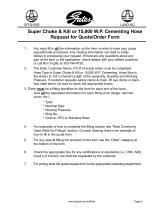
Super Choke & Kill or 15,000 W.P. Cementing Hose Request for Quote/Order Form 1. You must fill in all the information on the form in order to have your quote request/order processed. Any missing information can lead to costly delays in processing your request. If there are any questions about any part of the form or the application, check details with your oilfield customer, or call Ron Trujillo at 303-744-4735. The Date, Customer Name, P.O.# (if actual order) must be completed. Hose Type is Super Choke & Kill or 15,000 W.P. Cementing. Hose Size is the Hose I.D. Fill in Overall Length of the...
Open the catalog to page 5
Quote/Order Form S C&K or CEMENTING HOSE REQUEST FOR QUOTE \ ORDER Hose Size Hose Type _ Safety Clamp & Chain □ S C&K Hose 15,000 psi W.P. - 22,500 psi test - Spec 475SL □ Cementing Hose 15,000 psi W,P, - 22,500 psi test - Spec 4758L Overall Length Working Pressure Add-On Fittings (will be furnished welded) | TPC: Working Pressure. Working Pressure _ Nominal Size Pipe Size_ HAMMER UNION-MALE SUB/NUT Pipe Size. Nominal Size. Nominol Size Working Pressure .Nominal Size. Working Pressure _ Pipe Size _ HAMMER UNION-MALE SUB/NUT Pipe Siie. Nominal Size. CERTIFICATIONS /STANDARDS * =Request Compliance/...
Open the catalog to page 6
Technical Information
Open the catalog to page 7
Progressive Products Rapidly Advancing
Open the catalog to page 8
Gates High Performance Dynamic Pressure Rated Rotary Hose Assemblies To keep pace with rapidly advancing drilling technology involving directional drilling and down-linking with negative pressure pulses, Gates offers a high performance API 7K rated rotary hose assembly that far exceeds minimum standards. In addition to a high quality hose construction, the Gates system has a swage attached coupling with no seals to leak and no set screws to loosen with operation vibrations or epoxy to weaken with working temperatures above 180°F. Burst test results significantly exceed the API 7K minimum standards...
Open the catalog to page 9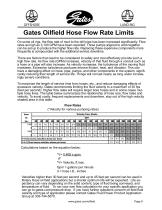
Gates Oilfield Hose Flow Rate Limits On some oil rigs, the flow rate of mud to the drill pipe has been increased significantly. Flow rates as high as 3,100 GPM have been reported. Three pumps aligned to work together can be set up to produce the higher flow rate. Replacing these expensive components more frequently is compounded with the additional service downtime. There are factors that need to be considered to safely and cost effectively provide such a high flow rate. As flow rate (GPM) increases, velocity of that fluid through a conduit such as a hose or a pipe will also increase. As velocity...
Open the catalog to page 10
Safety & Maintenance of Gates Oilfield Hose Assemblies Foreword The objective of this manual is to emphasize SAFETY by providing recommended procedures for proper handling, storage, use and maintenance of Rotary/Vibrator/Choke & Kill/BOP hose assemblies. External inspection and field pressure testing prior to any continued service of a hose assembly is critical to ensure safe operation. These are MANDATORY PROCEDURES for applications where an assembly failure could result in serious bodily injury or severe property damage. Scope This procedure is a recommended practice for the storage, handling,...
Open the catalog to page 11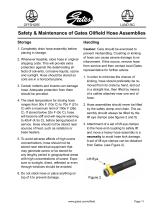
Safety & Maintenance of Gates Oilfield Hose Assemblies Storage 1. ompletely drain hose assembly before C placing in storage. Caution: Care should be exercised to prevent mishandling. Crushing or kinking of hose can cause severe damage to reinforcement. If this occurs, remove hose from service and then contact local Gates representative for further advice. 2. henever feasible, store hose in original W shipping crate. This will provide extra protection against the deteriorating effects of solvents, corrosive liquids, ozone and sunlight. Hose should be stored so coils are in a horizontal plane....
Open the catalog to page 12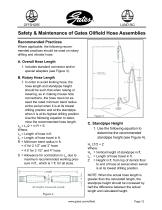
Safety & Maintenance of Gates Oilfield Hose Assemblies Recommended Practices Where applicable, the following recommended practices should be used on rotary drilling and vibrator hose. A. Overall Hose Length 1. ncludes standard connector and/or I special adapters (see Figure 3). B. Rotary Hose Length 1. n order to avoid kinking hose, the I hose length and standpipe height should be such that when raising or lowering, as in making mouse hole connections, the hose must not exceed the rated minimum bend radius at the swivel when it is at its lowest drilling position and at the standpipe when it is...
Open the catalog to page 13
Safety & Maintenance of Gates Oilfield Hose Assemblies D. Vibrator Hose Length 1. It’s important to choose a vibrator hose having an inside diameter equal to that of the pump discharge fitting and the fluid supply line inside diameters. This is necessary to allow free flow of fluid and to avoid turbulence or unnecessary abrasion of the hose tube. The length of vibrator hose should be given careful consideration. It should be long enough to prevent kinks near the couplings, yet short enough to prevent kinks in the radius near the middle of the hose. E. Hose Connections 1. ine pipe threads should...
Open the catalog to page 14
Safety & Maintenance of Gates Oilfield Hose Assemblies Operations Caution: Care should be exercised during operation to prevent crushing or kinking of hose. Crushing or kinking can cause severe damage to cable reinforcement. If this occurs, remove hose from service and test as outlined in the “Field Test Pressure” section. A. Working Temperature 1. orking temperature should not W exceed the rating of the hose. Temperatures encountered higher than the rated temperature will reduce hose life expectancy. B. After Coolers 1. ompressors should always be C equipped with after coolers to lower the air...
Open the catalog to page 15All GATES catalogs and technical brochures
 HYDRAULIC & FLEET HOSE PRODUCTS
769 Pages
 FLEETRUNNER® BELTS
2 Pages
 MICRO-V® ARAMID
2 Pages
 GATES INDUSTRIAL POWER TRANSMISSION
302 Pages
 POWERGRIP® GT®3
199 Pages
 POWERGRIP™ GT4™
2 Pages
 Hydraulics Catalog
769 Pages
 Engine Cooling Fan Module
2 Pages
 Heater Hose Assemblies
2 Pages
 iLok™ Coupling
6 Pages
 Coolant Outlets
2 Pages
 Thermostats and Caps
2 Pages
 Turbo Charger Steel Tube Kit
2 Pages
 Fan Pulley Brackets
2 Pages
 Accessory Belt Drive System
2 Pages
 FleetRunner®Belts
2 Pages
 Micro-V®Aramid
2 Pages
 DriveAlign® Laser Tool
2 Pages
 Electric Water Pumps
1 Page
 BladeRunner® Belts
2 Pages
 Hose Management System
4 Pages
 2017 products catalog
253 Pages
 EFG4K
EFG4K1 Page
 EFG5K
EFG5K1 Page
 BRASS PRODUCTS
190 Pages
 HOSE, COUPLINGS + EQUIPMENT
229 Pages
 2015 PRODUCTS CATALOG
629 Pages
 INDUSTRIAL ENGINE PRODUCTS
137 Pages
 government & Military Catalog
11 Pages
 Grounds Maintenance Equipment
750 Pages
 Automotive Hydraulics & Fleet hose
684 Pages
 2012 MASTER PRODUCTS CALOG
100 Pages
 Mining Products Catalog
136 Pages
 Hydraulic Products Catalog
593 Pages
 Powersport Applications 2013
75 Pages
 Fleet & Heaw-Dutv Applications
733 Pages
 Water pump catalog
302 Pages
 ED
ED1 Page
 Nov9061
1 Page
 high temp hose
6 Pages
 TH7 TH8
4 Pages
 Cotton Cleaner Belt
2 Pages
 Gates Metric Power Belts
4 Pages
 BELT PRODUCTS
92 Pages
 PowerBand® Belts
4 Pages
 PowerGrip® Twin Power®
2 Pages
 PowerGrip® GT®2
2 Pages
 2012 products catalog
275 Pages
 2012 INDUSTRIAL HOSE CATALOG
229 Pages


Archived catalogs
 Industrial Hose product catalogue
192 Pages
 Specialty Synchronous Belts
36 Pages


- GATES piping
- Plastic hose
- Structure hose
- Flexible hose
- GATES transmission belt
- Neoprene® hose
- Abrasion-resistant hose
- Wire-braided hose
- GATES industrial belt
- GATES rubber belt
- Steel hose
- Oil-resistant hose
- Industrial belt
- Automatic crimping machine
- Standard hose
- Weather-resistant hose
- GATES plastic belt
- Hose for high-pressure applications