


Air Cooled heat Exchanger Belt Drives

Air Cooled heat Exchanger Belt Drives
Catalog excerpts
A P P L I C A T I O N Air-Cooled Heat Exchanger Belt Drives M A N U A L 17525 September 2005 The Driving Force in Power Transmission®
Open the catalog to page 1
Table of Contents Description Page ACHE Applications Safety Policy . . . . . . . . . . . . . . . . . . . . . . . . . . . . . . . . . . . . . . . . . .1 Application ‘Alerts’ . . . . . . . . . . . . . . . . . . . . . . . . . . . . . . . . . . .2-3 Preventative Maintenance Tools . . . . . . . . . . . . . . . . . . . . . . . . . . .3 Troubleshooting . . . . . . . . . . . . . . . . . . . . . . . . . . . . . . . . . . . . .4-5 ACHE Belt Drives Poly Chain GT2 Belt Specifications . . . . . . . . . . . . . . . . . . . . . . . . .6 Poly Chain GT2 Standard Lengths . . . . . . . . . . . . . . . . . . . ....
Open the catalog to page 2
Safety Policy WARNING! Be Safe! Gates belt drive systems are very reliable when used safely and within Gates application recommendations. However, there are specific USES THAT MUST BE AVOIDED due to the risk of serious injury or death. These prohibited misuses include: Primary In-Flight Aircraft Systems Do not use Gates belts, pulleys or sprockets on aircraft, propeller or rotor drive systems or in-flight accessory drives. Gates belt drive systems are not intended for aircraft use. Lift Systems Do not use Gates belts, pulleys or sprockets in applications that depend solely upon the belt to raise/lower,...
Open the catalog to page 3
ACHE Application 'Alerts' Air-Cooled Heat Exchangers are pres- ent in many industries including Power Maximizing belt life means avoiding the following pitfalls: Incorrect installation practice, weak framework, and loose mounting bolts are common contributors to drive misalign- ment. See that bolts are properly secured and that the motor does not move. Ensure proper tracking of a belt drive by aligning the sprockets after ten- sion has already been applied to the belt. Make sure the entire belt width is riding on the sprocket. Use a laser alignment device or straight edge to align the sprockets....
Open the catalog to page 4
ACHE Application ‘Alerts’ Improper Belt Tension: Field problems are often related to belt tension. Low belt tension can result in self-tensioning or ratcheting. With self-tensioning, the belt’s teeth begin to show hook wear. With ratcheting, the tensile members are compressed and weakened. Tooth shear or straight-across breaks are often the end result of low belt tension. Ensure proper tension is applied during installation. The use of a Sonic Tension Meter is recommended for quick and accurate tension measurements. Additional Recommendations: • Check tension, alignment, and inspect the hardware...
Open the catalog to page 5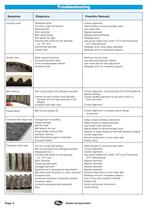
Possible Remedy Unusual noise Misaligned drive Too low or high belt tension Backside idler Worn sprocket Bent guide flange Belt speed too high Incorrect belt profile for the sprocket Subminimal diameter Excess load Correct alignment Adjust tension to recommended value Replace sprocket Replace sprocket/flange Redesign drive Use proper Gates Poly Chain* GT®2 and PowerGrip® Redesign drive using larger diameters Redesign drive for increased capacity Tension loss Weak support structure Excessive sprocket wear Fixed (nonadjustable) centers Excessive load Use alternate sprocket material Use inside idler...
Open the catalog to page 6
JiS^P. The Driving Force in Power Transmission
Open the catalog to page 7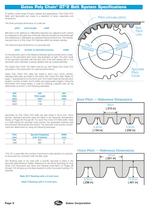
Gates Poly Chain® GT 2 Belt System Specifications To satisfy a wide range of loads, speeds and applications, Poly Chain GT2 Belts and Sprockets are made in a selection of sizes, capacities and The three principal dimensions of a belt are: pitch pitch length width Belt pitch is the distance in millimeters between two adjacent tooth centers as measured on the pitch line of the belt. Belt pitch length ism the total length (circumference) in millimeters as measured along the pitch line. The theoret- ical pitch line of a Poly Chain GT2 Belt lies within the tensile member. The three principal dimensions...
Open the catalog to page 8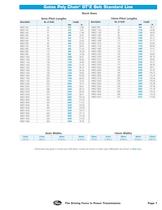
Gates Poly Chain® GT 2 Belt Standard Line Stock Sizes Dimensions are given in inches and millimeters. Inches are shown in black type. Millimeters are shown in blue type. JiS^P. The Driving Force in Power Transmission
Open the catalog to page 9
PowerGrip® GT 2 Belt Drives Gates 8mm, 14mm pitch PowerGrip® GT®2 belts have helically-wound fiberglass tension members embedded in a Neoprene®* body with the belt teeth faced with a tough wear-resistant nylon fabric. The three principal dimensions of a belt are Pitch Pitch Length Width Belt pitch is the distance in millimeters between two adjacent tooth centers as measured on the pitch line of the belt. Belt pitch length is the total length (circumfer- ence) in millimeters as measured along the pitch line. The theoretical pitch line of a PowerGrip® GT2 belt lies within the tensile member. The...
Open the catalog to page 10
PowerGrip® GT 2 Belt Drives The following tables list the stock PowerGrip" GV2 belts and their dimensions. 8mm Pitch PowerGrip® GT®2 Stock Belt Lengths 14mm Pitch PowerGrip® GT®2 Stock Belt Lengths 8MGT Stock Belt Widths 14MGT Stock Belt Widths JiS^P. The Driving Force in Power Transmission
Open the catalog to page 11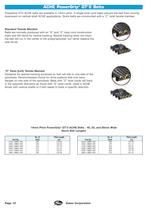
ACHE PowerGrip® GT 2 Belts PowerGrip GT2 ACHE belts are available in 14mm pitch. A single twist cord helps prevent the belt from moving downward on vertical shaft ACHE applications. Stock belts are constructed with a "Z" twist tensile member. Standard Tensile Member Belts are normally produced with an "S" and "Z" twist cord construction (right and left hand) for neutral tracking. Neutral tracking does not mean the belt will run in the center of the pulley/sprocket, but rather lessens the side thrust. "Z" Twist (Left) Tensile Member Designed for special tracking purposes so belt will ride to one...
Open the catalog to page 12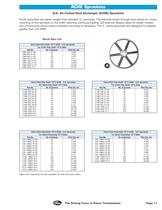
ACHE Sprockets Q.D. Air-Cooled Heat Exchanger (ACHE) Sprockets ACHE sprockets are lighter weight than standard TL sprockets. The reduced length through bore allows for closer mounting of the sprocket on the shaft, reducing overhung loading. QD bushing designs allow for easier installa- tion of horizontal drives where overhead mounting is necessary. The 'F' series sprockets are designed for speeds 14mm Pitch Poly Chain" GT"2 ACHE - Q.D. Sprockets For 20mm Poly Chain" GT 2 Belts Taper-Lock* sprockets are also available for most sizes and widths. JiS^P. The Driving Force in Power Transmission
Open the catalog to page 13All GATES catalogs and technical brochures
 HYDRAULIC & FLEET HOSE PRODUCTS
769 Pages
 FLEETRUNNER® BELTS
2 Pages
 MICRO-V® ARAMID
2 Pages
 GATES INDUSTRIAL POWER TRANSMISSION
302 Pages
 POWERGRIP® GT®3
199 Pages
 POWERGRIP™ GT4™
2 Pages
 Hydraulics Catalog
769 Pages
 Engine Cooling Fan Module
2 Pages
 Heater Hose Assemblies
2 Pages
 iLok™ Coupling
6 Pages
 Coolant Outlets
2 Pages
 Thermostats and Caps
2 Pages
 Turbo Charger Steel Tube Kit
2 Pages
 Fan Pulley Brackets
2 Pages
 Accessory Belt Drive System
2 Pages
 FleetRunner®Belts
2 Pages
 Micro-V®Aramid
2 Pages
 DriveAlign® Laser Tool
2 Pages
 Electric Water Pumps
1 Page
 BladeRunner® Belts
2 Pages
 Hose Management System
4 Pages
 2017 products catalog
253 Pages
 EFG4K
EFG4K1 Page
 EFG5K
EFG5K1 Page
 BRASS PRODUCTS
190 Pages
 HOSE, COUPLINGS + EQUIPMENT
229 Pages
 2015 PRODUCTS CATALOG
629 Pages
 INDUSTRIAL ENGINE PRODUCTS
137 Pages
 government & Military Catalog
11 Pages
 Grounds Maintenance Equipment
750 Pages
 Automotive Hydraulics & Fleet hose
684 Pages
 2012 MASTER PRODUCTS CALOG
100 Pages
 Mining Products Catalog
136 Pages
 Oilfield Products Catalog
183 Pages
 Hydraulic Products Catalog
593 Pages
 Powersport Applications 2013
75 Pages
 Fleet & Heaw-Dutv Applications
733 Pages
 Water pump catalog
302 Pages
 ED
ED1 Page
 Nov9061
1 Page
 high temp hose
6 Pages
 TH7 TH8
4 Pages
 Cotton Cleaner Belt
2 Pages
 Gates Metric Power Belts
4 Pages
 BELT PRODUCTS
92 Pages
 PowerBand® Belts
4 Pages
 PowerGrip® Twin Power®
2 Pages
 PowerGrip® GT®2
2 Pages
 2012 products catalog
275 Pages
 2012 INDUSTRIAL HOSE CATALOG
229 Pages


Archived catalogs
 Industrial Hose product catalogue
192 Pages
 Specialty Synchronous Belts
36 Pages


- GATES piping
- Plastic hose
- Structure hose
- Flexible hose
- GATES transmission belt
- Neoprene® hose
- Abrasion-resistant hose
- Water hose
- Wire-braided hose
- GATES industrial belt
- GATES rubber belt
- Steel hose
- Oil-resistant hose
- Hydraulic hose
- Industrial belt
- Automatic crimping machine
- Standard hose
- Weather-resistant hose
- GATES plastic belt
- Hose for high-pressure applications