


2012 INDUSTRIAL HOSE CATALOG

2012 INDUSTRIAL HOSE CATALOG
- Specifications: Gates offers a range of industrial hoses designed for various applications, including acid-chemical, petroleum transfer, food and beverage, and air and multi-purpose. Each hose is constructed with specific materials to ensure chemical resistance and durability.
- Procedures: The document emphasizes the importance of following the Gates Crimp Data Manual and Safety Guide for proper hose assembly and maintenance. This includes using RFID tags for tracking hose data and expected lifespan.
- Standards and Testing: Gates hoses are tested to API 7K standards, ensuring they exceed safety requirements for coupling pull and burst pressure tests.
- Recommendations: Users are advised to select hoses based on the Gates Chemical Resistance Table and to contact Gates for guidance on applications involving high temperatures or specific chemicals.
- Product Details: Detailed specifications for various hose types, including Stallion, Stallion Crush Resistant, and Mustang, are provided. These include dimensions, pressure ratings, temperature ranges, and construction materials.
- Specifications: Designed for tank truck, barge, ship, or storage tank transfer of chemical products. Features a monofilament helix for suction and crush resistance.
- Temperature Range: -40°F to +250°F (-40°C to +121°C).
- Construction: Modified Cross-linked Polyethylene tube, synthetic textile reinforcement, and EPDM cover.
- Applications: Suitable for over 950 basic chemicals. Not recommended for closed steam cleaning.
- Specifications: Contains a wire helix for full suction capability. Ultrahigh Molecular Weight Polyethylene tube for chemical resistance.
- Temperature Range: -40°F to +212°F (-40°C to +100°C).
- Applications: Suitable for over 450 basic chemicals. Designed for easy cleaning.
- Specifications: Contains a wire helix for full suction capability. EPDM tube stock withstands 250°F applications.
- Temperature Range: -40°F to +250°F (-40°C to +121°C).
- Applications: Suitable for mild chemical products.
- Specifications: Designed for spraying lawns and trees with pesticides and herbicides. Made from PVC with synthetic textile reinforcement.
- Temperature Range: -10°F to +130°F (-23°C to +55°C).
- Applications: Not suitable for chemicals with more than 2% Toluene or Xylene.
- Specifications: Suitable for paint spray applications and transfer of petroleum-based products.
- Applications: Designed for use with aliphatic and aromatic hydrocarbons.
- For applications involving high temperatures or specific chemicals, contact Gates Corporation for guidance.
- Use permanent couplings for fluid temperatures above 125°F (+52°C).
- Special order requirements and remnant lengths are available for certain products.
The document provides detailed specifications for various types of industrial hoses, including their compatibility with chemicals, temperature ranges, construction materials, and packaging details. The hoses are compatible with commercially available Bio-Diesel fuels up to B-100 but are not recommended for acids or high-pressure paint spray applications requiring static conductive hoses. The temperature range for continuous service is -40°F to +150°F (-40°C to +66°C).
Construction:
The hoses are constructed with a Type Z (Special Flexible Nylon II) tube, synthetic high tensile textile cord reinforcement, and a Type A (Neoprene) cover. The design factor is 4:1.
Couplings and Packaging:
Specific couplings are recommended for different applications, such as Binks 3 piece compression ring for paint service. Packaging varies by hose size, with reels ranging from 300' to 800'.
Branding and Special Orders:
Hoses are branded with continuous ink print labels. Special production runs require minimum order quantities of 25,000 feet for all sizes.
Applications and Recommendations:
The hoses are recommended for applications requiring premium-grade braided hoses with excellent flexibility and resistance to air, water, petroleum oils, gasoline, kerosene, and fuel oil. They offer excellent weather and ozone resistance but are not recommended for constant contact with fuels or Bio-Diesel fuels.
Standards and Safety:
The hoses meet specific standards for nonconductivity and electrical resistance. They are designed to be flame resistant and have high oil resistance.
Tables and Data:
The document includes detailed tables listing hose specifications such as nominal I.D. and O.D., maximum working pressure, suction, minimum bend radius, weight per foot, and pricing per foot. These tables help in selecting the appropriate hose for specific industrial applications.
The document outlines the specifications for various industrial hoses, including their dimensions, pressure ratings, and material compositions. The hoses are designed for different applications such as air, water, petroleum oils, and lubricating oils. They are available in various colors and sizes, with specific requirements for special production runs and minimum order quantities.
Procedures:
Special production runs require minimum order quantities of 5,000 to 25,000 feet per size, depending on the hose type. The hoses are packaged in reels, with most being one-piece lengths. Specific packaging details are provided for different hose sizes.
Standards:
The hoses meet various standards, including MSHA 30 CFR 18.65 for flame resistance and ARPM classifications for oil resistance. They are nonconductive at 1000 volts D.C., with electrical resistance greater than one megohm per inch.
Recommendations:
The hoses are recommended for use in applications requiring flexibility, resistance to air, water, petroleum oils, and lubricating oils. Specific temperature ranges are provided for continuous service. Caution is advised against using Lock-On hoses in applications with vibrations or pressure surges.
Key Data from Tables:
The tables provide detailed specifications for each hose type, including nominal inner and outer diameters, maximum working pressure, suction capacity, minimum bend radius, weight per foot, and pricing per foot. Each hose type is associated with a specific Gates item number.
Critical Information:
Special order requirements and remnant lengths are specified, with no remnant lengths allowed. The document emphasizes the importance of adhering to the specified standards and recommendations to ensure safety and performance.
The document provides detailed specifications for various types of hoses, including their nominal inner diameter (I.D.), outer diameter (O.D.), maximum working pressure (W.P.), suction, minimum bend radius, weight per foot, standard packaging, and list price per foot. The hoses are categorized by size and type, with specific item numbers for ordering.
Recommended Applications:
The hoses are recommended for applications requiring maximum flexibility and resistance to air, water, and heat. They are suitable for use with SAE oils in intermittent contact and are ideal for air and water applications in industries such as mining, construction, agriculture, vehicle repair, and in-plant operations. The hoses offer outstanding resistance to heat and ozone and are suitable for light agricultural spraying.
Temperature Range:
The hoses are designed for continuous service in temperatures ranging from -40°F to +200°F (-40°C to +93°C).
Construction:
The hoses are constructed with a Type B1 specially compounded elastomer tube, synthetic high tensile textile cord reinforcement, and a Type P (EPDM) cover. The cover is available in red or black, with perforated options for sizes through 1/2".
Design Factor:
The hoses have a design factor of 3:1.
Couplings:
Various coupling options are available, including Gates Power Crimp®, Gates GLX®, and Gates SS, with specific recommendations based on hose size.
Packaging:
The hoses are packaged in exact length reels, with most reels being one-piece lengths. Packaging varies by hose size, with specific lengths and increments detailed for each size.
Branding:
The hoses feature continuous ink branding with specific product information.
Special Order Requirements:
Special production runs require minimum order quantities of 25,000 feet, with specific requirements for color and cover options.
Standards:
The hoses meet ARPM standards for medium oil resistance and limited oil resistance, depending on the type.
Product Range:
The document includes a comprehensive range of industrial hose products, including options for acid-chemical, air and multi-purpose, food and beverage, marine, material handling, mining, oilfield, petroleum transfer, pressure washer, steam, and water applications.
The document provides detailed specifications for various types of industrial hoses, including Air & Vapor Duct, Air and Multi-Purpose Hose, and Food and Beverage Hose. Each hose type is described with its nominal inner diameter (I.D.), outer diameter (O.D.), maximum working pressure (W.P.), suction capacity, minimum bend radius, weight per foot, standard packaging, and list price per foot.
Procedures and Recommendations:
1. Air & Vapor Duct (Heavy Duty): Recommended for heavy-duty heating and ventilating applications. Not suitable for conveying liquids. Temperature range: -30°F to +250°F. Constructed with a neoprene tube and cover, reinforced with synthetic fabric and helical wires.
2. Air and Multi-Purpose Hose (Ohmega®): Suitable for medium-duty air and water applications requiring high electrical resistance. Temperature range: -20°F to +150°F. Constructed with an EPDM tube and cover, reinforced with synthetic textile cord.
3. Divers’ Air Hose (33HB): Designed for handling gas mixtures in diving applications. Temperature range: -40°F to +120°F. Constructed with a nitrile tube and neoprene cover, reinforced with braided synthetic textile cord.
4. Food and Beverage Hose (Food & Beverage Master®): Suitable for transferring milk, juice, beer, and other FDA-sanitary products. Temperature range: -40°F to +230°F. Constructed with a Sanitron™ tube and EPDM cover, reinforced with synthetic textile and monofilament helix.
Standards and Compliance:
Hoses meet various standards such as FDA, 3A-Class 3, and USDA requirements, ensuring suitability for specific applications like food and beverage transfer.
Special Order Requirements:
Special production runs may require minimum order quantities and specific lengths. Contact Gates Corporation for pricing and availability.
Key Data from Tables:
The tables provide a comprehensive list of hose specifications, including dimensions, pressure ratings, and pricing. Each entry is associated with a specific Gates item number for easy reference.
- Food Master® Lite™: Suitable for transferring food products like animal fat and vegetable oil at temperatures up to 230°F. Constructed with a Type C2 (Modified Nitrile) tube and cover, reinforced with synthetic textile and steel wire helix. Available in various sizes with a design factor of 4:1.
- Sani-Pure™: Designed for discharge of food products requiring FDA sanitary hose. Features a Type C2 (Modified Nitrile) tube and cover, with synthetic textile reinforcement. Operates in temperatures from -40°F to +230°F.
- Aquarius® Potable Water: Used for transferring potable and non-potable water. Made with a Type D2 (Natural Rubber) tube and EPDM cover, suitable for temperatures from -40°F to +150°F.
- Bulk Commodity Hoses (690SB, 692SB, 610W): Designed for transferring bulk food products like flour and sugar. Constructed with natural rubber tubes and reinforced with synthetic textile and steel wire helix. Temperature range varies by product.
- All hoses are coiled and wrapped in polyethylene for packaging.
- Special production runs require minimum order quantities, typically 400 feet for sizes through 4" and 200 feet for larger sizes.
- Remnant lengths may be available at a discount.
- All hoses meet FDA requirements, with some also meeting 3A-Class 3 and USDA standards.
- Hoses are branded with continuous transfer labels indicating compliance and specifications.
- Specific cut lengths are available through the Cut Length Program.
The document outlines specifications for various types of hoses used in marine and stationary engines. The temperature range for continuous service is from -40°F to +257°F (-40°C to +125°C). The construction includes a tube made of Type P (EPDM), black, with multiple plies of synthetic fabric reinforcement and a cover that is heat and ozone resistant. The design factor is 4:1.
Couplings and Packaging:
Couplings available are types 1, 5, 6, or 7, as referenced in the Hose Coupling Section. The hoses are packaged in 50' lengths, coiled and wrapped in polyethylene, with specific packaging for different sizes.
Branding and Special Orders:
Hoses are branded with a continuous transfer label. Special production runs require minimum order quantities of 400 feet per size, and special transfer labels can be requested.
Standards:
The hoses meet SAE 20R1, Class D-2 standards, with limited oil resistance for the cover.
Applications and Recommendations:
The hoses are recommended for open-end water discharge applications and coolant connections on marine and stationary engines where oil resistance is required. They are suitable for temperatures ranging from -40°F to +212°F (-40°C to +100°C) for certain types.
Construction Details:
The document provides detailed construction information for different hose types, including the materials used for the tube, reinforcement, and cover, as well as the design factor.
Special Order Requirements and Standards:
Special production runs have specific minimum order requirements, and the hoses meet various SAE standards depending on the type.
Data Tables:
The document includes detailed tables listing nominal inner and outer diameters, maximum working pressure, minimum bend radius, weight per foot, and pricing for different hose sizes and specifications.
The document provides detailed specifications for various types of marine hoses, including dimensions such as nominal inner diameter (I.D.) and outer diameter (O.D.), maximum working pressure (W.P.), suction capacity, minimum bend radius, weight per foot, and standard packaging options. Each hose type is identified by a specific item number and list price.
Procedures and Recommendations:
The hoses are recommended for specific applications such as marine wet exhaust, engine water circulation, discharge lines, heat exchangers, and fuel line applications. The document specifies the temperature range for continuous service, construction materials, and design factors for each hose type.
Standards and Compliance:
The hoses meet various industry standards such as SAE J2006 R2, SAE J1527, USCG Type A, and NMMA type acceptance. The document outlines the construction details, including tube, reinforcement, and cover materials, which are designed for oil, heat, and fuel resistance.
Packaging and Branding:
Packaging details include lengths and types of packaging, such as reels and cartons. Branding is done through continuous transfer labels or ink brands, providing product identification and compliance information.
Special Order Requirements:
Special production runs require minimum order quantities, and specific lengths can be ordered under certain conditions. The document notes that remnant lengths are not available.
Key Data from Tables:
The tables provide a comprehensive list of hose specifications, including dimensions, pressure ratings, and pricing. The data is organized by hose type and size, allowing for easy comparison and selection based on application needs.
1. GATES® 4219G Fuel Line: Exceeds SAE 30R6 and SAE 30R7 standards, NMMA type accepted, high oil resistance.
2. Marine Hose 4663K: Suitable for fuel tank filler applications, temperature range -40°F to +212°F, meets SAE 30R5 standards.
3. Vacuum Tubing 4040A: Ideal for windshield washers, tested to SAE J1037, temperature range -40°F to +257°F.
4. Material Handling Hose 609W: For pneumatic transfer of bulk cement, temperature range -40°F to +150°F, static conductive.
5. Material Handling Hose 688SB: For bulk material transfer, abrasion-resistant, temperature range -40°F to +150°F.
6. Hot Air Blower Hose: For conveying hot air up to 350°F, temperature range -40°F to +350°F.
7. Material Handling Hose 770SB: For light duty vacuum service, temperature range -40°F to +150°F.
8. Sand Blast Hose 429W: For abrasive materials at high velocity, temperature range -40°F to +150°F.
- Special production runs require minimum order quantities, varying by product.
- Remnant lengths are sometimes available at a discount.
- Specific cut lengths available through the Cut Length Program.
- Products meet various SAE standards and are NMMA type accepted.
- Hoses are designed with specific oil resistance classes and temperature ranges.
- Products are packaged in specified lengths and branded with continuous transfer labels.
- Tables provide detailed specifications including nominal I.D. and O.D., maximum working pressure, minimum bend radius, weight per foot, and pricing per foot for various hose types.
- Specifications: Available in black (3618) and yellow (3618Y) covers, with nominal inner diameters ranging from 3/4 inch to 3 inches. Maximum working pressure is 500 psi.
- Construction: Features a nitrile tube, braided high tensile steel wire reinforcement, and a modified nitrile cover. Design factor is 4:1.
- Applications: Suitable for heavy-duty, high-pressure industrial, construction, and pneumatic mining applications.
- Temperature Range: -22°F to +180°F (-30°C to +82°C).
- Standards: Tube meets ARPM Class B for medium oil resistance; cover meets MSHA 30 CFR 18.65 for flame resistance.
- Specifications: Designed for rock dusting in underground coal mines, with nominal inner diameters from 1 1/4 inch to 3 inches and a maximum working pressure of 100 psi.
- Construction: Natural rubber tube with synthetic textile and steel wire helix reinforcement, and a modified nitrile cover.
- Temperature Range: -40°F to +180°F (-40°C to +82°C).
- Standards: Cover meets MSHA 2G-11C for flame resistance.
- Specifications: Available in Grade D and E, with working pressures of 5,000 psi and 7,500 psi respectively. Designed for rotary drilling and motion compensator applications.
- Construction: Features a modified nitrile tube, multiple layers of polyester cord and steel cables for reinforcement, and an UltraBrasion cover.
- Temperature Range: -4°F to +180°F (-20°C to +82°C).
- Standards: Complies with API Spec 7K and ISO 14693.
- Specifications: Used for cementing applications with working pressures of 5,000 psi and 10,000 psi.
- Construction: Similar to rotary/vibrator drilling hoses, with a focus on handling abrasive and corrosive materials.
- Standards: Meets API Spec 7K and ISO 14693.
- Fluoroelastomer Tube: Rated at 15,000 psi working pressure, with a temperature range of -4°F to +212°F. Constructed with high tensile steel cables and a modified nitrile cover for abrasion and corrosion resistance.
- Nitrile Tube: Available in 5,000 psi and 10,000 psi working pressures, with a temperature range of -4°F to +250°F. Features multiple layers of spiraled steel wire and a neoprene cover.
- Designed for rotary drilling and vibrator applications, these hoses handle up to 20% H2S for 1 hour at 93°C. Available in 5,000 psi and 7,500 psi working pressures, with a temperature range of -4°F to +200°F.
- Used in offshore drilling rigs, these hoses are available in 5,000 psi and 10,000 psi working pressures. They are constructed to resist abrasion, corrosion, and up to 20% H2S.
- All hoses are packaged in heavy-duty wooden crates or cartons and feature a continuous yellow transfer label for branding and traceability.
- Optional accessories include safety clamps, hose lift eyes, collar clamps, and stainless steel armor.
- Certification and standards compliance include API Spec 7K, ISO 14693, and NACE MR0175.
- Field welding of fittings to couplings is not recommended.
- For detailed information on end fittings and couplings, contact the nearest Gates E&S facility.
- Black Gold® Super Choke and Kill Hose: Designed for offshore drilling rigs, with a working pressure of 15,000 psi and a temperature range of -4°F to +200°F. It features multiple layers of high tensile steel cables and fabric reinforcement.
- Black Gold® Rotary Decoking Hose: Used in oil refining for decoking operations, with pressure ratings of 5,000 psi and 7,500 psi for different grades. It operates in temperatures from -4°F to +180°F.
- Powerbraid® Plus Hose: Suitable for rotary applications on drilling rigs, with working pressures ranging from 1,500 to 5,000 psi. It is designed for temperatures between -40°F and +180°F.
- Oilfield Vacuum Hose: Economical and lightweight, designed for oilfield waste recovery and vacuum truck service, with a maximum working pressure of 150 psi.
- Hoses are constructed with various materials such as fluoroelastomer, nitrile, and neoprene, providing resistance to abrasion, corrosion, oil, and weather.
- Reinforcement typically includes high tensile steel wire or polyester cord, ensuring durability under high pressure and flexing conditions.
- Hoses are equipped with swaged or butt-welded couplings, with options for API standard flanges or custom end fittings.
- Field welding of fittings to couplings is not recommended.
- Hoses are packaged in heavy-duty wooden crates or coiled and wrapped in polyethylene, depending on the type.
- Each hose features a continuous transfer label with specifications and branding information.
- Hoses meet various industry standards, including NACE and API specifications, and are available with optional certifications such as test certificates and third-party witness tests.
- Accessories such as safety clamps, hose lift eyes, collar clamps, and stainless steel armor are available for additional protection and functionality.
- Contact Gates E&S facilities for detailed information and custom requirements.
- Special production runs and remnant lengths are available under specific conditions.
- Longhorn® MegaFlex®: Designed for maximum flexibility and kink resistance, suitable for tank trucks and oil field service trucks. Temperature range: -40°F to +180°F.
- Arctic™ Longhorn® MegaFlex®: Ideal for cold weather conditions, maintaining flexibility down to -65°F. Suitable for similar applications as the Longhorn® MegaFlex®.
- Petroleum Drop 150SD MegaFlex®: Suitable for transferring bio-diesel and ethanol blends, with a temperature range of -30°F to +180°F.
- Steer®: Designed for oilfield service truck use, with a focus on refined fuels and oils. Temperature range: -40°F to +180°F.
- Maverick™: Suitable for oilfield service truck use, with a temperature range of -40°F to +180°F.
- Super-Vac™: Designed for tank truck service, including oilfield vacuum trucks, handling crude oil, water, and drilling mud. Not recommended for refined petroleum products like gasoline.
- Determine Required Hose Size: Based on the size of fittings or pipes.
- Find Actual Rated Working Pressure and Temperature: Take readings ahead of the hose connection.
- Determine Condition of Steam: Use a steam chart to identify if the steam is saturated or superheated.
- Select the Correct Hose: Choose a hose that meets the steam condition and pressure requirements.
- Determine Length Required: Length is dictated by the application.
- Select Couplings Required: Use interlocking and permanent crimped types for steam hose applications.
- Maintenance and Inspection: Follow guidelines for proper maintenance and inspection.
- 232MB Steam Queen® and 205MB Steam King®: Both are recommended for all types of steam up to 250 PSI and 450°F. They feature a special cover for oil resistance and require specific couplings.
- Construction: Includes a Type P2 (EPDM) tube, braided high tensile steel wire reinforcement, and a perforated cover.
- Packaging: Various packaging options are available, including reels and bulk packs.
- Shark® and Barracuda®: Designed for water suction and discharge, with temperature ratings and construction details provided.
- Applications: Suitable for agricultural, construction, and industrial applications.
- Do not alternate use between steam and water.
- Ensure proper grounding for electrical continuity.
- Special order requirements and remnant lengths are specified for custom needs.
This section provides definitions for various terms related to hoses and couplings, such as API Thread, Block Number, Conductive, Coupling, Ferrule, Helix, I.D., Insert, IPT, MBR, NPSH, NPSM, NPT, NPTF, O.D., Resistant, Shank, and different types of threads and seals. These definitions are crucial for understanding the technical specifications and applications of hoses and couplings.
The document outlines the specifications for hoses, including Inside Diameter (I.D.), Hose Name, Rated Working Pressure, Suction, Outside Diameter (O.D.), Tube and Cover Types, Minimum Bend Radius, Hose Weight, Temperature Range, and Hose Category. These specifications help in selecting the appropriate hose for specific applications.
The document classifies oil resistance into three classes based on physical properties after exposure to oil: Class A (High Oil Resistance), Class B (Medium Oil Resistance), and Class C (Limited Oil Resistance). This classification aids in choosing hoses based on their oil resistance capabilities.
Two examples are provided to illustrate how to select a hose based on specific requirements such as diameter, pressure rating, temperature, and application. These examples guide users in navigating the Hose Finder Data Pages to find suitable hoses.
The data pages list various hoses with their specifications, including I.D., Rated Working Pressure, Suction, O.D., Tube and Cover Types, Minimum Bend Radius, Hose Weight, Temperature Range, and Hose Categories. This comprehensive table assists in comparing and selecting hoses for different industrial applications.
- Specifications: Each hose is listed with its internal diameter (I.D.), rated working pressure (W.P.), suction capacity, outer diameter (O.D.), tube and cover types, minimum bend radius, weight per foot, and temperature range. These specifications are crucial for selecting the appropriate hose for specific industrial applications.
- Hose Categories: The hoses are categorized based on their application, such as marine, air and multi-purpose, petroleum transfer, food and beverage, material handling, and mining. Each category is tailored to meet the demands of its specific environment.
- Temperature and Pressure Ratings: The document provides minimum and maximum temperature ratings for each hose, indicating the operational limits. Pressure ratings are also specified, ensuring the hose can withstand the required operational pressures.
- Material and Construction: Information on the materials used for the tube and cover of each hose is provided, which affects the hose's durability, flexibility, and resistance to various substances.
- Applications: Specific applications for each hose type are mentioned, such as coolant, wet exhaust, fuel fill, and air ducting, guiding users in selecting the right hose for their needs.
- Temperature Range: The hoses cover a wide range of temperatures, from -65°F to +450°F, accommodating various industrial environments.
- Pressure Capacity: Hoses are rated from 5 psi to 5000 psi, indicating their suitability for different pressure requirements.
- Material Compatibility: The document highlights the compatibility of hoses with different materials, such as oil, water, air, and chemicals, ensuring safe and efficient operation.
- Flexibility and Durability: Minimum bend radius and weight per foot are provided, indicating the flexibility and ease of handling of each hose type.
- Gates Chemical Rating System: This section explains the rating system used to evaluate the effect of chemicals on polymers. Ratings include "1" for preferred constant contact, "2" for acceptable intermittent contact, "X" for not recommended, and "-" for insufficient data.
- Notes on Chemical Resistance: Several notes provide guidance on interpreting the chemical resistance table, including considerations for environmental changes, solvent compatibility, fluid discoloration, and fluid permeation through hose walls.
- Hose Coupling Materials: Recommendations for hose couplings are provided, listing suitable materials such as Iron, Carbon Steel, Stainless Steel (304 and 316), Aluminum, Brass, and Polypropylene. The table indicates the compatibility of these materials with various chemicals.
- Chemical Resistance Table: A comprehensive table lists chemicals, their forms, and the compatibility ratings with different polymers and coupling materials. This table is crucial for selecting the appropriate hose and coupling for specific chemical applications.
Catalog excerpts

INDUSTRIAL HOSE, COUPLINGS + EQUIPMENT POWERING PROGRESS™ HOSE, COUPLINGS + EQUIPMENT GATES CORPORATION 1551 Wewatta Street Denver, CO 80202 800.366.3128 / Fax 303.744.4499 Gates.com/industrialhose Gates Industrial Hose Catalog Cover Print.indd 1 39496-000 March 2012 Supersedes October 2009 Edition 2012 INDUSTRIAL HOSE CATALOG 3/30/12 9:49 AM
Open the catalog to page 1
GATES INDUSTRIAL HOSE PRODUCTS ADDITIONS / MODIFICATIONS Product Description 690SB 5" & 6" ID x 100 Ft. Lengths Adapta Flex™ Black UPS reels 1/4", 1/2", 3/4" & 1" ID’s Arctic™ Longhorn™ MegaFlex -65˚ F, 2", 3" & 4" ID’s Barricade™ 4219BG Carbureted Engines Barricade™ 4219BF Fuel Injection Food Master® Light 3/4" x 200 Ft. Length DEF Diesel Exhaust Fluid Dolphin® 6-5/8" x 100 Ft. Length GL Couplings Global Low Pressure for specific Ind. Hoses GSP Couplings Global Spiral® Couplings for specific Ind. Hoses Hose Cut Length Program New hoses/sizes added Hydrocarbon Drain Hose 3/4" ID LOL Lock-On Hose...
Open the catalog to page 2
GATES INDUSTRIAL HOSE PRODUCTS CANCELLATIONS Product Description 6B Dura Master® 1-1/4" through 1-1/2" and all 315 WP Replaced by Duro Flex® 19B Plant Master 1-1/4" through 1-1/2" and all 500 WP Replaced by Premo Flex® 119B Plant Master® 1-1/4" through 1-1/2" and all 500 WP Replaced by Premo Flex® 319MB Gold Master Check Prod. Application for specific replacement 4689M Fuel Fill (USCG Type A1 and B1) No replacement Appaloosa Check Prod. Application for specific replacement Scorpion™ X-Treme Replaced by Scorpion™ Trident Replaced by Oilfield Service 400D ® ® ® ® 2 gates.com/industrialhose Gates...
Open the catalog to page 3
WARNING Gates Corporation recommends industrial hoses for normal service as described in this catalog. Other applications should be referred to your respective marketing representative. In any application, there may be inherent risk of bodily injury or property damage and the user is responsible for implementation of adequate safety precautions. It is the responsibility of the person supplying the hose to advise the user of proper instructions for the adequate safe use and/or precautions and to warn the user of consequences of failure to heed such instruction. Should a hose assembly fail during...
Open the catalog to page 10
Gates Industrial Hose Cut Length Program offers distributors easy access to custom cut length hoses. Over 150 large I.D. standard-stock industrial hose products are available in this program. It includes our most popular hose lines as well as those that Thanks to this program, you never have to pass up an order for special lengths of Gates Industrial Hose. Your customer has a special request for a specific length of cut hose.* Check the inventory list to be sure the hose is available for custom Call Gates Customer Service with your order - 800-366-3128. Your cut length hose will ship in two days...
Open the catalog to page 11
SELECTION OF HOSESand Couplings Selection of Hoses AND COUPLINGS There are many types of industrial hoses—all designed for a particular application or several related applications. When hoses are mated with the proper couplings and used in the correct application, hose assemblies will give long, trouble-free service. This catalog is designed to make certain that you obtain long service life by: • Helping you select the proper hose and coupling from among the many types available. • Giving you suggestions on how to take reasonable care of the hose assembly and maintain it for maximum service life....
Open the catalog to page 14
GATES INDUSTRIAL HOSE PRODUCTS SELECTION OF of HosesANDCouplings (continued) Selection HOSES and COUPLINGS (continued) Rubber hoses are used basically to convey material. They are used for a variety of reasons, but principally for: • • • • • Flexibility; allows for changes in alignment, hookup or outlet. Absorbing vibration. Resistance to corrosive fluids. Resistance to abrasion. Providing a closed system. In applying any product, the more you know about the application, the better the product you choose to meet the needs of the application. This is particularly true with hose because of the...
Open the catalog to page 15
SELECTION OFof Hoses and Couplings (continued) Selection HOSES AND COUPLINGS (continued) Proper hose selection is the first step in preventive maintenance. Selecting the best product for the application will allow you to obtain the maximum life expectancy from the product for the best value. When selecting the correct hose, use the acronym STAMPED as your guide: S – Size: T – Temperature: A – Application: I.D. (Inside Diameter) O.D. (Outside Diameter) Based on the machinery sizing. Consider exterior and interior temperature, as well as temperature impact on the material being conveyed. Where...
Open the catalog to page 16
GATES INDUSTRIAL HOSE PRODUCTS HOSE TEMPERATURE RANGES Hose Temperature Ranges Temperature ranges for the industrial hoses are shown by application groups. The range in the Normal Service column indicates the usual temperature range for each specific hose listed under each application group. The lower limit column indicates the approximate temperature at which the hose will become too stiff to use. For information on applications or temperatures not listed in this table, contact Denver Product Application. Application Group Acid-Chemical 77B Colt® Mustang® ™ Renegade Stallion® ® Thermo-Ag 570...
Open the catalog to page 17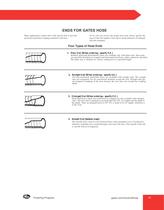
ENDS FOR GATESHose Ends for Gates HOSE Many applications require hose with special ends to provide protection and better coupling retention to the hose. To be sure you receive the proper hose end, always specify the type of end, the length of end and its inside diameter (if enlarged and non-standard). Four Types of Hose Ends 1. Plain End (When ordering—specify P.E.) Braided, spiral and thermoplastic hoses are available only with plain ends. Plain ends are generally furnished on wrapped and horizontal braid hoses, unless otherwise specified The plain end is obtained by merely cutting hose to a...
Open the catalog to page 18All GATES catalogs and technical brochures
 HYDRAULIC & FLEET HOSE PRODUCTS
769 Pages
 FLEETRUNNER® BELTS
2 Pages
 MICRO-V® ARAMID
2 Pages
 GATES INDUSTRIAL POWER TRANSMISSION
302 Pages
 POWERGRIP® GT®3
199 Pages
 POWERGRIP™ GT4™
2 Pages
 Hydraulics Catalog
769 Pages
 Engine Cooling Fan Module
2 Pages
 Heater Hose Assemblies
2 Pages
 iLok™ Coupling
6 Pages
 Coolant Outlets
2 Pages
 Thermostats and Caps
2 Pages
 Turbo Charger Steel Tube Kit
2 Pages
 Fan Pulley Brackets
2 Pages
 Accessory Belt Drive System
2 Pages
 FleetRunner®Belts
2 Pages
 Micro-V®Aramid
2 Pages
 DriveAlign® Laser Tool
2 Pages
 Electric Water Pumps
1 Page
 BladeRunner® Belts
2 Pages
 Hose Management System
4 Pages
 2017 products catalog
253 Pages
 EFG4K
EFG4K1 Page
 EFG5K
EFG5K1 Page
 BRASS PRODUCTS
190 Pages
 HOSE, COUPLINGS + EQUIPMENT
229 Pages
 2015 PRODUCTS CATALOG
629 Pages
 INDUSTRIAL ENGINE PRODUCTS
137 Pages
 government & Military Catalog
11 Pages
 Grounds Maintenance Equipment
750 Pages
 Automotive Hydraulics & Fleet hose
684 Pages
 2012 MASTER PRODUCTS CALOG
100 Pages
 Mining Products Catalog
136 Pages
 Oilfield Products Catalog
183 Pages
 Hydraulic Products Catalog
593 Pages
 Powersport Applications 2013
75 Pages
 Fleet & Heaw-Dutv Applications
733 Pages
 Water pump catalog
302 Pages
 ED
ED1 Page
 Nov9061
1 Page
 high temp hose
6 Pages
 TH7 TH8
4 Pages
 Cotton Cleaner Belt
2 Pages
 Gates Metric Power Belts
4 Pages
 BELT PRODUCTS
92 Pages
 PowerBand® Belts
4 Pages
 PowerGrip® Twin Power®
2 Pages
 PowerGrip® GT®2
2 Pages
 2012 products catalog
275 Pages


Archived catalogs
 Industrial Hose product catalogue
192 Pages
 Specialty Synchronous Belts
36 Pages


- GATES piping
- Plastic hose
- Structure hose
- Flexible hose
- GATES transmission belt
- Abrasion-resistant hose
- Wire-braided hose
- GATES industrial belt
- GATES rubber belt
- Steel hose
- Oil-resistant hose
- Hydraulic hose
- Industrial belt
- Automatic crimping machine
- Standard hose
- Weather-resistant hose
- GATES plastic belt
- Hose for high-pressure applications