


- Company
- Products
- Catalogs
- News & Trends
- Exhibitions
AT 1 Laser alignment

AT 1 Laser alignment
The document introduces the Gates AT-1 laser alignment device, designed to prevent machine downtime caused by improper pulley alignment. It highlights the device's ability to quickly and accurately measure misalignment, offering a solution to noise, wear, and vibrations in machinery.
Features and Benefits
- Suitable for multi-ribbed belts, V-belts, and synchronous belts.
- Applicable for both horizontally and vertically mounted machines.
- Identifies parallel and angular misalignment between pulleys.
- Compact and lightweight, allowing easy handling by a single operator.
Important Note
The device should not be used in explosive risk areas.
Product Specifications
- Construction: ABS plastics housing with an anodised aluminium back plate.
- Targets: Includes two magnet targets with adjustable centre lines.
- Temperature Range: Operates between -10 °C and +50 °C.
- Standard Compliance: Laser class 2, CE approved, and RoHS 2 compliant.
Technical Characteristics
- Calibration Accuracy: Offset less than 0.5 mm, angle less than 0.1°.
- Pulley Diameters: Suitable for diameters of 60 mm and larger, including non-magnetic pulleys with adhesive tape.
- Beam Angle: 78°.
- Measurement Distance: Up to 10 meters (33 feet).
- Battery: Operates on one R6 (AA) 1.5V battery for 8 hours of continuous use.
- Output Power: Less than 1 mW.
- Laser Wavelength: 635 - 670 nm.
- Weight: 0.25 kg.
- Dimensions: 147 mm (W) x 87 mm (H) x 28 mm (D).
Conclusion
The Gates AT-1 laser alignment device is a precise tool for ensuring proper pulley alignment, enhancing machine efficiency and reducing downtime. However, it is crucial to avoid using it in environments with explosive risks.
Catalog excerpts

AT-1 LASER ALIGNMENT DEVICE THE PERFECT TOOL FOR PULLEY ALIGNMENT Noise, wear on pulleys, belts and bearings, vibrations and in the end … machine downtime may all be caused by improper pulley alignment. This can be prevented by using Gates’ AT-1 laser alignment device. A fast and accurate method to measure misalignment is offered by Gates’ unique laser alignment device, LASER AT-1. Mounted in a few seconds, the laser line projected onto the targets allows you to quickly ascertain and correct misalignment. It identifies parallel as well as angular misalignment between the pulleys and is suitable for pulley diameters of 60mm and larger. It can be used on both horizontally and vertically mounted machines. FEATURES + BENEFITS Suitable for multi-ribbed belts, V-belts and synchronous belts. For both horizontally and vertically mounted machines. Shows parallel and angular misalignment between the pulleys. Compact & lightweight tool: easy to handle by one operator. IMPORTANT NOTE! GATES AT-1 LASER ALIGNMENT DEVICE SHOULD NOT BE USED IN EXPLOSIVE RISK ARE
Open the catalog to page 1
AT-1 LASER PRODUCT SPECIFICATIONS CONSTRUCTION ABS plastics housing. Anodised aluminium back plate. 2 pieces magnet targets with adjustable centre line (PN 7401-10012). TEMPERATURE RANGE Laser class 2. CE approved. RoHS 2 compliant: the device complies with the European Directive (2002/95/EC) on the restriction of the use of certain hazardous substances in electrical and electronic equipment. Parallel misalignment IMPORTANT NOTE! GATES AT-1 LASER ALIGNMENT DEVICE SHOULD NOT BE USED IN EXPLOSIVE RISK AREAS. Fleeting angle Fleeting angle Angular misalignment AT-1 LASER TECHNICAL CHARACTERISTICS...
Open the catalog to page 2All Gates catalogs and technical brochures
 Industrial hose catalogue
92 Pages
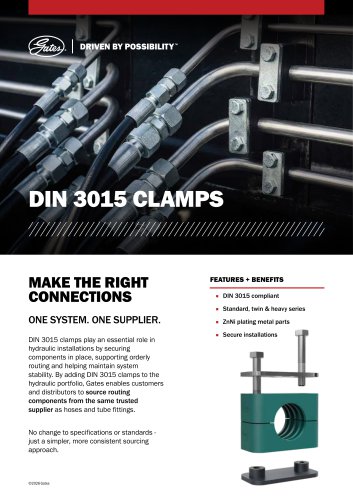 TUBE CLAMPS
2 Pages
 TUBE CLAMPS
39 Pages
 MEGACRIMP™ COUPLINGS
5 Pages
 GATES QUICK-LOK™
24 Pages
 DESIGN FLEX PRO™
1 Page
 DESIGN POWER
2 Pages
 DATA CENTER PUMPS
2 Pages
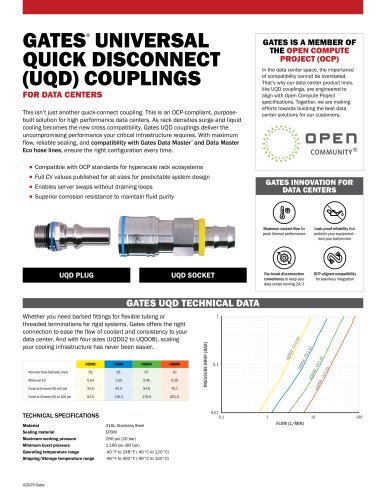
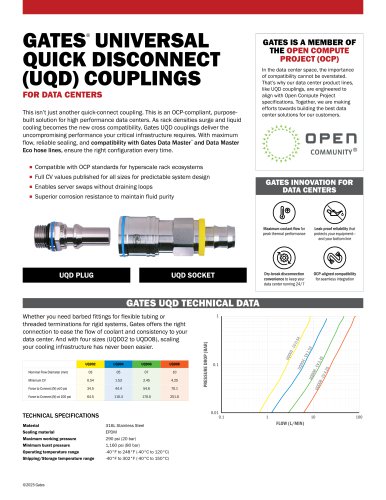
 GATES DATA CENTER COUPLINGS
4 Pages
 ProV Hose Sell sheet
2 Pages
 ProSeries IA3K Sell sheet
2 Pages
 MegaSys Sell sheet
2 Pages
 eCrimp APP Flyer
1 Page
 DSO Cutting ring Sell Sheet
3 Pages
 Hydraulic Tube Fittings Brochure
16 Pages
 Machinery Brochure
20 Pages
 Crimper checklist
2 Pages
 MXG 5K Sell sheet
2 Pages
 MXG 4K Sell sheet
2 Pages
 MXT Sell sheet
2 Pages
 M2T Sell sheet
2 Pages
 Tri Power Sell sheet
2 Pages
 GPP Belts Brochure
8 Pages
 Texrope Catalogue
24 Pages
 Super HC Brochure
22 Pages
 Super HC Sell sheet
2 Pages
 Quad Power 4 Sell sheet
2 Pages
 Quad Power 4 Promo sheet
1 Page
 PowerGrip GT4 Sell Sheet
2 Pages
 Mini Poly Chain Sell sheet
2 Pages
 Design Power
2 Pages
 Chain to belt Promo Sheet
2 Pages
 Chain to belt Sell Sheet
2 Pages
 Boost Sell Sheet
2 Pages
 Boost Catalogue
88 Pages
 Preventive Maintenance Manual
92 Pages
 Predator sell sheet
2 Pages
 Sonic tension meter 550C
2 Pages
 PRO Series CR1 & CR2
2 Pages
 PRO series
2 Pages
 Coolrunner Belts
2 Pages
 Micro-V Water Pumps
2 Pages
 Electric Water Pumps
2 Pages
 Chain-to-Belt Solutions
2 Pages
 Hydraulic Tube Fittings Catalogue
216 Pages








- Pump
- Industrial pump
- Pump with electric motor
- Stationary pump
- Seawater pump
- Centrifugal pump
- GATES piping
- GATES fitting
- Chemical pump
- GATES hydraulic fitting
- Screw-in fitting
- Metal fitting
- GATES plastic hose
- Compact pump
- Quick coupling
- Stainless fitting
- GATES structure hose
- Impeller pump
- GATES flexible hose
- GATES transmission belt