
- Catalogs
- Gardner Denver Thomas
- 520 Series


- Company
- Products
- Catalogs
- News & Trends
- Exhibitions
520 Series

520 Series
- Custom-designed for refrigerant recovery.
- Corrosion-protected aluminum parts.
- Lightweight die-cast aluminum components.
- Oil-less, non-lubricated piston and cylinder.
- Permanently lubricated ball bearings.
- Balanced for smooth, low vibration, and quiet operation.
- UL and CE/TUV/UL approvals for different voltage models.
- Compatible with multiple refrigerants including R-11, R-12, R-22, and others.
- Minimum compression ratio of 50:1.
- Liquid and vapor recovery rates specified.
- Models require a start capacitor and switching mechanism.
- Additional cooling air flow is necessary to maintain motor temperatures.
- Vapor pressure varies with refrigerant and temperature; suction pressure must be limited to avoid motor shutdown.
- 520CJ75: Operates at 100V 50/60Hz, with specific flow rates and pressure limits. Weighs 18.5 lbs (8.4 kg).
- 520CK75: Operates at 115V 60Hz, with specific flow rates and pressure limits. Weighs 17 lbs (7.7 kg).
- 520CL75: Operates at 220V 50Hz, with specific flow rates and pressure limits. Weighs 18.5 lbs (8.4 kg).
Catalog excerpts

FEATURES • Custom designed for Refrigerant Recovery applications • • • • • • • • • • • • All wetted aluminum parts treated for corrosion protection from moisture Lightweight die cast aluminum components Oil-less, non-lubricated piston and cylinder Permanently lubricated ball bearings Balanced for smooth, low vibration and quiet operation UL approval on 115V 60Hz model CE/TUV/UL approval on 220-240V 50Hz model C ompatible with Refrigerants R-11, R-12, R-22, R-113, R-114, R-123, R-134A, R404A, R-410A, R-500 and R-502 Minimum Compression Ratio = 50:1 (11" Hg @ 435 psig and 29.5" Hg barometer) Liquid Recovery Rate: 5-15 lbs/min* Vapor Recovery Rate: .5-1.0 lb/min* Liquid compatible Head/Valve system *Recovery rates may vary depending on recovery system design Thomas Division is an ISO 9001 registered company
Open the catalog to page 1
520 Series Performance Data HEAD CONFIGURATION MODEL NUMBER mbar (gauge) MIN. AMBIENT START TEMP. MOTOR VOLTAGE/FREQUENCY MOTOR TYPE Capacitor Start Capacitor Start Capacitor Start CURRENT AT RATED LOAD (AMPS) POWER AT RATED LOAD (WATTS) STARTING CURRENT (LOCKED ROTOR, AMPS) CAPACITOR VALUE MIN. FULL LOAD SPEED (RPM) THERMAL PROTECTOR OPEN TEMP. MOTOR INSULATION CLASS Note 1: estart stated in terms of differential pressure between crankcase and inlet port. R Note 2: he model 520 requires a start capacitor and a switching mechanism (mechanical or electronic). T Note 3: ressure flow stated assumes...
Open the catalog to page 2
THREAD THRU PULL PLUG) CAPACITOR LEAD LINE LEADS QUICK DISCONNECT (YELLOW, BROWN LEADS) FLAG TERMINAL EXHAUST (PULL PLUG) (PULL PLUG) (PIPE PLUG) PULL PLUG) CAPACITOR LEAD LINE LEADS QUICK DISCONNECT (YELLOW, BROWN LEADS) FLAG TERMINAL EXHAUST (PULL PLUG) (PULL PLUG) (PIPE PLUG) The information presented in this material is based on technical data and test results of nominal units. It is believed to be accurate and reliable and is offered as an aid to help in the selection of Thomas products. It is the responsibility of the user to determine the suitability of the product for his intended use...
Open the catalog to page 3All Gardner Denver Thomas catalogs and technical brochures
 660 Series
3 Pages
 7011 Series
4 Pages
 7006 Series
12 Pages
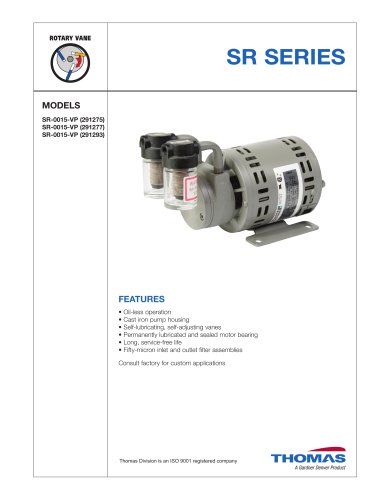 SR Series Performance Data
2 Pages
 VTE | DTE series
12 Pages
 QR SERIES
3 Pages
 MINIATURE series
24 Pages
 SR Series
20 Pages
 Continuous Inkjet Systems
8 Pages
 Accessories Catalog
12 Pages
 380 Series
3 Pages
 2110Z Series
3 Pages
 LINEAR SERIES
3 Pages
 F120 Series
4 Pages
 5002F
5002F6 Pages
 Miniature Diaphragm Pumps
11 Pages
 1610 Series
4 Pages
 Diaphragm Pumps
20 Pages
 118 SERIES
2 Pages
 Diaphragm Pumps
6 Pages
 Peristaltic Pumps Catalog
20 Pages
 Linear Diaphragm Pumps
12 Pages


Archived catalogs
 RotaryVanePumps
24 Pages
 Rotary Vane Pumps
12 Pages
 500 Series
2 Pages
 014 Series
3 Pages
 115 Series
2 Pages
 135 Series
2 Pages
 415Z
415Z2 Pages
 309 Series
3 Pages
 2520 Series
3 Pages
 405 Series
3 Pages
 2220 Series
2 Pages
 415 Series
2 Pages
 215 Series
2 Pages
 2250 Series
2 Pages
 617 Series
2 Pages
 319 Series
2 Pages
 260 Series
2 Pages
 910 & 2907 SERIES
2 Pages
 010 Series
3 Pages
 230 Series
2 Pages
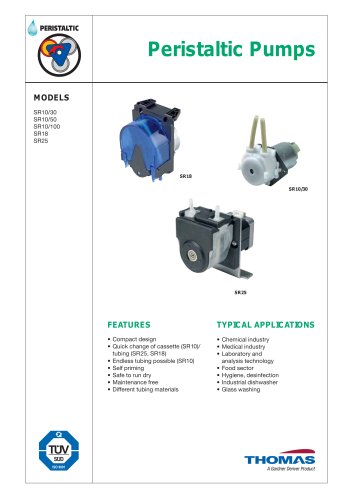 Peristaltic Pumps Catalog
20 Pages
 DiaphragmLiquidPumps
8 Pages
 LMF SERIES
6 Pages
 Linear DiaphragmPumps
12 Pages
 BLDC Product Overview
3 Pages
 800X Series
23 Pages


- Pump
- Industrial pump
- Pump with electric motor
- Stationary pump
- Seawater pump
- Self-priming pump
- Chemical pump
- Compressor stage
- Stainless steel pump
- Air compressor
- Stationary compressor
- Positive-displacement compressor
- Vacuum generator
- Suction pump
- Transfer pump
- Pump for the chemical industry
- Vacuum pump
- Diaphragm pump
- Industrial compressor
- Compact pump