


Stellram Superior cutting tools

Stellram Superior cutting tools
The document introduces Stellram® cutting tools, now part of the Hoffmann Group's product range, which are designed to enhance productivity in machining both conventional and critical metals, particularly hard-to-machine materials.
The Hoffmann Group supports its extensive sales network with a modern logistics center, ensuring high supply and delivery accuracy.
Stellram® offers a variety of products such as X-Grade™ tools, aluminum and contour milling cutters, and indexable face mills, each tailored for specific machining needs.
Stellram® has pioneered innovations like cermet and octagonal milling inserts, significantly impacting the machining industry.
The document details materials used in machining, including stainless steels, titanium and its alloys, and super alloys, each with unique properties and applications.
Stellram®'s patented X-grades with ruthenium substrates enhance performance by reducing hot crack formation and extending tool life.
The flexibility of cutter bodies allows for burr-free plunging and easy adjustments without length correction when changing inserts.
Details on milling cutters and indexable inserts include dimensions, materials, and recommended usage conditions for optimal performance.
The document describes suitable materials for machining and coatings like TiN-TiCN-Al2O3-CVD and TiAlN-PVD that enhance wear resistance.
Specific feed rates and cutting speeds are recommended for different materials and operations to achieve desired results and prolong tool life.
Numerous product variants are listed with part numbers, dimensions, and prices, emphasizing ordering in box quantities and spare parts details.
Important notes include replacing screws when exchanging inserts and balancing shell-type milling cutters with their arbor.
Innovations like the Stellram® 5505 VX offer high flexibility and additional fixation for inserts under high axial stresses.
Details on tool types, shank types, sizes, and insert sizes are provided, with application recommendations.
Tools are suitable for various milling operations and designed for high performance with patented X-grades.
Standard application values and recommended feed rates are specified for different materials and insert types.
Pricing is valid up to 31.07.2012, with some items being non-stock and subject to manufacturer's terms.
Tools feature 4 cutting edges for optimal efficiency, with a design that reduces radial forces and enhances performance in face milling.
Catalog excerpts

Superior cutting tools from Stellram® With Stellram® the Hoffmann Group offers special solutions for the machining of conventional and critical metals INNOVATION Machining ann offm nge eH in th duct ra New p pro Grou
Open the catalog to page 1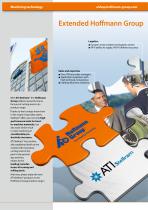
Machining technology Extended Homann Group Logistics Europe's most modern tool logistics centre 99 % ability to supply, 99.9 % delivery accuracy Sales and expertise Over 700 area sales managers Application engineers with high technical competence Leading eBusiness solutions With ATI Stellram® the Homann Group added a powerful manufacturer of cutting tools to its product range. Thanks to their unique know-how in the scope of specialty steels, Stellram® oers you not only high performance tools for hardto-machine materials, but also tools which result in steel machining in considerable productivity...
Open the catalog to page 2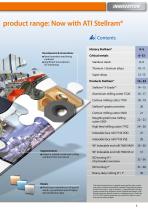
product range: Now with ATI Stellram® Contents History Stellram® Development & innovations New innovative machining methods Signicant innovationen for machining Critical metals Stainless steels Titanium / titanium alloys Super alloys Products Stellram® Stellram® X-Grade™ Aluminium milling cutter 5720 Contour milling cutter 7700 Stellram® grades overview Contour milling cutter 5500 Roughing ball nose milling cutter 5505 High feed milling cutter 7792 Indexable face mill 7745 VOD Indexable face mill 7745 VSE 90° indexable end mill 7690 VA09 Segmentations Industry-related metals and cutting solutions...
Open the catalog to page 3
Machining technology Signicant innovations for machining Over the years, Stellram® has developed signicant innovations for machining. Many standard tools we know today can be traced back to developments of this company. 1995 – Octagonal milling inserts Enables more economic face milling operations due to 8 cutting edges. 1984 – Ruthenium grades With the X-Sorten™ Stellram® created grades, which are unparalleled in the machining of hard-to-machine materials. 1976 Invention and patenting of Cermet. 1964 Patenting of positive turning inserts. Exotic alloys – Zirconium, Hafnium, Niobium or Vanadium...
Open the catalog to page 4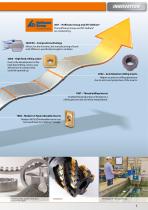
2011 – Homann Group and ATI Stellram® The Homann Group and ATI Stellram® are cooperating. 2 2004/05 – Composite technology Allo Allows, for the rst time, the manufacturing of tools w with dierent, specically brought in carbides. 2003 – Hi feed milling cutter High Due to the development of the e high feed milling cutters, new dimensions in productivity could be opened up. 2002 – Anti-Rotation milling inserts Higher security in milling operations due to anti-twist protection of the inserts. 1987 – Thread milling inserts Enabled the production of threads in a milling process due to helical interpolation....
Open the catalog to page 5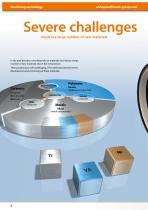
Machining technology Severe challenges result in a large number of new materials In the past decades, new demands on materials have led to a large number of new materials also in the metal sector. Their processing is still challenging. ATI is dedicated to the further development and processing of these materials. Fibre-reinforced composite Ceramics Inorganic Non-metallic Materials Polymers Blends (polymer compounds) Metals Alloys (metal compounds) Hybrid composite
Open the catalog to page 6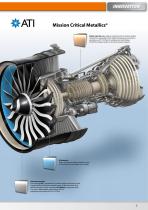
Mission Critical Metallics Metallics® Nickel materials play today an important role in modern engine construction, especially where highest temperature resistance is essential, e. g. ATI 718 Plus, for compressors and turbines. ATI 625 for exhaust nozzles or for thrust reverser systems. 6 5 o e aust o es o o t ust e e se syste s. VA materials T Today, also special stainless steels are used in the production of engines and turbines. Titanium materials T The company ATI is represented in modern engine construction with a large number of titanium materials today. At the same time, they deliver the...
Open the catalog to page 7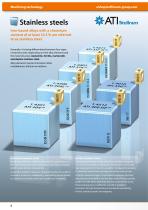
Machining technology Iron-based alloys with a chromium content of at least 10.5 % are referred to as stainless steel. Generally, it is being dierentiated between four types of stainless steel, depending on their alloy elements and the metal structure: Austenitic, ferritic, martensitic and duplex stainless steel. Alloy elements may be chromium nickel, molybdenum, titanium or niobium. Austenitic stainless steels By adding nickel in a sucient extent, the crystal lattice of the steel structure is converted into a cubic face-centered, which is also known as Austenite. Austenitic stainless steels are...
Open the catalog to page 8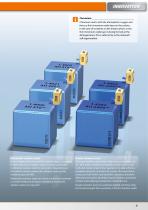
INNOVATION Chromium __________________________________ Chromium reacts with the atmospheric oxygen and forms a thin chromium oxide layer on the surface. In the case of scratches on the metal surface, a new thin chromium oxide layer is being formed at the damaged area. This is referred to as the material's self regeneration. Martensitic stainless steels Have a similar structure as ferritic stainless steels. Compared to them they have a higher carbon content, causing the martensitic stainless steels to be curable. Depending on the carbon content, martensitic stainless steels can be hardened up...
Open the catalog to page 9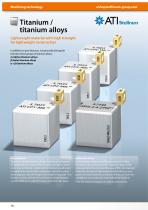
Machining technology Lightweight material with high strength for lightweight construction In addition to pure titanium, we generally distinguish between three groups of titanium alloys: α (Alpha) titanium alloys β (Beta) titanium alloys α + β titanium alloys Pure titanium Titanium is characterised by a high resistance to a number of oxidising acids. Titanium has a similar strength as aluminium. Due to the high melting point, titanium is well suited to applications where high temperature resistance and an advantageous ratio of strength and weight is required. Pure titanium is often oered to the...
Open the catalog to page 10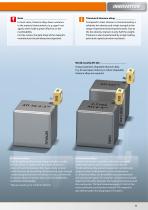
INNOVATION Note __________________________________ Titanium & titanium alloys ________________ In most cases, titanium alloys have a variance in the material characteristics (e. g. aged / not aged), which habe a great inuence on the machinability. For this reason, the data sheet of the material's manufacturer should always be requested. Compared to steel, titanium is characterised by a relatively low density and a high strength in the range of quenched and tempered steels. Due to the low density, titanium is only half the weight. Titanium is also characterised by a high melting point and a good...
Open the catalog to page 11Archived catalogs
 Extra long centre drill
1 Page
 EN TPC milling cutters
24 Pages
 GARANT Tool24
12 Pages
 EN e Tool
12 Pages
 GARANT Tool Grinding
28 Pages
 GARANT heavy-duty rack
67 Pages
 GARANT Cabinets Group 95
116 Pages
 GARANT LockingSystem
50 Pages
 GARANT Micro-Ausdrehkopf
8 Pages
 GARANT Feinbohrkopf
8 Pages
 GARANT ERCO+
5 Pages
 GARANT ERCO
5 Pages
 Modern Materials
32 Pages
 Zero Clamp
36 Pages
 Innovation Machining
4 Pages


- Chuck
- Solid milling cutter
- Fabric clothing
- LED lighting
- Polyester clothing
- Clamping device
- Drilling tool
- Cotton clothing
- Steel milling cutter
- Milling tool with replaceable insert
- Solid drill bit
- Clamping milling cutter
- Saw blade
- Vice
- Workbench
- Machine vise
- Milling cutter with cylindrical shank
- Grade
- Face milling cutter