

H 41

H 41
The Hydromette BL H 41 is a device designed to measure the moisture content in wood and wood fibre insulants. It is particularly useful for those processing or assessing wood fibre insulants, ensuring that facades are checked before plastering to prevent moisture-induced damage.
- Wood Moisture: 5.5 to 40% (dry mass)
- Wood Fibre Insulating Boards: 4.5 to 45% (dry mass)
- Temperature Compensation: -10 to +40 °C
- 7-level wood species correction for over 300 types
- Manual or automatic wood temperature compensation from 10 to +40 °C
- 6 new characteristic curves for wood fibre insulants, categorized by material density and manufacturing process (wet/dry)
The device comes with various accessories, including special insulated electrode nuts necessary for accurate measurements. The Hydromette BL H 41 is available in different sets:
- Set 1: Includes M 20 drive-in electrode, replacement pins, cap nuts, measuring cable, conversion kit, and carrying case.
- Set 2: Includes additional M 19 push-in electrode with insulated pins for measuring in finished thermal insulation systems.
- Without Accessories: The device can also be purchased without additional accessories.
Using the correct electrode nuts is crucial to avoid false readings. The conversion kit M 20-DS 16-i is specifically designed for wood fibre insulating boards.
Catalog excerpts

Wood & wood fibre insulants HYDROMETTE BL H 41 The Hydromette BL H 41 is a measuring device for determining the moisture content of wood and, in particular, of wood fibre insulants. The meter features 6 new characteristic curves for wood fibre insulants, grouped according to the gross density of the material (in kg/m3) and the board manufacturing process (wet/dry). This device is suited for everyone who processes or assesses wood fibre insulants. With the BL H 41 a fagade can be checked prior to plastering to ensure that future moisture-induced damage - e.g. flaking of plastering or lignin exudation - is avoided. The sets contain special insulated electrode nuts that reduce the impact of surface moisture. MEASURING RANGES: ■ WOOD MOISTURE 5.5 to 40 % (dry mass) ■ WOOD FIBRE INSULATING BOARDS 4.5 to 45 % (dry mass) ■ TEMPERATURE COMPENSATION -10 to +40 °C The new characteristic curves are based on products by these manufacturers: AGE PAN* SYSTEM PROPERTIES ■ 7-level wood species correction (more than 300 types) ■ Wood temperature compensation is done manually or automatically in the range from 10 to +40 °C through the unit temperature ■ 6 new characteristic curves for wood fibre insulants ■ Curves are grouped according to the gross density of the material (in kg/m3) and the board manufacturing process (wet/dry)
Open the catalog to page 1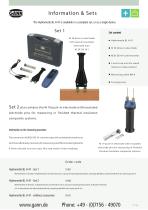
Information & Sets The Hydromette BL H 41 is available in a complete set, or as a single device. Set content M 20 drive -in elec trode with special insulated elec trode nuts n 20 drive -in elec trode M n 20 -DS 16 -i conversion kit M n ex tra cap nuts for wood 2 moisture measurement n Measuring cable MK 8 n Carr ying case Set 2 also contains the M 19 push-in electrode with insulated electrode pins for measuring in finished thermal insulation composite systems. Information on the measuring procedure The conversion kit M 20-DS 16-i contains special insulated electrode nuts, which are absolutely...
Open the catalog to page 2All GANN Mess- u. Regeltechnik GmbH catalogs and technical brochures
 ELECTRONIC MOISTURE METERS
118 Pages
 BL COMPACT TF-IR 2
1 Page
 Catalogue
112 Pages
 MPC 4032
1 Page
 MPP-5
MPP-51 Page
 TF 3
TF 31 Page
 TK-MP 101
1 Page
 TK-MP 301
1 Page
 TK-MP 501
2 Pages
 M 20-DS 16-i
1 Page
 M19
M191 Page
 LB 71
LB 711 Page
 DMT-8
DMT-82 Pages
 BL B 2
1 Page


- Measuring device
- Concentration analyzer
- Data logger
- Temperature datalogger
- Digital pyrometer
- Portable analyzer
- USB datalogger
- Data-logger with screen
- IR pyrometer
- Digital gauge
- Portable gauge
- Portable pyrometer
- Industrial measuring module
- Datalogger with LCD display
- Moisture meter
- Programmable datalogger
- Non-contact thermometer
- Portable moisture meter
- Moisture analyzer
- Thermometer with laser pointer