
- Catalogs
- GAMMA ZINKEN - JET
- Cutters Drills and Blades

Cutters Drills and Blades

Cutters Drills and Blades
Solid carbide spiral router bits are designed for optimal performance with special cutting edge geometry. They feature a fully usable cutting length, round clearance angle for easy re-sharpening, and a longer groove for efficient chip ejection. Made from high-quality hard metal, these bits ensure long-lasting operations and are produced using advanced CNC machines. Special designs are available upon request.
- Right Spiral Cutter: Suitable for cutting plastics, light alloys, and materials with difficult chip removal. The positive spiral aids in upward chip ejection, ideal for blind grooves.
- Left Spiral Cutter: Facilitates downward chip ejection, requiring the board to be left.
These cutters are recommended for various materials including plastics, natural wood, MDF, and light alloys. For light alloys, using nebulized air mixed with oil is suggested to maintain tool cleanliness. The right spiral provides the best finish on the lower panel side, while the left spiral is better for the top side.
These bits offer efficiency and versatility, manufactured according to CE safety regulations. They allow for considerable savings due to the reversibility of knives and slight precision adjustments. The interchangeable knives can be used in both portable routers and CNC machines, ideal for assembling fittings and creating grooves.
The document includes detailed tables listing various cutter types, dimensions, and article numbers, providing a comprehensive guide for selecting the appropriate tool for specific applications.
The document provides detailed specifications for various types of router bits and cutters used in woodworking and composite material processing. It emphasizes the importance of using cutters with larger shanks to minimize vibrations and improve precision.
- Cylindrical Cutters: Suitable for boring and creating grooves in wood. They offer a high-quality finish due to the frontal sharpening of side-cutting edges.
- Pivot Rabbeting Cutters: Used for fitting iron fittings in window frames, with template guides provided by the manufacturer.
- Double-Edge Cutters: Designed for precise trimming and can handle significant material removal.
- Trimming Cutters: Available with both upper and lower bearing guides, ensuring precision and repeatability in trimming operations.
- Jointing Cutters: Specifically designed for assembling hidden junction systems.
- Dovetail Cutters: Ideal for creating strong and durable joints, particularly in woods like beechwood.
- Chamfer Cutters: Used for creating bevels and inclined surfaces, especially in materials like Corian®.
- V-Grooving Cutters: Suitable for engraving and creating grooves in plasterboards.
- When using cylindrical cutters, ensure the correct diameter is chosen to fit the machine's template guides.
- For trimming operations, adjust the cutter height to remove sharp edges effectively.
- Use paraffin on pivots and wood to prevent overheating during chamfering.
- Various bearings and screws are available for different cutter models, enhancing their versatility and functionality.
- Tork keys are recommended for secure assembly and maintenance of the cutters.
The document serves as a comprehensive guide for selecting and using router bits and cutters in woodworking, emphasizing precision, safety, and the importance of using the right accessories for optimal performance.
- Concave Cutters: These include bearing-guided concave cutters with step and pivot concave cutters, designed for precision work in inaccessible areas.
- Convex Cutters: Widely used for their versatility, these cutters are suitable for making grooves, chamfering, and avoiding splintering. They are used in both workshop and home furniture production.
- Ogee Cutters: Known for their classic profile, these cutters are used to create aesthetically pleasing mouldings in carpentry.
- Raised Panel Cutters: Inclined and concave raised panel cutters are designed for producing the middle panels of furniture doors using portable milling machines.
This document provides detailed specifications for various router bits and accessories. It includes information on bearings, screws, and Tork keys, with specific dimensions and codes for each component. The document lists standard and optional accessories, emphasizing the importance of selecting the correct bearing size for different cutter diameters.
The document describes different types of router bits, including those with simple and complex profiles. It specifies the appropriate bearing sizes for each cutter diameter and provides guidelines for reducing cutter speed to 18,000 RPM for larger diameters. The section also covers bearing-guided cutters, highlighting the ability to change bearings to achieve different profiles.
Profile cutters for picture frames and handles are discussed, with recommendations for multiple passes to remove large amounts of material. The document advises on creating cylindrical grooves for efficient chip evacuation when working with solid wood.
Half round cutters are designed for rounding edges on various materials, including laminated woods. Joint cutters for drawers are detailed, with instructions on using different bearing sizes to achieve desired joint strength and appearance.
T-Slot cutters are used for fixing objects to walls, with practical advice on workpiece stabilization. Round cutters are primarily used for creating grooves for inserting rods and cloth in furniture production.
This section emphasizes the versatility of modular cutters, which can be assembled in various configurations. It provides safety measures for assembling cutters and accessories, ensuring proper fit and rotation. The document also includes examples of modular cutter applications, such as conic joints and matchboards, with practical tips for optimizing performance and durability.
The document provides detailed specifications for various modular cutters and slotting cutters used in woodworking. It includes information on assembled double trimming cutters, modular cutters for gaskets, and slot cutters with a bore of 10 mm. The minimum distance between cutters and the dimensions of cavities produced are specified.
Instructions are provided for assembling modular cutters in various configurations. The document advises on staggering cutters to avoid contact between cutting edges and using distance pieces to achieve desired cutting heights. Safety measures are emphasized, such as ensuring the correct number of components and proper tightening of the closing nut.
The document recommends maintaining a minimum distance of 10 mm between cutters and provides guidelines for selecting bearings based on gasket sizes. It also suggests using cylindrical shank boring bits to reduce costs and avoid inconveniences associated with specially made shanks.
Details on available accessories, such as bearings, screws, and distance pieces, are included. The document lists various arbors and bushings for modular cutters, along with their dimensions and part numbers.
Several tables provide data on cutter dimensions, part numbers, and configurations for different applications. These tables help users select the appropriate components for their specific needs.
The document outlines the use of modular cutters for creating furniture doors with different profiles, including simple, medium, and complex profiles. It provides step-by-step instructions for assembling cutters to achieve desired profiles and cutting heights.
Emphasis is placed on ensuring all components are assembled with clockwise rotation and that the guide ball bearing is positioned correctly to minimize cutting strain. Users are advised to follow safety measures when assembling cutters and accessories.
This document provides detailed specifications for various types of boring bits and related components used in woodworking and CNC machinery. It includes measurements, materials, and specific applications for each tool.
- Flat Countersink for Boring Bits: Designed for use with Ø 8 mm bits to fix shelves and accessories in cupboards. Allows for quick and effective adjustment of the desired countersink.
- Boring Bits for Blind Holes: Made of extra-fine micrograin tungsten carbide, suitable for CNC and point-to-point machines. Features round spurs for increased rotation speed and feed rate, reducing manufacturing time.
- Boring Bits for Through Holes: Designed to drill through holes on panels without splintering. Includes a shank with an M5 adjusting screw.
- Countersink to be Fixed to the Shank: For use with boring bits of shank Ø 10x27 mm, must be clamped to the shank.
- Universal Countersink: Compatible with all steel drills on the market.
- Hinge Boring Bit: Specifically for setting hinges and other hardware in furniture, with a negatively ground spur angle to prevent chipping.
- Cylindrical Shank: Used for mounting bits with threaded shank M12x1 on routers.
- Shank with Driving Flat and Adjusting Screw: Enables use of bits with threaded shank M12x1 on automatic machines.
- Interchangeable Spring Collets: For use on combined machines and routers, with safety precautions to ensure proper use.
Emphasizes the importance of regular maintenance and safety precautions, such as checking the efficiency of reducing sleeves and ensuring proper clamping to extend tool life and ensure safety.
Includes information on various chucks and collet holders for CNC routers and point-to-point machines, specifying the most common types and their applications.
Tool holders are essential components used in carpentry machines, with ISO30 being the most common type. When ordering, it is crucial to specify the brand and model of your machine to ensure compatibility with the electros-pindle's pull stud.
These high-precision collets are commonly used in woodworking and mechanical fields. They can tighten up to 1 mm less than their nominal diameter, ensuring a secure fit in machine tool chucks.
Pull studs are subject to wear and should be replaced when necessary. The choice of pull stud depends on the electrospindle manufacturer, and it is advisable to consult the technical handbook or the electrospindle's plate for guidance.
These spindles, available for Vitap, Biesse, and Morbidelli machines, feature M5 locking screws for securing boring bits. They are designed for quick and efficient tool changes.
Gamma Zinken offers a wide range of circular saw blades, including low noise options that reduce acoustic noise by 10-15 dB. The blades are made from high-resistance steel and hard metal, conforming to CE standards. The design focuses on quality, safety, and thermal expansion considerations.
For wood, the blade should protrude at least the height of the tooth, with three teeth cutting simultaneously for optimal finish. For aluminium or plastics, the FT45N (negative) blade is recommended for manual feed machines, while the FT45 (positive) is suitable for automatic feed. The RW blade is ideal for cutting various building materials.
Reduction rings allow circular blades to fit different machines by adapting the hole to the machine shaft. It is recommended to choose a blade bore matching the spindle diameter to avoid eccentricity and vibration.
- Type GLW: Ideal for ripping and cross-cutting soft wood, equipped with a chip thickness limiter to prevent rebounds, suitable for manual feed cutting.
- Type G2W: Used for ripping soft wood and crosscutting medium hardness wood, plywood, and insulating materials.
- Type G3W: Provides a better finish than G2W, used for hard wood and medium hardness wood.
- Type G4W: Designed for crosscutting hard and medium hardness wood, plywood, and insulating materials.
- Type G5W: Offers excellent finish on thin hard natural wood and is used for sizing wooden panels and composites.
- Type TF: Specifically for cutting melamine and laminated chipboard panels.
- Type TFS: Designed for industrial sectioning, suitable for single or multiple panels.
- Flat Toothed: Used for scoring the bottom side of panels, requiring careful machine adjustment.
- Conical Toothed: Easy to adjust, used for veneered and melamine panels.
- Type DH: For cutting panels coated with plastic, melamine, or laminate.
- Type DHN: Features a negative cutting angle for better control.
- Type RW: For cutting non-ferrous metals, plastics, and resins.
- Type FT45: For aluminium sections and plastic materials.
- Type TS: Used in construction for cutting boards and coatings, even with nails.
- FT45N Type: Trapezoidal-flat toothed blade with a negative cutting angle, designed for cutting thin light alloy and plastic sections. The negative angle provides better control and resistance to accidental blockage. Suitable for mitre saws, pendulum saws, and automatic machines.
- KHS Type: High-quality planer knives for professional use, ideal for joineries and furniture factories. Available in various sizes, with custom lengths on request.
- KL Type: Standard quality knives for general use, recommended for roughing wood with potential nails. Minimum order quantity applies.
- Offers a range of HSS planer knives for self-aligning systems and serrated back knives ready for profiling.
- HW planer knives available for portable machines like Makita, Metabo, and DeWalt.
- Magnetic alignment tool for spindle moulders and planing machines, supplied with thickness adjustment gouges.
- High Output Cutter: Basic tool for carpentry, featuring helically placed knives for improved cutting.
- Adjustable Tenon: Versatile tool for basic carpentry, available in light alloy or steel, with easy thickness adjustment.
- Naco Shutter Cutterhead: Produces listels for shutters, includes calibrated distance rings and radius knives.
- Comprehensive tool for various carpentry tasks, including smoothing, rebating, and joint creation, with professional model features.
- Three-Profile Cutter: Designed for small series furniture production, allowing precision adjustment between jamb and transom. Made from light alloy with hard metal knives, available in multiple profiles.
- Plus Cutter: A complete system for furniture doors, enabling the creation of staves. It uses hard metal knives and is made from a special light alloy.
- 2-Piece Set for Cabinet Doors: Allows creation of cabinet doors with or without grooves for glass panels. Includes spacers for joint precision adjustment. Knives are hard metal with additional profiles available.
- 3-Piece Set for Internal Doors: Suitable for doors up to 48 mm thick, with adjustable central groove. Includes spacers for joint precision and hard metal knives with various profiles.
- Left and Right Variants: Innovative designs for increased safety and smoother feed. Made from light alloy, supplied with reversible straight knives and various profile options.
- Designed for perfect concave grooves with adjustable radius precision. Available in different sizes, fitting multiple radius knives made of hard metal.
- Universal cutterhead fitting knives with radii of 5, 6, 8, or 10 mm, inclined at 45°. Supplied with 10 mm radius knives, with other sizes available separately.
- Designed for creating perfect rounded edges with three different radius sizes per cutterhead.
- Smaller cutterhead supports radii of 12.5 mm, 15 mm, and 17.5 mm; larger supports 20 mm, 22.5 mm, and 25 mm.
- Knives are made of hard metal (HW) and feature a 3° exit angle for a smooth finish.
- Used for producing round mouldings, ideal for staff beads in doors and handrails.
- Supports two different HW profile knives.
- Most commonly used joint for its safety and strength.
- Features a micrometrical adjustment system for precision and flexibility in joint production.
- Made from a special light alloy and uses HW knives.
- Fast and simple joint creation process.
- Includes a special calibrated 2.5 mm spacer for precise adjustments.
- Equipped with interchangeable HW knives.
- Allows for precise contouring and reproduction of profiles using a master template.
- Supplied with an aluminium ring and spacer to prevent contact with the cutterhead.
- Available in various thicknesses and diameters.
- Versatile and economical, supplied with straight knives and counterprofiles.
- Knives made of special carbon steel, used in pairs with counterprofiles.
- Allows mounting of all hinge brands with adjustable hole positions.
- Equipped with a 35 mm central drill bit and two lateral bits with a 2.5 mm adapter.
- Suitable for any column drill with a 600 mm support base for stability.
- Includes bits with Ø 10 mm shank for specific metalware types like AGB or Maico.
- Features a 3 spindles head for mounting window closure metalware.
The document describes various drilling guides and devices used in furniture manufacturing, focusing on their specifications and applications. Key products include the FKB 48 drilling template for sliding doors, FSC 24 drilling guide for furniture, FMA 12 adjustable drilling guide for handles, and FRB 20 Plus for barrel joints.
This tool is designed for embedding handles in sliding doors without the need for expensive CNC machines. It includes two plates that secure to the door with screws and drilling templates for handle holes. The template allows for adjustable handle positioning up to 60 mm from the door edge.
Composed of two 25 mm square aluminum bars, this guide facilitates the assembly of panels and cabinets. It includes guide bearings for various drill bit sizes and can be used for precise drilling of cabinet backs and shelves. The standard hole spacing is 32 mm, with the first hole at 16 mm.
This guide is used for drilling holes for furniture and door handles, with a standard inter-axis of 32 mm. It includes a 25 mm square aluminum bar and steel guide bushes. The structure allows for adjustable positioning and rotation at specific angles.
Designed for artisans and hobbyists, this device allows for precise drilling of barrel joints using a portable drill. It ensures accurate alignment and depth control for both vertical and horizontal holes.
The document also mentions bit-stop rings for maintaining consistent hole depth and hardened steel bearings for durability. Replacement bearings are available for various diameters.
Each device is designed to simplify and enhance the precision of drilling operations in furniture manufacturing. The guides and templates are adaptable for different furniture sizes and configurations, providing flexibility and ease of use for both professional and amateur craftsmen.
The document provides guidance on using the FRB system for embedding shelf support bushings, emphasizing the use of Gamma Zinken drill bits for consistency in diameter, length, and attachment. This ensures efficient drilling without frequent depth adjustments. The document also highlights the utility of mounting a flaring tool on drill bits ranging from Ø 5 to Ø 12 mm for creating seats for threaded zamac bushings.
A detailed list of drill bits for the FRB 20 Plus is provided, including diameters, specifications, and article numbers. For additional sizes, users are directed to the tool catalog section F.
The Smart Base is described as a versatile tool that enhances the capabilities of milling machines. It allows for precise pantographing of cabinet doors and is compatible with various templates for doors and windows. The Smart Base is made of anodized aluminum, providing durability and smooth operation. It includes a centering device to align bearings with the machine shaft, reducing vibrations and improving joint quality.
The document describes a device for creating dovetail joints, emphasizing its ability to produce strong and aesthetically pleasing furniture. The CDR 200 board is compatible with any milling machine and features a metalcrylate comb surface to minimize vibrations. The document advises using the Smart Base if additional stability is needed.
A comprehensive list of spare parts and optional components is included, with specifications and article numbers for easy reference.
Catalog excerpts

Sez A - Frese in HM integrale - Solid carbide spiral router bits I dettagli fanno la differenza Speciale geometria del tagliente e della testa Lunghezza tagliente dichiarata interamente utile Spoglia evolvente per ottime riaffilature Spoglia a larghezza costante Scarico prolungato per una migliore evacuazione del truciolo Metallo duro di alta qualità e durata Progettazione avanzata Esecuzione con macchine CNC di ultima generazione Esecuzioni speciali a richiesta del cliente Details make the difference Special geometry of cutting edge and head Cutting length fully useable Round clearance angle for good re-sharpening Clearance angle of uniform width Longer groove for an easy chip ejection High quality hard metal for long lasting operations Accurate projecting phase Produced with the newest CNC machines Special production on request Es. lavorazione con fresa elica positiva Migliore finitura ---- Es. lavorazione con fresa elica negativa Migliore finitura ---- Example of working with a right spiral cutter Better Finish ---- Example of working with a left spiral cutter Better Finish ----
Open the catalog to page 1
Sez A - Frese in HM integrate - Solid carbide spiral router bits Tipo lE - Z l Fresa elicoidale HW integrate - Rotazione destra elica positiva Consigliata per il taglio di plastica, leghe leggere, materiali accoppiati con alluminio e tutti i materiali che producono un truciolo fluente con difficolta di evacuazione. L'elica positiva favorisce lo scarico del truciolo verso l'alto. Adatta per creare cave a fondo cieco. Solid carbide spiral cutter - Right-hand rotation Right spiral Used for cutting plastics, light alloys, aluminium-base materials and any materials producing flowing shavings with...
Open the catalog to page 2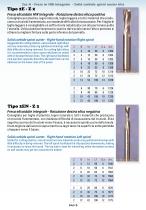
Tipo 2E - Z 2 Fresa elicoidale HW integrate - Rotazione destra elica positiva Consigliata per plastica, legno naturale, leghe leggere e tutti i materiali che produ-cono un truciolo frammentato, con modeste difficolta di evacuazione. Per il taglio di leghe leggere e consigliabile un soffio di aria nebulizzata con olio per tenere pulito l'utensile. L'elica positiva favorisce lo scarico del truciolo verso l'alto e pertanto si ottiene la migliore finitura sulla parte inferiore del pannello. Solid carbide spiral cutter - Right-hand rotation Right spiral Suggested for cutting plastics, natural wood,...
Open the catalog to page 3
Tipo 2EPN - Z 2 Fresa elicoidale HW integrale Rotazione destra elica positiva e negativa Scarico del truciolo verso il basso, e necessario quindi uscire dalla tavola. Utilizzata per taglio e sezionatura di legno natutale, impiallacciato e nobili-tato in genere. La presenza di entrambi i versi dell'elica fa si che entrambe le superfici abbiano un'ottima finitura. Solid carbide spiral cutter - Right-hand rotation Right and left spiral Shaving released downwards, making it necessary to leave the board. Used to cut and sever natural, veneered and noble wood. Both sides of the propeller being used...
Open the catalog to page 4
Tipo 3E - Z 3 Fresa elicoidale HW integrate - Rotazione destra elica positiva Consigliata per il taglio di legno duro, MDF, materiali derivati dal legno e tutti i materiali che producono un truciolo fine senza difficolta di evacuazione. Ottima finitura, superficie liscia e pulita. L'elica positiva favorisce lo scarico del truciolo verso l'alto, adatta per creare cave a fondo cieco. Solid carbide spiral cutter - Right-hand rotation Right spiral Particularly suited for cutting hardwood, MDF, wooden by-products and any materials producing sharp shavings, with no difficulty in being removed. Excellent...
Open the catalog to page 5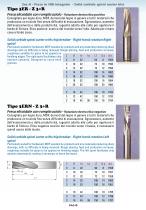
Sez A - Frese in HM integrate - Solid carbide spiral router bits Tipo 3ER - Z 3+R Fresa elicoidale con rompitruciolo - Rotazione destra elica positiva Consigliata per legno duro, MDF, derivati del legno in genere e tutti i materiali che producono un truciolo fine senza difficolta di evacuazione. Sgrossatura, aumento dell'avanzamento e della produttivita, rugosita adatta alle colle per applicare il bordo di finitura. Elica positiva: scarico del truciolo verso l'alto. Adatta per creare cave a fondo cieco. Solid carbide spiral cutter with chip breaker - Right-hand rotation Right spiral Particularly...
Open the catalog to page 6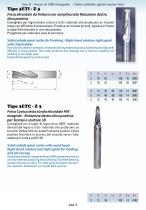
Sez A - Frese in HM integrate - Solid carbide spiral router bits Tipo 3ETI - Z 3 Fresa elicoidale da finitura con rompitruciolo Rotazione destra elica positiva Consigliata per legno tenero e duro e tutti i materiali che producono un truciolo lungo con difficolta di evacuazione. Produce un truciolo piccolo, sgrossa e finisce la superficie lavorata in una sola passata. Progettata per realizzare cave di serrature. Solid carbide spiral cutter for finishing - Right-hand rotation right spiral with chip breaker Particularly suited for softwood, hardwood and any materials producing flowing shavings with...
Open the catalog to page 7
Sez R - Frese a coltelli intercambiabili - Router bits with interchangeable knives Durata ed efficienza - Efficiency and long working life Metallo duro così duro che non si può saldare Possibilità di piccola regolazione della precisione Tungsten carbide tips with extreme hardness Possibility of a slight precision adjustment of the knives Studio particolare delle forme per più utilizzi Economia di utilizzo con la reversibilità dei coltelli Shapes of special design for several applications Considerable savings thanks to the reversibility of knives Grande versatilità Prodotte secondo norme europee...
Open the catalog to page 8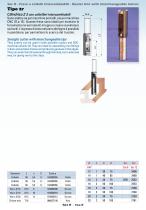
Tipo 2r Cilindrica Z 2 con coltellini intercambiabili Sono adatte sia per macchine portatili, sia per macchine CNC (G .0 12). Queste frese sono ideali per montare la ferramenta nei serramenti in legno e creare scanalature sui bordi. L'ingresso di testa nel pieno del legno e possibile in pendolare, per permettere lo scarico del truciolo. Straight cutter with interchangeable tips They cutters can be used in both portable routers and CNC-machines (shank 12). They are ideal for assembling iron fittings in door and window frames and producing grooves in the edges. They can enter the full material...
Open the catalog to page 9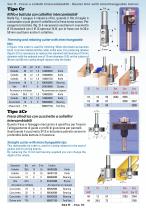
Sez R - Frese a coltelli intercambiabili - Router bits with interchangeable knives Tipo Cr Rifilo e battuta con coltellini intercambiabili Nella fig. 1 esegue il classico rifilo, quando il filo di taglio e consumato si puo girare il coltellino e la fresa torna nuova. Per eseguire la battuta (fig. 2) e necessario sostituire il cuscinetto 0 19 standard con il 0 13 optional. N.B. per le frese con ht 30 e 50 mm sostituire anche il coltellino. Trimming and rebating cutter with interchangeable tips In figure 1 the cutter is used for trimming. When the blade has became blunt, it can be rotated and the...
Open the catalog to page 10All GAMMA ZINKEN - JET catalogs and technical brochures
 Modular slot router cutters
12 Pages
 Circular saw blades
16 Pages
 Planer knives
2 Pages


- Cutting system
- Milling tool
- Solid milling cutter
- Fabric clothing
- Knife cutting system
- Polyester clothing
- Cotton clothing
- Milling tool with replaceable insert
- Solid drill bit
- Workbench
- Work jacket
- Shell-end milling cutter
- Solid carbide milling cutter
- Sheet cutting machine
- Ball nose milling cutter
- Cutting milling cutter
- Rotary blade cutting center
- Tungsten carbide drill bit