
- Catalogs
- Gamewell-FCI
- FSL100 SERIES FLAME DETECTORS AND ACCESSORIES

FSL100 SERIES FLAME DETECTORS AND ACCESSORIES
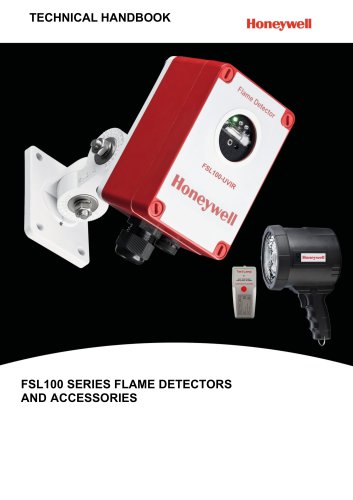
FSL100 SERIES FLAME DETECTORS AND ACCESSORIES
The handbook provides comprehensive guidance on the FSL100 Series Flame Detectors, intended for professionals responsible for installation, operation, and maintenance. It includes models such as FSL100-IR3, FSL100-UV, and FSL100-UVIR.
Emphasizes strict adherence to safety procedures to prevent personal injury or equipment damage. Unauthorized modifications are prohibited due to potential safety hazards. Key safety features include hazardous area certification and automatic sensor self-tests.
The FSL100 series includes models that detect invisible infrared or ultraviolet light to identify fires. The detectors use microprocessors for signal analysis, with the IR3 model offering superior nuisance alarm rejection.
Details the siting, mounting, and orientation of the detectors, including considerations for the cone of vision, shadow effect, and weather protection. Detectors should be positioned to avoid shadow areas and mounted at appropriate heights to prevent smoke interference.
Covers power supply requirements, cabling recommendations, and wiring diagrams for various configurations, including connections to controllers and fire control panels. Specific guidelines for cable type, size, and grounding are provided.
Outlines procedures for commissioning, functional testing, and fault analysis to ensure proper operation. Regular functional testing is recommended to maintain sensitivity.
Describes normal operation, fault conditions, and the use of display LEDs and relay outputs. The FSL100 has three LEDs indicating power, fault, and alarm conditions.
Provides guidelines for routine maintenance to ensure the longevity and reliability of the detectors. Regular inspection and cleaning are recommended, with annual servicing by an approved Honeywell technician.
Instructions for installing the detector using the swivel mount and cleaning procedures. Installation should be performed by qualified personnel.
Safety instructions, operation, and maintenance for the test lamp used in non-hazardous areas.
Guidelines for safe operation and maintenance of the test lamp in hazardous environments.
Lists detailed specifications for the FSL100 detectors and accessories, including power, alarm output, connection options, and environmental conditions.
Includes EC Declaration of Conformity and other national and international compliance certificates.
Provides details on how to order the FSL100 Series products, including various models and accessories.
Outlines the policy for returning and repairing products, including warranty information. Contact Honeywell Analytics Technical Support for warranty claims, repairs, or returns.
The handbook includes figures illustrating wiring configurations and tables with cable data, terminal allocation, accessory specifications, and ordering information.
Provides contact details for Honeywell Analytics across different regions for customer service and technical support.
The publication includes a disclaimer noting that while efforts have been made to ensure accuracy, no responsibility is accepted for errors or omissions.
Catalog excerpts
TECHNICAL HANDBOOK FSL100 SERIES FLAME DETECTORS AND ACCESSORIES
Open the catalog to page 1
Revision History
Open the catalog to page 2
Disclaimer In no event shall Honeywell be liable for any damages or injury of any nature or kind, no matter how caused, that arise from the use of the equipment referred to in this manual. Strict compliance with the safety procedures set out and referred to in this manual, and extreme care in the use of the equipment, are essential to avoid or minimise the chance of personal injury or damage to the equipment. The information, figures, illustrations, tables, specifications, and schematics contained in this manual are believed to be correct and accurate as at the date of publication or revision....
Open the catalog to page 3
This page deliberately left blank.
Open the catalog to page 4
FSL100 Series Flame Detectors Technical Handbook
Open the catalog to page 5
Technical Handbook
Open the catalog to page 6
This technical manual is available in several languages and it covers the installation, operation and maintenance of the following equipment: • FSL100-IR3 Flame Detector (Triple Infrared) • FSL100-UV Flame Detector (Ultraviolet) • FSL100-UVIR Flame Detector (Ultraviolet and Infrared) • FSL100-TL Test Lamp, Charger and Case (Safe Areas) • FSL100-TLX Test Lamp, Charger and Case (Intrinsically safe - IECEx, ATEX) This Manual should be read by everyone who operates or monitors the FSL100 Flame Detection system. Only personnel who have been fully trained by Honeywell are authorised to Install, Set-up,...
Open the catalog to page 7
This page deliberately left blank. FSL100 Series Flame Detectors Technical Handbook
Open the catalog to page 8
SAFETY 2 Safety Hazards, Warnings and Cautions Important Read and understand the instruction manual before operating or servicing the equipment. 2.1 General Warnings and Cautions WARNINGS AND CAUTIONS 1. Installation and commissioning must only be carried out by a Honeywell Analytics approved person or by a qualified person trained in accordance with this manual, and only in accordance with the recognized regulations and standards of the appropriate authority in the country concerned. Do not make any unauthorised changes to the equipment as essential safety and certification requirements may...
Open the catalog to page 9
SAFETY Every effort has been made to ensure the accuracy of this document; however, Honeywell Analytics can assume no responsibility for any errors or omissions in this document or their consequences. Honeywell Analytics would greatly appreciate being informed of any errors or omissions that may be found in the content of this document. For information not covered in this document, or if there is a requirement to send comments/corrections about this document, please contact Honeywell Analytics using the contact details given on the back page. Honeywell Analytics reserve the right to change or...
Open the catalog to page 10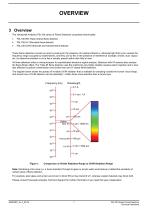
OVERVIEW 3 Overview The Honeywell Analytics FSL100 series of Flame Detectors comprises three models: FSL100-IR3 Triple Infrared flame detector FSL100-UV Ultraviolet flame detector FSL100-UVIR Ultraviolet and Infrared flame detector These flame detectors monitor an area by looking for the presence of invisible infrared or ultraviolet light that occur outside the frequency range occupied by visible flames, and they can do this in the presence of interference (sunlight, smoke, dust, vapour etc.) to determine whether or not a fire is actually present within their field of view. All three detectors...
Open the catalog to page 11
This page deliberately left blank. FSL100 Series Flame Detectors Technical Handbook
Open the catalog to page 12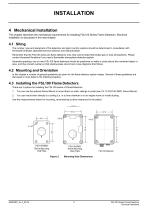
INSTALLATION 4 Mechanical Installation This chapter describes the mechanical requirements for installing FSL100 Series Flame Detectors. Electrical installation is discussed in the next chapter. 4.1 Siting The number, type and placement of fire detectors and alarm control systems should be determined in consultation with Honeywell Analytics specialist technical advisors and Site specialists. Remember that the FSL100 series are flame detectors only; they cannot detect flammable gas or dust atmospheres. Please contact Honeywell Analytics if you need a flammable atmosphere detection system. Generally...
Open the catalog to page 13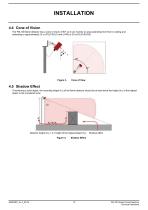
INSTALLATION 4.4 Cone of Vision The FSL100 flame detector has a cone of vision of 90° so it can monitor an area extending from floor to ceiling and extending to approximately 23 m (FSL100-UV and UVIR) or 35 m (FLS100-IR3). 4.5 Shadow Effect If monitoring a solid object, the mounting height (h d) of the flame detector should be at least twice the height (ho) of the highest object in the monitored zone: Detector height (hd) = 2 x height of the highest object (ho) Figure 4. Shadow effect Shadow Effect FSL100 Series Flame Detectors Technical Handbook
Open the catalog to page 14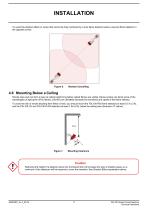
INSTALLATION To avoid the shadow effect (in zones that cannot be fully monitored by a solo flame detector) place a second flame detector in the opposite corner. Shadow Cancelling 4.6 Mounting Below a Ceiling Smoke rises and can form a layer at ceiling height long before naked flames are visible. Dense smoke can block some of the wavelengths of light given off by flames, and this can ultimately decrease the sensitivity and speed of the flame detector. To avoid the risk of smoke blocking their fields of view, you should mount the FSL100-IR3 flame detectors at least 0.5 m (2 ft), and the FSL100-UV...
Open the catalog to page 15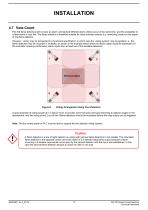
INSTALLATION 4.7 Vote Count FSL100 flame detectors will not give an alarm until several different alarm criteria occur at the same time, and the probability of a false alarm is very low. The flame detector is therefore suitable for relay activated actions (i.e. drenching) based on the signal of one flame detector. However, ‘voting’ may be demanded in a functional specification, in which case the ‘voting-system’ may be applied; i.e., the flame detectors may be mounted in multiples, as shown in the example below where an alarm output would be dependent on the controller receiving confirmatory alarm...
Open the catalog to page 16
INSTALLATION 4.8 Weather Protection It is recommended to place a hood or shield above the flame detector to protect it from sunlight, rain and snow. A stainless steel metal plate of approximately 30 x 30 cm (12 x 12 in) can be mounted directly above the flame detector without inhibiting its field of view. A similar plate can be used to shield it from potential false alarm sources such as smoke-stack flares. 4.9 Hot Work Flame Detectors may alarm in the presence of hot work, for example a welding operation, and this must be taken into account when doing Hot Work risk assessments and when issuing...
Open the catalog to page 17All Gamewell-FCI catalogs and technical brochures
 VESDA SENSEPOINT XCL
3 Pages
 Xtralis® Open Protocol HLITM
2 Pages
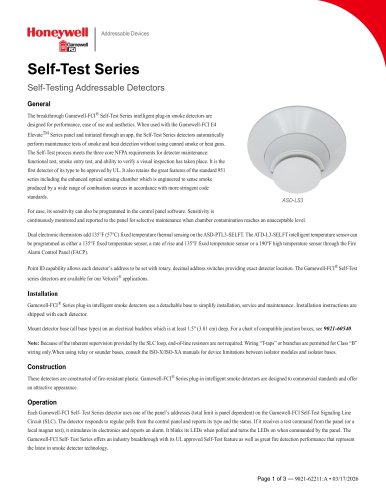 Self-Test Series
3 Pages

Archived catalogs
 IdentiFlex 100
2 Pages
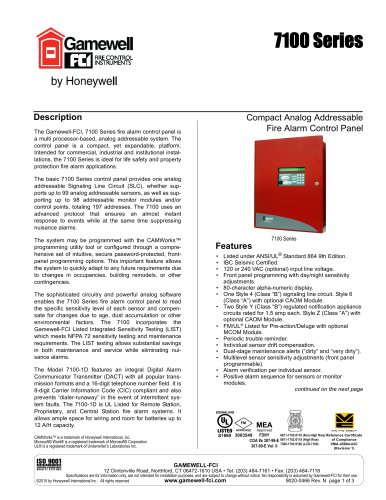 7100 Series
3 Pages
 S3 Series Control Panel
4 Pages
 Sensepoint Pro
6 Pages
- DC power supply
- AC/DC power supply
- Transformer
- Rectangular housing
- Dry transformer
- Digital I/O
- Wall-mount box
- IO module
- Filter cartridge
- Industrial housing
- Digital IO module
- Communication gateway
- Fine filter cartridge
- Protection housing
- Power transformer
- Transceiver module
- Outdoor housing
- Industrial detector
- Serial gateway