

Storage tank level controller

Storage tank level controller
The document describes the ETS/ENR level electronics designed for controlling and monitoring liquid levels, particularly in the metal finishing and electroplating industries. These devices utilize conductive level measurement and are compliant with EN 61326 for electromagnetic compatibility and SIL 2 functional safety according to EN 61508.
Level Monitoring
The ETS 100 device is used for monitoring liquid levels as a MIN or MAX switching contact. It switches contacts when the liquid level exceeds or falls below set thresholds. The ETS 200 can independently monitor two separate liquid levels in one tank.
Level Control
The ENR 300 level controller features a switching relay output for MIN/MAX control and an additional switching contact for further level monitoring. The ETS 410 has four signal inputs and relay outputs, allowing detection and evaluation of four independent levels in one tank, potentially via a PLC. For higher dielectric strength requirements, the EVG 200 electronic ballast device can be used.
Technical Specifications
- ETS 100: 1 level switching point, 1 changeover switch, 1 LED display, voltage 20-230 V AC/DC, switching voltage < 250 V AC, switching current ≤ 5 A.
- ETS 200: 2 level switching points, 2 changeover switches, 2 LED displays, voltage 20-230 V AC/DC, switching voltage < 250 V AC, switching current ≤ 5 A.
- ETS 410: 4 level switching points, 4 changeover switches, 4 LED displays, voltage 20-230 V AC/DC, switching voltage < 60 V DC, switching current ≤ 2 A.
- ENR 300: 3 level switching points, 2 changeover switches, 2 LED displays, voltage 20-230 V AC/DC, switching voltage < 250 V DC, switching current ≤ 5 A.
Additional Features
All devices include a test function, have a switching delay of 3 seconds, and are adjustable with 16 stages for trigger sensitivity. They are designed for mounting on a 35 mm rail and have a casing made of Polyamide PA 6.6 with a flammability class of V0 (UL94). The devices operate within an ambient temperature range of -20 to 60°C and can be stored between -40 to 70°C with a maximum humidity of < 75%.
Catalog excerpts
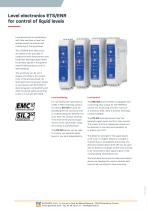
Level electronics ETS/ENR for control of liquid levels Level electronics in combination with float switches or level rod probes permit the control and monitoring of the liquid level. The ETS/ENR level electronics are based on the principle of conductive level measurement and have been developed specifically for process liquids in the general metal finishing industry and for electroplating. The sensitivity can be set in stages according to the conductivity of the process liquid. All level electronics have been tested in accordance with EN 61326 for electromagnetic compatibility and offer functional safety according to SIL 2 in line with EN 61508. Level monitoring Level control For monitoring the liquid level as a MIN or MAX switching contact, The ENR 300 level controller is equipped with a switching relay output for the MIN/MAX the device ETS 100 is used. On exceeding the set maximum level or undershooting the defined minimum level, the contact switches. If the level of the process liquid returns to the “permitted” range, the contact is switched back. control. For monitoring a further minimum or maximum level, there is another switching contact available. The dielectric strength of the signal inputs is 50 V DC. If a higher dielectric strength is required (e.g. in pulseplating processes), the electronic ballast device EVG 200 can be used with an dielectric strength of 200 V DC and has to be connected to each signal inputs of the corresponding level electronics. The level electronics and the electronic ballast device are designed for control cabinets with top-hat rail mounting for close mounting. The ETS 200 device can be used to monitor two separate liquid levels in one tank independently. The ETS 410 level electronics have four separate signal inputs and four relay outputs. This means that four independent levels can be detected in one tank and evaluated, for in-stance via a PLC
Open the catalog to page 1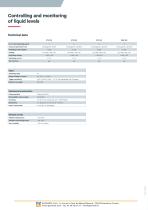
Controlling and monitoring of liquid levels Technical data ETS 100 No. of level switching points Contacts (potential-free) Switching status display Switching voltage Switching current Test function Input Switching delay Output voltage / current Trigger sensitivity 0,05...100 kΩ (10 μS ... 2 x 10⁴ μS) adjustable with 16 stages Dielectric strength Mechanical construction Casing material Flammability class housing Ambient temperature Transport and storage temp.
Open the catalog to page 2All Galvatek catalogs and technical brochures
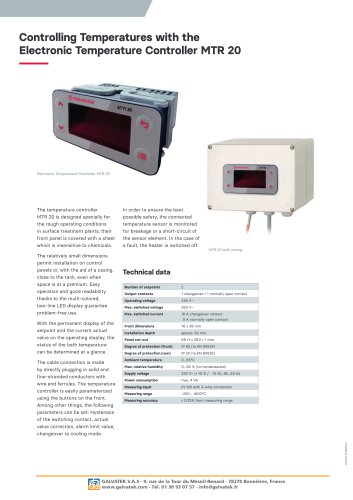 MTR20
MTR201 Page
 SF Probe
1 Page
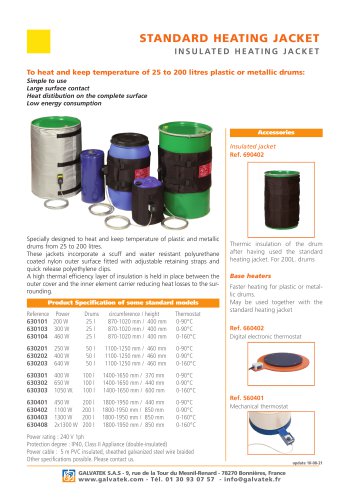 STANDARD HEATING JACKET
1 Page
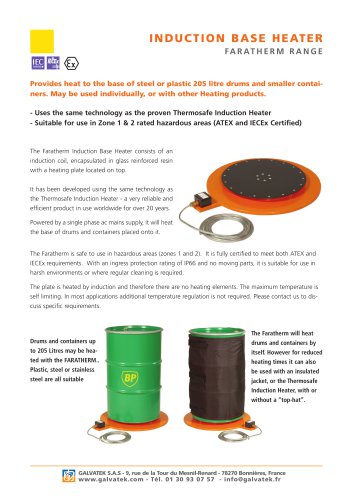 Faratherm Range
2 Pages
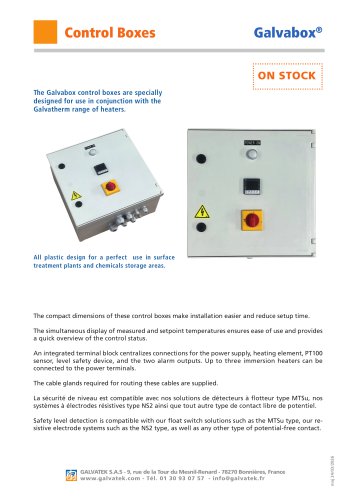 control box
2 Pages
 BC and BC/L
2 Pages
 ROTKAPPE ABS
2 Pages
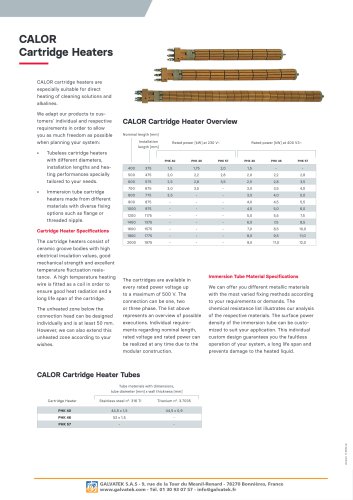 CALOR Cartridge Heaters
2 Pages
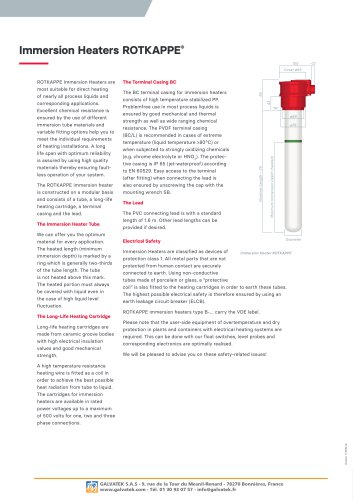 Immersion Heaters ROTKAPPE®
2 Pages
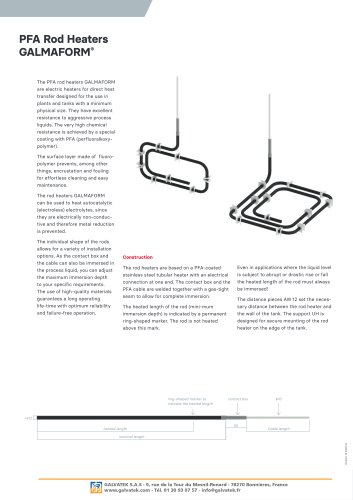 PFA Rod Heaters GALMAFORM®
2 Pages
 Conductive level probe
2 Pages
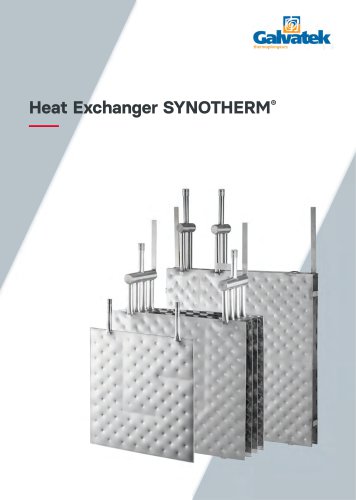 Heat Exchanger SYNOTHERM®
8 Pages
 General Product brochure
8 Pages
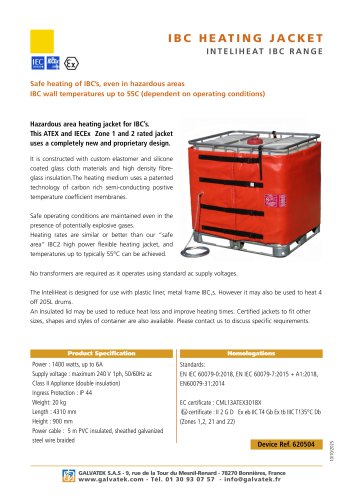 Inteliheat IBC Range
1 Page
 Inteliheat Range
1 Page
 Silicone Heating Belt
1 Page
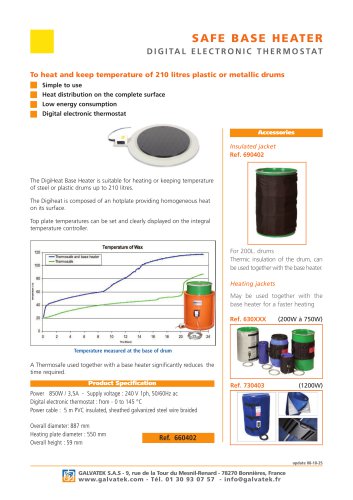 Digiheat Range
1 Page
 BASE HEATER - 560401
1 Page
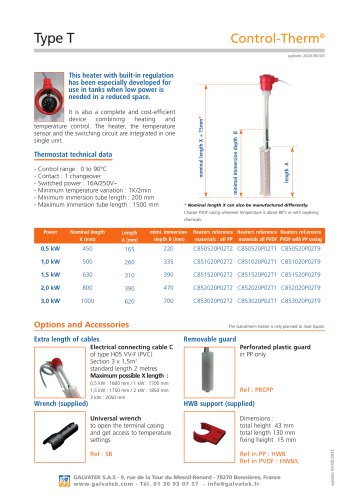 Control-Therm Type T
1 Page
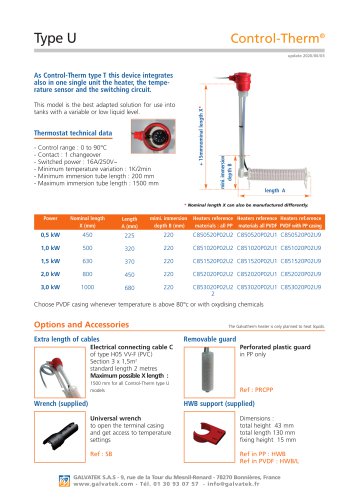 Control-Therm Type U
1 Page
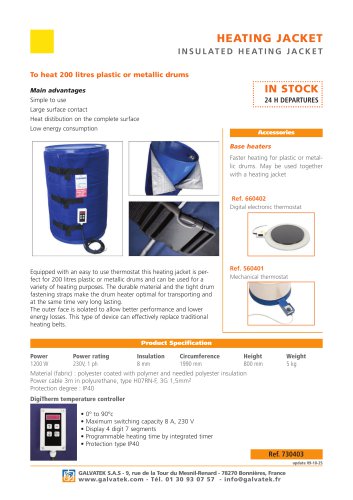 Insulated Heating Jacket
1 Page
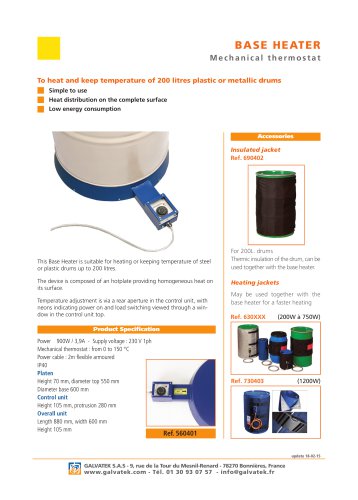






- Temperature probe
- Resistance temperature sensor
- Level limit switch
- Liquid level detector
- Digital temperature control
- Heat exchanger unit
- Thermocouple temperature transducer
- Pt100 temperature transducer
- Temperature controller
- Float level switch
- Liquid/liquid heat exchanger
- Stainless steel temperature transducer
- Stainless steel level detector
- Digital temperature controller
- Threaded level switch
- Heater
- Plate heat exchanger
- Tubular heat exchanger
- RTD temperature sensor
- Tank level limit switch