

NS/NT Electrode Level Detectors
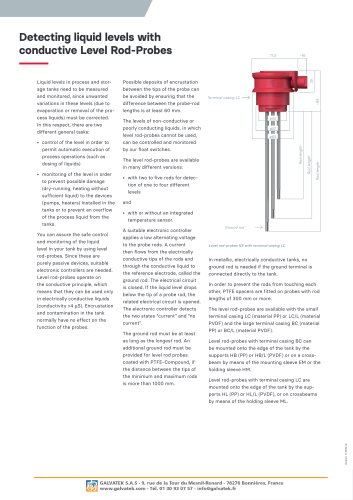
NS/NT Electrode Level Detectors
Liquid levels in process and storage tanks must be measured and monitored to correct unwanted variations due to evaporation or removal of process liquids. This involves two main tasks: controlling the level for automatic process operations and monitoring the level to prevent damage to devices or overflow.
Level Rod-Probes
Level rod-probes are used for safe control and monitoring of liquid levels in tanks. They operate on the conductive principle and are suitable for electrically conductive liquids with conductivity greater than 4 μS. They are unaffected by encrustation and contamination, provided the difference between probe-rod lengths is at least 60 mm.
Non-Conductive Liquids
For non-conductive or poorly conducting liquids, float switches are recommended instead of level rod-probes.
Probe Variants
Level rod-probes are available in versions with two to five rods for detecting one to four different levels, and with or without an integrated temperature sensor. A suitable electronic controller applies a low alternating voltage to the probe rods, detecting the states of 'current' and 'no current' based on liquid level.
Installation Requirements
The ground rod must be at least as long as the longest rod, with additional requirements for PTFE-coated probes. In metallic tanks, no ground rod is needed if the ground terminal is connected directly to the tank. PTFE spacers are used to prevent rods from touching each other.
Materials and Casings
Level rod-probes are made from various materials for optimal chemical and thermal resistance. Terminal casings are available in small (LC) and large (BC) sizes, made from PP or PVDF, with a protection degree of IP 65. The BC version is recommended for high temperatures or oxidizing chemicals.
Specifications
Specifications include coating materials, maximum liquid temperatures, and probe rod materials. The selection table provides options for control and monitoring electronics, detailing the number of levels to be detected and the corresponding probe rod types.
Conclusion
Level rod-probes, when used with suitable electronic controllers, ensure safe control and monitoring of important process parameters, offering flexibility in installation and material choice to suit various industrial needs.
Catalog excerpts
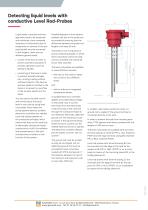
Liquid levels in process and storage tanks need to be measured and monitored, since unwanted variations in these levels (due to evaporation or removal of the process liquids) must be corrected. In this respect, there are two different general tasks: • control of the level in order to permit automatic execution of process operations (such as dosing of liquids) • monitoring of the level in order to prevent possible damage (dry-running, heating without sufficient liquid) to the devices (pumps, heaters) installed in the tanks or to prevent an overflow of the process liquid from the tanks. You can assure the safe control and monitoring of the liquid level in your tank by using level rod-probes. Since these are purely passive devices, suitable electronic controllers are needed. Level rod-probes operate on the conductive principle, which means that they can be used only in electrically conductive liquids (conductivity >4 gS). Encrustation and contamination in the tank normally have no effect on the function of the probes. Possible deposits of encrustation between the tips of the probe can be avoided by ensuring that the difference between the probe-rod lengths is at least 60 mm. The levels of non-conductive or poorly conducting liquids, in which level rod-probes cannot be used, can be controlled and monitored by our float switches. The level rod-probes are available in many different versions: • with two to five rods for detection of one to four different levels • with or without an integrated temperature sensor. A suitable electronic controller applies a low alternating voltage to the probe rods. A current then flows from the electrically conductive tips of the rods and through the conductive liquid to the reference electrode, called the ground rod. The electrical circuit is closed. If the liquid level drops below the tip of a probe rod, the related electrical circuit is opened. The electronic controller detects the two states "current" and "no current". The ground rod must be at least as long as the longest rod. An additional ground rod must be provided for level rod probes coated with PTFE-Compound, if the distance between the tips of the minimum and maximum rods is more than 1000 mm. In metallic, electrically conductive tanks, no ground rod is needed if the ground terminal is connected directly to the tank. In order to prevent the rods from touching each other, PTFE spacers are fitted on probes with rod lengths of 300 mm or more. The level rod-probes are available with the small terminal casing LC (material PP) or LC/L (material PVDF) and the large terminal casing BC (material PP) or BC/L (material PVDF). Level rod-probes with terminal casing BC can be mounted onto the edge of the tank by the supports HB (PP) or HB/L (PVDF) or on a crossbeam by means of the mounting sleeve EM or the holding sleeve HM. Level rod-probes with terminal casing LC are mounted onto the edge of the tank by the supports HL (PP) or HL/L (PVDF), or on crossbeams by means of the holding sleeve ML. Ral GALVATEK S.A.S - 9, rue de la Tour du Mesnil-Renard - 78270 Bonnieres, France www.galvatek.com - Tel. 01 30 93 07 57 - [email protected]
Open the catalog to page 1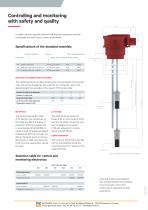
In order to ensure optimal chemical and thermal resistance, the level rod-probes are made from a variety of materials. Specifications of the standard materials Probe rod material Coating Code letter Temp. Sensor material (in case of NT) K PTFE-Compound B Stainless steel (Mat. No. 316 TI) T Titanium (Mat. No. 3.7035) Overview of available level rod-probes The switching points are determined by the various lengths of the probe rods and can be changed by the customer by cutting the rods to the desired length (not possible in the case of PTFE probe rods). Number of levels to be detected 12 3 4 Number...
Open the catalog to page 2All Galvatek catalogs and technical brochures
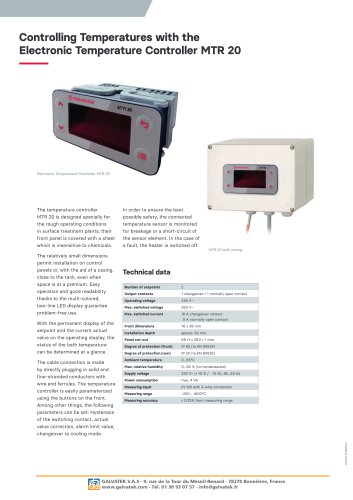 MTR20
MTR201 Page
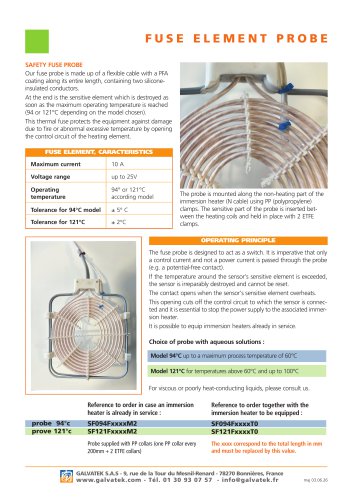 SF Probe
1 Page
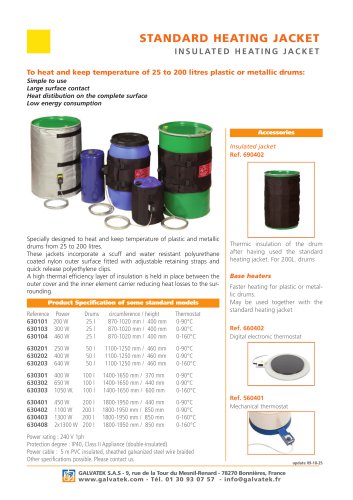
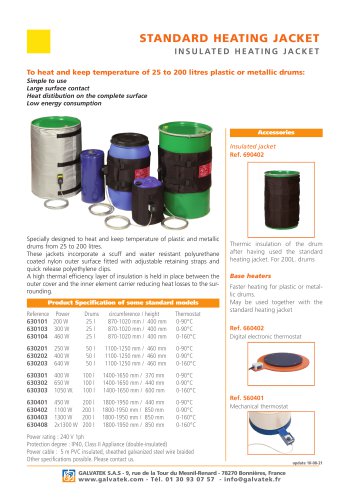 STANDARD HEATING JACKET
1 Page
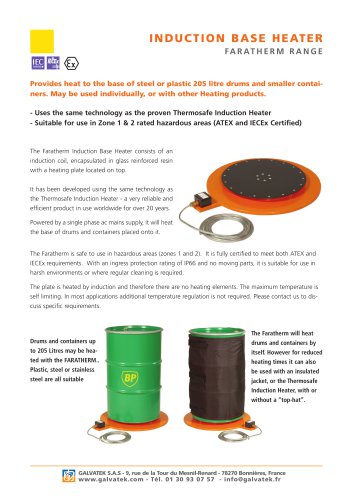 Faratherm Range
2 Pages
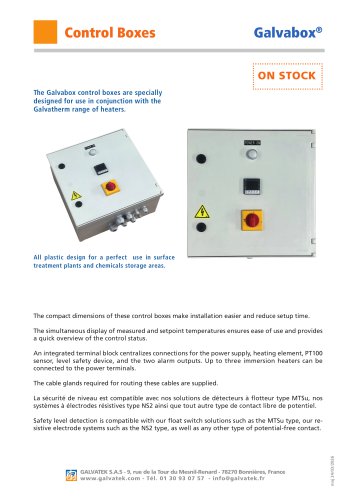 control box
2 Pages
 BC and BC/L
2 Pages
 ROTKAPPE ABS
2 Pages
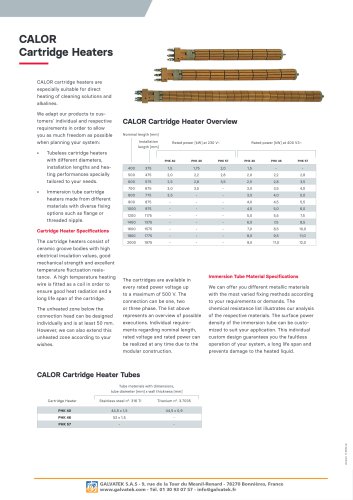 CALOR Cartridge Heaters
2 Pages
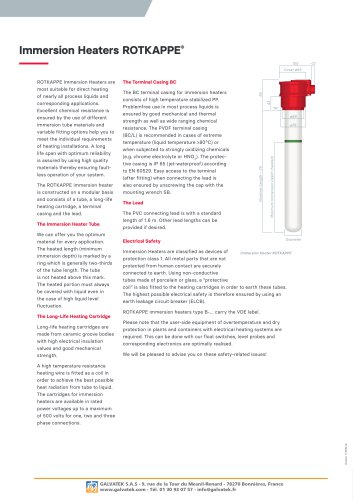 Immersion Heaters ROTKAPPE®
2 Pages
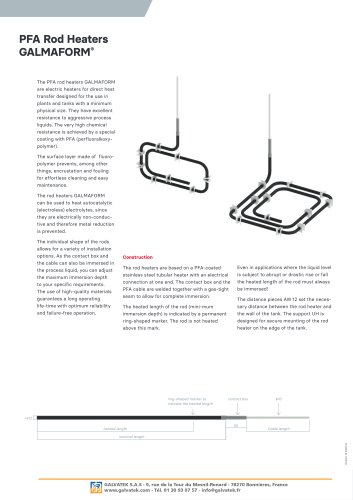 PFA Rod Heaters GALMAFORM®
2 Pages
 Conductive level probe
2 Pages
 Heat Exchanger SYNOTHERM®
8 Pages
 General Product brochure
8 Pages
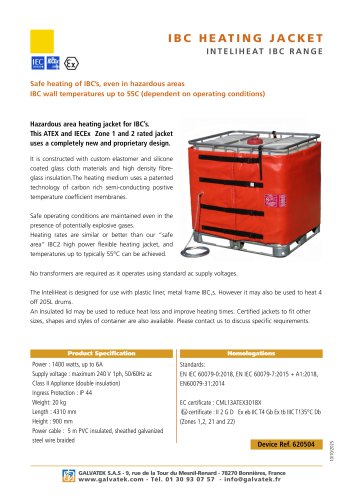 Inteliheat IBC Range
1 Page
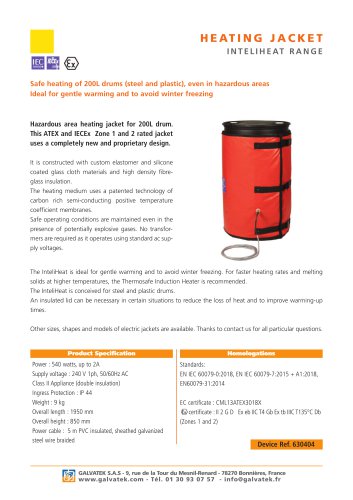 Inteliheat Range
1 Page
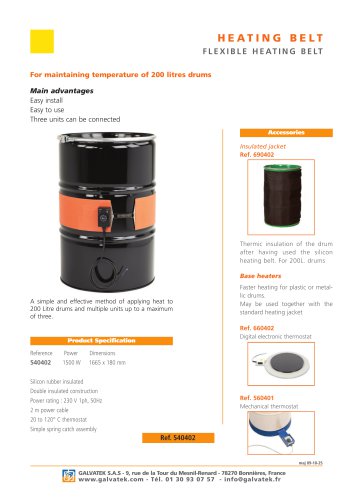 Silicone Heating Belt
1 Page
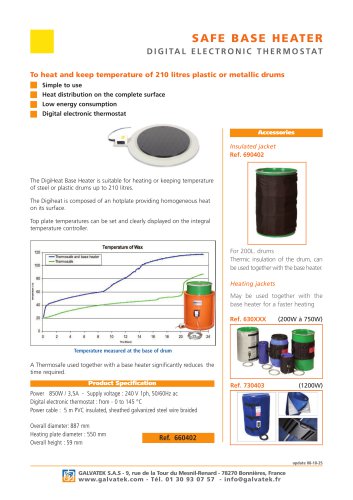 Digiheat Range
1 Page
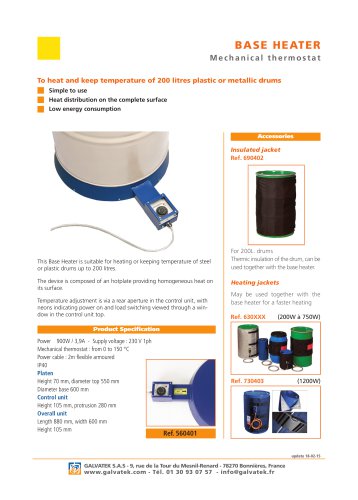
 BASE HEATER - 560401
1 Page
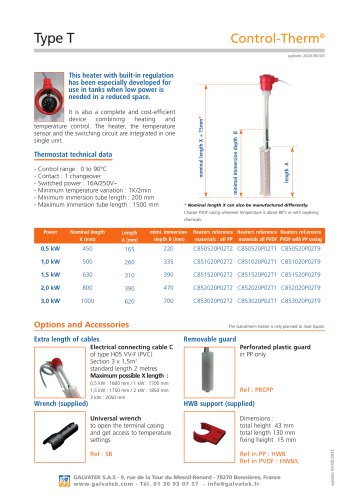 Control-Therm Type T
1 Page
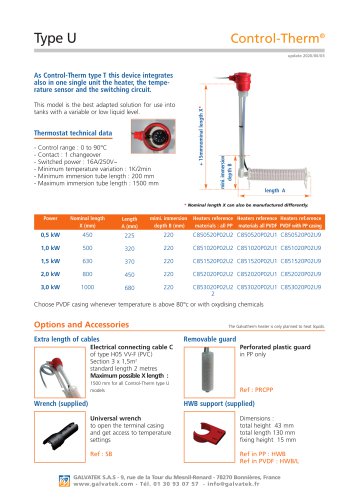 Control-Therm Type U
1 Page
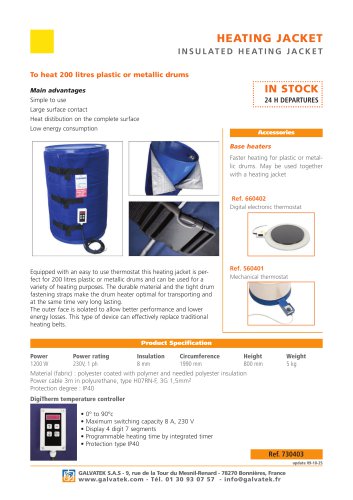 Insulated Heating Jacket
1 Page



- Resistance temperature sensor
- Level limit switch
- Liquid level detector
- Digital temperature control
- Heat exchanger unit
- Thermocouple temperature transducer
- Pt100 temperature transducer
- Temperature controller
- Float level switch
- Liquid/liquid heat exchanger
- Stainless steel temperature transducer
- Stainless steel level detector
- Digital temperature controller
- Threaded level switch
- Plate heat exchanger
- Tubular heat exchanger
- RTD temperature sensor
- Tank level limit switch