
- Catalogs
- GAI-TRONICS
- Emergency Roadside Telephone: Type 354 (ERT)


Emergency Roadside Telephone: Type 354 (ERT)

Emergency Roadside Telephone: Type 354 (ERT)
- Supports six languages: English, French, German, Italian, Spanish, and Welsh.
- Includes a user display for prompting, volume control, and non-voice communication.
- Ergonomic design with patented safety features meeting European Standards (BS EN 12767).
- Environmentally friendly with solar cells and low power consumption.
- Low maintenance costs, increased reliability, and rapid installation.
- Comprehensive diagnostics with automatic self-testing and reporting.
Catalog excerpts
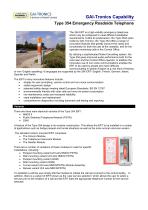
GAI-Tronics Capability Type 354 Emergency Roadside Telephone The 354 ERT is a high-visibility emergency telephone, which may be configured to meet different installation requirements. Unlike its predecessor, the Type 352A (also made by GAI-Tronics), the Type 354 offers a range of innovative features that greatly improve the clarity and functionality for both the user at the roadside, and for the operator monitoring calls in the Control Office. By utilizing a sophisticated Noise-Cancelling system, the Type 354 gives improved audio performance both for the road user and the Control Office operator. In addition the innovative use of non-voice communications enables the ERT to be used by people who have difficulty communicating in spoken English (e.g. the hard of hearing or non- English speaking). 6 languages are supported by the 354 ERT- English, French, German, Italian, Spanish and Welsh The ERT’s many innovative features include: display for user prompting, volume control and non-voice communication stylish ergonomic design patented safety design meeting latest European Standards. BS EN 12767 environmentally friendly with solar cells and very low power consumption low maintenance costs and increased reliability rapid installation and replacement comprehensive diagnostics including automatic self testing and reporting Variants There are three main electrical variants of the Type 354 ERT: NMCS II Public Switched Telephone Network (PSTN) GSM A feature of the Type 354 design is its modular construction. This allows the ERT to be installed in a variety of applications such as bridge parapet and tunnel situations as well as the more normal columnar version. The standard column mounted ERT comprises: The Column Module The Telephone Instrument Module The Header Module There are a number of variations of these modules to cater for specific installations, including: Parapet mounting variant (2/4 wire NMCS/ PSTN) Wall mounting variant (2/4 wire NMCS/ PSTN) Parapet mounting variant (GSM) Wall mounting variant (GSM) Tunnel variant (2/4 wire NMCS/PSTN) Module Assembly Recess variant (2/4 wire NMCS/PSTN) To establish a call the user simply lifts the handset to initiate the call and connect to the control facility. In addition, there is a variant of ERT known as the ‘user service selection’ which allows the user to select a service prior to the initiation of a call and the ERT dials the appropriate telephone number for the service selected.
Open the catalog to page 1
GAI-Tronics Capability Type 354 Emergency Roadside Telephone Control System The development of the Type 354 ERT included the parallel development of a number of supporting subsystems: Telephone Text Controller (TTC). This PC based system is designed to initiate and manage calls from ERT’s where the operator has selected that the call should be switched to a text mode call. Centralised Maintenance Depot Terminal Equipment (CMDTE). This is a server based system to which all of the deployed 354 ERT’s call into on a daily basis in order to report the ERT’s current health status, as well as check...
Open the catalog to page 2All GAI-TRONICS catalogs and technical brochures
 VoIP Clean Phone®
2 Pages
 Public Help
2 Pages
 Red Alert Telephone
20 Pages
 LED Strobe
2 Pages
 RED ALERT® Compact Tower
2 Pages
 RED ALERT® Pedestal
2 Pages
 Rugged Telephone
12 Pages
 Behavioral Health Telephones
12 Pages
 Commander GSM (GSM-R)
2 Pages
 Acoustic Hood - 16dB
1 Page
 EX Beacons - Xenon, 21 Joule
2 Pages
 Model 13360 / 13361
2 Pages
 Cable Selection Guide
4 Pages
 Hood 16dB
1 Page
 Industrial Communications System
33 Pages
 Help Point PHP400
2 Pages
 Help Point VR
2 Pages
 Hood 23dB
2 Pages
 Public Address Systems PA/GA
4 Pages
 RigCom
2 Pages
 RigCom IEC & ATEX Zone 1
2 Pages
 Sentinel
2 Pages
 Sounder / Beacon Combined Ex
2 Pages
 Titan Telephone
2 Pages
 Titan GSM (GSM-R)
2 Pages
 Titan GSM-R Solar Powered
2 Pages
 VR Help Point
2 Pages
 Telephone Features
2 Pages
 Solar Powered GSM-R Titan
2 Pages
 VoIP Clean phone
2 Pages
 Help Points
2 Pages
 Embedded Telephone Kit
2 Pages
 Elemecplus
5 Pages
 UL Division I RigCom
2 Pages
 On-Board Communications
2 Pages
 GSM (GSM-R) Titan
2 Pages
 Hood: 23dB
2 Pages
 VoIP Auteldac 4
2 Pages
 PHP400 Help Point
2 Pages
 Public Access Help Point
2 Pages
 Embedded Phone Kit
2 Pages
 IEC & ATEX Zone 1 RigCom
2 Pages
 Hood Post
1 Page
 GSM (GSM-R) Commander
2 Pages
 Accessories
2 Pages
 Ex Sounder
2 Pages
 Hood 9dB
1 Page
 Ex Combination Alarm
2 Pages
 Commander with Headset
2 Pages
 Titan For Rail
2 Pages
 Ex Beacons-5 Joule
2 Pages
 Ex Beacons, 21 Joule
2 Pages
 Sonic Alarm
4 Pages
 PullSwitch
1 Page
 On-board Communication
2 Pages
 EZ Page Intercom system
2 Pages


- Power supply unit
- DC power supply
- Electrical cable
- AC/DC power supply
- Rectangular housing
- Power cable
- Windows PC
- Insulated cable
- Insulated electrical cable
- Metal box
- Single-output power supply
- Electrical data cable
- Warning light
- Signal amplifying integrated circuit
- Indoor enclosure
- LED beacon light
- Compact housing
- Control pedal
- Outdoor housing
- Strobe warning light