


- Company
- Products
- Catalogs
- News & Trends
- Exhibitions
LCB Series

LCB Series
The LCB Series provides tension and compression solutions with threaded receptacles and posts for easy installation. Some models offer high IP ratings and submersible capabilities, while others include flats for enhanced support during installation. Fatigue-rated versions are available for extended life cycles.
To prevent damage, do not exceed the sensor's IP rating and store it in a dry area. Ensure loads are centered and inline, using flats or lock nuts for support during installation. Maximum bolt torque specifications are provided for various models.
Proper mounting requires inline and centered loads, flat support surfaces, and correct load fixture contact. Measurement tolerances are specified based on decimal points.
Proper cable handling is essential to avoid damage. Minimize stress and movement, and ensure bends do not exceed specified radii. Different cable materials are recommended based on application needs.
The LCB series uses a 6-pin Bendix cable or a non-removable cable with four bare wires. Standard wiring includes + and - Excitation and Signal connections, with additional Sense connections for six-wire setups.
Cable shielding should be grounded on one end to prevent ground loops. Annual calibration is recommended, with options for NIST and A2LA accredited calibrations.
Common issues include high zero output, non-responsive outputs, and incorrect load readings. Solutions involve checking power, wiring, and load placement. Recalibration may be necessary to confirm sensor performance.
Additional resources and support are available through FUTEK's website, including calibration data and recalibration services.
Ensure stability of structures to accommodate temperature changes and confirm support surfaces are stable under load. Internal damage from liquid exposure is irreparable. Recalibration is available to confirm sensor performance.
Potential causes of noisy or unstable output include noisy power supply, unstable load, proximity to high power equipment, and ground loops. Solutions include ensuring power supply stability, securing load fixtures, rerouting cables, and confirming proper wiring and grounding. Load cells should not contain active electronics that contribute to noise.
Noise reduction tips and support information for FUTEK instruments are available online. Annual recalibration is recommended, with periods defined by application and usage conditions. Calibration data and services are accessible through FUTEK's website. Technical support and repair services can be requested online.
Catalog excerpts

Tension and Compression Sensor Family Manual Sensor Solutions Source Load · Torque · Pressure · Multi-Axis · Calibration · Instruments · Software
Open the catalog to page 1
LCB Tension and Compression Sensor Family Manual Table of Contents Features . . . . . . . . . . . . . . . . . . . . . . . . . . . . . . . . . . . . . . . . 3 . . Shield Usage and Connections . . . . . . . . . . . . . . . . . . . . . 10 . . Maximum Installation Torque. . . . . . . . . . . . . . . . . . . . . . . . . 5 Bolt Torque and Tightening Pattern. . . . . . . . . . . . . . . . . . . . 7 Further Support Resources. . . . . . . . . . . . . . . . . . . . . . . . . . 13 Cable Care and Routing. . . . . . . . . . . . . . . . . . . . . . . . . . . . . 8 Sensor Solution Source Load · Torque · Pressure...
Open the catalog to page 2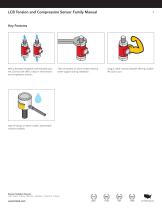
LCB Tension and Compression Sensor Family Manual With a threaded receptacle and threaded post, the LCB load cell offers a drop-in inline tension and compression solution. Flats are present on some models allowing better support during installation. High IP ratings on select models. Submersible versions available. Sensor Solution Source Load · Torque · Pressure · Multi-Axis · Calibration · Instruments · Software Fatigue rated versions available offering a higher life cycle cou
Open the catalog to page 3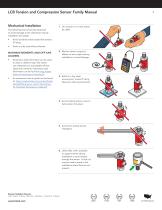
LCB Tension and Compression Sensor Family Manual Mechanical Installation The following items should be observed to avoid damage to the LCB sensor during installation and usage. • 1. Do not pull on or carry sensor by cable. Avoid conditions that exceed the sensors IP rating. Store in a dry area without fixtures. MAXIMUM MOMENTS AND OFF-AXIS LOADING • Extraneous load information can be used to assist in determining if the sensor can withstand any unavoidable off-axis loads and moments. Extraneous load information can be found at: http://www. futek.com/extraneous-load-factor An extraneous how-to...
Open the catalog to page 4
LCB Tension and Compression Sensor Family Manual MAXIMUM CENTER HUB INSTALLATION TORQUE MODEL MAXIMUM BOLT TORQUE (in-lbs) Sensor Solution Source Load · Torque · Pressure · Multi-Axis · Calibration · Instruments · Software
Open the catalog to page 5
LCB Tension and Compression Sensor Family Manual Mounting and Installation Below is information for proper mounting and installation. Refer to the sensor spec sheet for thread information and proper load cell orientation to maximize performance and limit cable interference. • 1. Load must be in line and centered when compensating linkages are not used 90° Measurements are called out on the sensor spec sheet and have the following tolerances based on the number of decimal points present. DECIMAL FORMAT 2. Support surfaces must be flat and inline Active End Fixed End 3. Load fixture must contact...
Open the catalog to page 6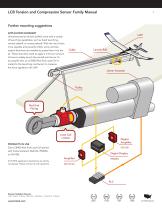
LCB Tension and Compression Sensor Family Manual Further mounting suggestions APPLICATION SUMMARY Unmanned aerial vehicles (UAVs) come with a variety of launching capablities, such as hand launching, vertical takeoff, or runway takeoff. With the rise of ever more capable and powerful UAVs, some vehicles require launchers are needed to propel them into the air. These launchers need to apply a minimum amount of force to safely launch the aircraft into the air. To accomplish this, an LCB400 Rod End Load Cell is mated to the launching mechanism to measure the force applied to the UAV. Launch Rail...
Open the catalog to page 7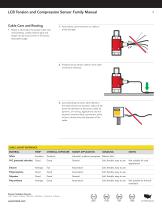
LCB Tension and Compression Sensor Family Manual Cable Care and Routing • Below is information for proper cable care and handling. Cable material type and length can be found online in the sensor description page. 1. Avoid stress and movement on cable to avoid damage. 2. Properly secure sensor cable to limit cable movement influence. 3. Avoid bending the strain relief. Bends in the cable should not exceed a radius of ten times the diameter of the sensor cable for dynamic, or moving, applications and not exceed a onetime static, permanent, bend of two to three times the diameter of the cable....
Open the catalog to page 8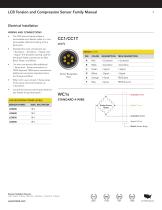
Bridge Sensor XXXΩ LCB Tension and Compression Sensor Family Manual 9 – Excitation (White) – Signal (Green) Electrical Installation Shield (Floating) Power Supply (+) (Red) The LCB load cell series utilizes a removeable 6-pin Bendix cable or a nonremoveable cable terminating to four bare wires. Ground (–) (Black) Standard four wire connections are + Excitation, – Excitation, + Signal, and – Signal. The standard coloring code for the above listed connections are Red, Black, Green, and White. Consult the sensor’s online spec sheet for any further wiring information. LCB EXCITATION POWER LEVELS...
Open the catalog to page 9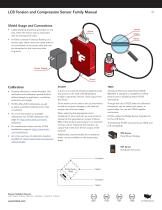
LCB Tension and Compression Sensor Family Manual Shield Usage and Connections • Cable shielding should be grounded on one end, either the sensor side or instrument side to avoid ground loops. Shield Wires • A shield connection listed as floating on a sensors spec sheet means the cable shield is not connected on the sensor side and may be connected on the instrument side to ground. Power Supply • A yearly calibration is recommended. But verification and calibration period shall be defined based on application, conditions, endurance and usage. A shunt is an external resistance applied across two...
Open the catalog to page 10
LCB Tension and Compression Sensor Family Manual Troubleshooting When troubleshooting, we recommend that the sensor be removed from any fixtures. In order to confirm that that sensor is operating correctly, we suggest placing the sensor on a firm surface, and to apply a known load. We also recommend using a volt meter with a clean power supply to confirm the sensor is operating correctly. POSSIBLE CAUSE High zero output • Sensor is under preload • Fixtures or bolting stress for causes of pre-load. • Overload shift would not be repairable. • Sensor has been overloaded from too much load, off axis...
Open the catalog to page 11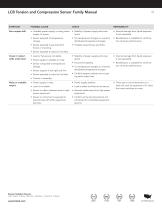
LCB Tension and Compression Sensor Family Manual POSSIBLE CAUSE Zero output drift • Unstable power supply, or noisy power supply, to sensor. • Stability of power supply and noise levels. • Internal damage from liquid exposure is not repairable. • Sensor exposed to temperature change. • For temperature changes or unevenly distributed temperature changes. • Recalibration is available for confirmation of sensor performance. • Sensor exposed to pre-load from fixture or mounting. • Possible loose fixtures and bolts • Sensor exposed to liquid or humidity. Creep in output while under load • Load or...
Open the catalog to page 12All FUTEK Advanced Sensor Technology, Inc. catalogs and technical brochures
 IHH500
4 Pages
 IPM650
3 Pages
 TDF675
2 Pages
 TDF650
2 Pages
 TDF600
2 Pages
 TDF400
2 Pages
 PFT510
2 Pages
 LTH Series
12 Pages
 TFF Series
13 Pages
 LLB Series
13 Pages
 FUTEK MODEL QTA163
1 Page
 Product Guide Eight Edition
36 Pages
 PMP410
1 Page
 PMP927
1 Page
 MBA400 series
2 Pages
 MBA500 series
2 Pages
 MTA400 series
2 Pages
 MTA500 series
2 Pages
 MTA505
2 Pages
 MTA600
2 Pages
 MAU300
1 Page
 IAC200
2 Pages
 IAA200
2 Pages
 IAA300
2 Pages
 FSH03912
2 Pages
 IHH500 Pro
4 Pages
 FSH03460
4 Pages
 FSH03633
3 Pages
 FSH03395
2 Pages
 FSH03927
2 Pages
 FSH03631
2 Pages
 USB520 series
3 Pages
 MODEL IAC200
2 Pages
 FSH00820: PFP350
1 Page
 FUTEK Product Guide
36 Pages
 Application Booklet
68 Pages
 Waste Management
1 Page
 Automated Capping Press
1 Page
 Nut Runner Force/Torque
1 Page
 Motor Test Stand
1 Page
 Power Tool Measurement
1 Page
 Torque/Motor Test Stand
1 Page
 Portable Crane Weighing
1 Page
 Material Force Testing
1 Page
 Batch Weighing
1 Page
 Snow Shoe Testing
1 Page
 Robotic Tactile Sensing
1 Page
 Nut Runner Force/Torque
1 Page
 DNA Synthesis
1 Page
 Multihead Weigher
1 Page
 Medical Patient Lift
1 Page
 Linear Test Stand
1 Page
 Silo Measurement
1 Page
 Tank Dispensing
1 Page
 Wire Tension Measurement
1 Page
 Toggle Force Clamp
1 Page
 Bolt Fastening
1 Page
 Medical Bag Weighing
1 Page


Archived catalogs
 FUTEK 2005 Catalog
24 Pages
 Product Guide 2007
24 Pages
 Medical / Rehabilitation
1 Page
 Automotive
1 Page
 Special and custom
1 Page
- Analysis software solution
- Tension/compression force transducer
- Steel load cell
- Strain gauge force sensor
- Terminal box
- Digital indicator
- Stainless steel force transducer
- Pressure probe
- Panel panel meter
- Measurement software
- Wall-mounted splice box
- Beam type force sensor
- Signal amplifying integrated circuit
- Compression force transducer
- Polymer junction box
- Membrane pressure sensor
- Analog pressure sensor
- IP67 force transducer
- Stainless steel pressure sensor