
- Catalogs
- Fusion Incorporated
- Paste Brazing & Soldering Alloys


Paste Brazing & Soldering Alloys

1 / 10 PagesView full catalog
Paste Brazing & Soldering Alloys
Product catalog summary
Introduction
The document provides an overview of Fusion Paste Brazing and Soldering processes, emphasizing the benefits of using Fusion Paste Alloys for efficient application of filler metal and flux. The paste is stored in a pressurized reservoir and can be applied using automatic or semi-automatic equipment.
The document provides an overview of Fusion Paste Brazing and Soldering processes, emphasizing the benefits of using Fusion Paste Alloys for efficient application of filler metal and flux. The paste is stored in a pressurized reservoir and can be applied using automatic or semi-automatic equipment.
The Fusion Paste Process
Fusion Paste Alloys enable simultaneous application of filler metal and flux, eliminating pre-fluxing and reducing costs through automation. Various conventional heating methods ensure a reliable bond by cleaning the joint area and allowing the filler metal to flow and form a strong joint.
Fusion Paste Alloys enable simultaneous application of filler metal and flux, eliminating pre-fluxing and reducing costs through automation. Various conventional heating methods ensure a reliable bond by cleaning the joint area and allowing the filler metal to flow and form a strong joint.
Paste Alloys
Fusion Paste Brazing or Soldering Alloys are custom blended, consisting of finely atomized filler metal, a fluxing agent, and a paste-like binder, ensuring precise application and consistent joint quality.
Fusion Paste Brazing or Soldering Alloys are custom blended, consisting of finely atomized filler metal, a fluxing agent, and a paste-like binder, ensuring precise application and consistent joint quality.
Selection Guides
The document includes selection guides for brazing and soldering fluxes and filler metals, providing criteria for choosing appropriate materials based on joint configuration, base metals, and service requirements.
The document includes selection guides for brazing and soldering fluxes and filler metals, providing criteria for choosing appropriate materials based on joint configuration, base metals, and service requirements.
Flux Types
Fluxes are categorized into non-corrosive, intermediate, and corrosive types, each with specific properties and applications. Non-corrosive fluxes are suitable for electrical applications, while intermediate and corrosive fluxes offer stronger action for more challenging surfaces.
Fluxes are categorized into non-corrosive, intermediate, and corrosive types, each with specific properties and applications. Non-corrosive fluxes are suitable for electrical applications, while intermediate and corrosive fluxes offer stronger action for more challenging surfaces.
Joint Configuration and Base Metals
The document discusses the importance of joint clearance and base metal compatibility in selecting filler metals, emphasizing proper metallurgical interaction and the impact of heating time and temperature on joint quality.
The document discusses the importance of joint clearance and base metal compatibility in selecting filler metals, emphasizing proper metallurgical interaction and the impact of heating time and temperature on joint quality.
Service Requirements
Filler metals must meet application specifications for strength and corrosion resistance, especially in environments with varying temperatures or moisture.
Filler metals must meet application specifications for strength and corrosion resistance, especially in environments with varying temperatures or moisture.
Conclusion
Fusion Paste Brazing and Soldering offer advantages such as cost reduction, improved joint quality, and elimination of manual errors. The document provides comprehensive guidance on selecting appropriate materials and processes for specific applications.
Fusion Paste Brazing and Soldering offer advantages such as cost reduction, improved joint quality, and elimination of manual errors. The document provides comprehensive guidance on selecting appropriate materials and processes for specific applications.
Specifications
The document lists various solder and brazing alloys, including their compositions, melting ranges, and suitable fluxes for industrial applications. It details specifications for different alloys, including Tin/Lead, Tin/Antimony, Tin/Silver, and Tin/Lead/Silver pastes, along with their ASTM specifications.
The document lists various solder and brazing alloys, including their compositions, melting ranges, and suitable fluxes for industrial applications. It details specifications for different alloys, including Tin/Lead, Tin/Antimony, Tin/Silver, and Tin/Lead/Silver pastes, along with their ASTM specifications.
Procedures
The document outlines the use of different fluxes, including non-corrosive and water-washable types, for aluminum and other base metals, emphasizing the importance of controlling heat during the brazing process.
The document outlines the use of different fluxes, including non-corrosive and water-washable types, for aluminum and other base metals, emphasizing the importance of controlling heat during the brazing process.
Standards and Recommendations
Recommendations for pairing specific fluxes with filler metals are provided to ensure optimal joint strength and reliability. The document also discusses the importance of using a controlled atmosphere to minimize oxidation during brazing.
Recommendations for pairing specific fluxes with filler metals are provided to ensure optimal joint strength and reliability. The document also discusses the importance of using a controlled atmosphere to minimize oxidation during brazing.
Key Data from Tables
The tables provide a comprehensive list of Fusion Paste Solder Alloys and Fusion Specialty Brazing Filler Metals, detailing their nominal compositions and melting ranges, crucial for selecting the appropriate alloy for specific applications.
The tables provide a comprehensive list of Fusion Paste Solder Alloys and Fusion Specialty Brazing Filler Metals, detailing their nominal compositions and melting ranges, crucial for selecting the appropriate alloy for specific applications.
Glossary
A glossary section defines key terms such as eutectic, filler metal, flux, and capillary attraction, providing clarity on technical jargon used throughout the document.
A glossary section defines key terms such as eutectic, filler metal, flux, and capillary attraction, providing clarity on technical jargon used throughout the document.
Introduction to Cleanliness
The document discusses the importance of cleanliness in brazing and soldering processes, introducing Fusion's Fuze-Clean metal preparation chemicals for precleaning and postcleaning of base metals.
The document discusses the importance of cleanliness in brazing and soldering processes, introducing Fusion's Fuze-Clean metal preparation chemicals for precleaning and postcleaning of base metals.
Precleaning (Surface Preparation)
Precleaning is crucial to remove foreign matter before assembly, ensuring proper capillary attraction and effective flux action. Methods include chemical cleaning and mechanical removal.
Precleaning is crucial to remove foreign matter before assembly, ensuring proper capillary attraction and effective flux action. Methods include chemical cleaning and mechanical removal.
Postcleaning (Flux Residues)
Postcleaning is necessary to remove corrosive flux residues that can damage joints over time. Suggested cleaners vary based on base metal and heating techniques.
Postcleaning is necessary to remove corrosive flux residues that can damage joints over time. Suggested cleaners vary based on base metal and heating techniques.
Key Terms and Concepts
Definitions of terms such as corrosive, liquidus, oxidation, slump, soldering, solidus, and wettability are provided to enhance understanding of the processes.
Definitions of terms such as corrosive, liquidus, oxidation, slump, soldering, solidus, and wettability are provided to enhance understanding of the processes.
See more
All Fusion Incorporated catalogs and technical brochures
 DISPENSABLE FLUX PRODUCTS
2 Pages
 No. 545 - Shotgun Assembly
2 Pages
 Brazing & Soldering
1 Page
 BRAZE MATE Model 200
1 Page
 "Braze Mate" Model 150
1 Page
 BRAZE MATE Model 100
1 Page
 APPLICATION DATA
1 Page
 Paste Brazing & Soldering Alloys
20 Pages
 Induction Atmosphere Brazing
2 Pages
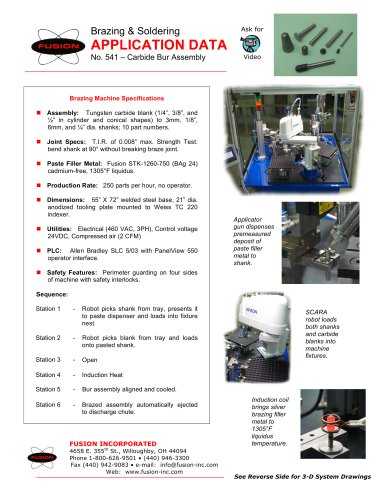
 Carbide Bur Brazing Machine
2 Pages







Archived catalogs


Related Searches
*Prices are pre-tax. They exclude delivery charges and customs duties and do not include additional charges for installation or activation options. Prices are indicative only and may vary by country, with changes to the cost of raw materials and exchange rates.
About DirectIndustry
DirectIndustry is a marketplace that offers B2B players a complete experience, from product sourcing to purchase. DirectIndustry is an entity of VirtualExpo Group.
Are you a buyer?
Are you a supplier?