


- Products
- Catalogs
- News & Trends
- Exhibitions
LIFEBOOK E5410

LIFEBOOK E5410
Fujitsu's commitment to environmental sustainability is reflected in its Product Carbon Footprint (PCF) analysis for the LIFEBOOK E5410. The estimated carbon footprint for this product is 805 kg CO2eq, with a standard deviation of +/- 69.9 kg CO2eq, calculated using the PAIA tool. This estimate represents the life cycle of an industry-average computer.
Fujitsu’s Environmental Philosophy and Mission
Fujitsu emphasizes sustainability as a core part of its business strategy, addressing global environmental issues such as climate change and resource scarcity through ICT solutions. The company aims to create new value and transform business and society by reducing greenhouse gas emissions.
Uncertainty and Life Cycle Analysis
The document acknowledges the uncertainty in calculating product carbon footprints, especially for product-to-product comparisons. Fujitsu strives for transparency in CO2eq emissions across the product's value chain to identify potential emission reductions. The life cycle phases considered include Raw Material, Assembly, Transport/Distribution, Use, and Disposal/Recycling.
PAIA Tool and Methodology
The PAIA tool, developed by MIT and other universities, provides a streamlined life cycle analysis to estimate the carbon impact of various PC products. It is not publicly available, and results may change as the tool is updated. The document is valid only with "THE ECO DECLARATION" of the specific product.
Assumptions for Carbon Footprint Calculation
Key assumptions include a screen size of 14 inches, use location in the EU, assembly location in Japan, a yearly energy demand of 19.48 kWh, product weight of 1.79 kg, and a product lifetime of 5 years.
Contact Information
Fujitsu Technology Solutions GmbH, Mies-van-der-Rohe-Straße 8, 80807 Munich, Germany.
Disclaimer
Technical data is subject to modifications, and any liability for completeness or accuracy is excluded. For further information, refer to ts.fujitsu.com/terms_of_use.html.
Catalog excerpts
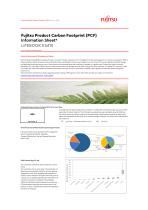
Fujitsu Product Carbon Footprint (PCF) March 2022 Fujitsu Product Carbon Footprint (PCF) Information Sheet* LIFEBOOK E5410 *covers all brand names followed by suffixes Fujitsu’s Environmental Philosophy and Mission Environmental sustainability has always formed a core part of Fujitsu’s business. From the adoption of park-style design for our factory in Kawasaki in 1935 to today’s ambitious Fujitsu Group Environmental Action Plan, sustainability is a key to every stage of our end to end ICT services. Significant climate change and declining biodiversity are just two of many serious environmental issues that continue to escalate on a global scale. Furthermore, with the world’s population now more than 7 billion, there are rising concerns about a shortage of food, water, energy and other resources. As a global ICT company, Fujitsu can create new value and transforms business and society. The Fujitsu Group is committed to helping resolve global environmental issues through the power of ICT. There are further activities from Fujitsu regarding climate change. Mid/long term vision and further activities are visible on the internet. FUJITSU Climate and Energy Vision : Fujitsu Global Estimated Product Carbon Footprint (PCF) of no more than 1) All estimates of carbon footprint are uncertain. To reflect the uncertainty, Fujitsu reports the 95th percentile of carbon footprint. The information provided here was calculated using the PAIA tool. The values shows the carbon footprint for the specification listed under assumptions table further below and represents the life cycle of an industry average computer. For this product, that estimate has a mean of Greenhouse Gas (GHG) Emissions (percentage of total) Life cycle phases can be grouped into five categories which includes Raw Material, Assembly, Transport/Distribution, Use and Disposal/Recycling (End of Life). GHG Emission (kg CO2 eq) The uncertainty of product carbon footprint is shown below. The uncertainty can be quite large. The calculation of absolute and comparable values for all the impacted categories of a life cycle analysies and especially for product carbon footprint during the entire life cycle of a product is not possible especially for the intention of a product-to-product comparison. Nevertheless, Fujitsu has attained a good transparency concerning CO2eq emissions along the entire value chain of the product in order to identify the potential for additional reduction of emissions.
Open the catalog to page 1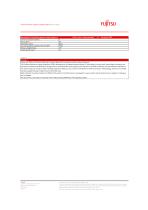
Fujitsu Product Carbon Footprint (PCF) March 2022 Fujitsu uses PAIA tool (Product Attribute to Impact Algorithm) to perform product carbon footprints. The Product Attribute to Impact Algorithm (PAIA), developed by the Massachusetts Institute of Technology in concert with Arizona State University, and University of California at Berkeley, is an approach to streamlined life cycle analysis (LCA) that aims to provide an efficient and cost-effective estimate of the carbon impact of a product class, including notebooks, desktops, LCD monitors, and televisions. PAIA is primarily a methodology, which...
Open the catalog to page 2All Fujitsu catalogs and technical brochures
 STYLISTIC Q7310
2 Pages
 LIFEBOOK U9310
2 Pages
 FUJITSU Tablet LIFEBOOK T939
8 Pages
 Fujitsu LIFEBOOK S938
6 Pages
 FUJITSU Workstation CELSIUS
2 Pages
 LIFEBOOK U7 Family
2 Pages
 FUJITSU Workstation CELSIUS R970
10 Pages
 From edge to core to cloud
8 Pages
 Online Storage Systems
2 Pages
 Data-Centric Storage
10 Pages
 CONTROL SYSTEM & OPTIONAL PARTS
28 Pages
 MULTI SPLIT
26 Pages
 PRIMEFLEX Cluster-in-a-box
2 Pages
 rx1330-m3
11 Pages
 rx2510-m2
10 Pages
 LIFEBOOK-S937
6 Pages
 ESPRIMO-X923-T
8 Pages
 ESPRIMO-X956-T
8 Pages
 Data sheet - PRIMERGY RX2530 M1
12 Pages
 Data sheet - PRIMERGY RX2540 M1
11 Pages
 Data sheet - PRIMERGY RX2520 M1
11 Pages
 ETERNUS JX40 S2
5 Pages
 ETERNUS DX60 S3
6 Pages
 ETERNUS JX40
5 Pages
 ETERNUS DX200 S3
6 Pages
 ETERNUS DX100 S3
6 Pages
 PRIMEQUEST 2800B
8 Pages
 PRIMEQUEST 2800B2
8 Pages
 PRIMEQUEST 2400E2
9 Pages
 PRIMEQUEST 2800E2
8 Pages
 FUJITSU Enterprise
138 Pages
 1800E
1800E9 Pages
 PRIMEQUEST 2400E
9 Pages
 PRIMEQUEST 2800E
10 Pages
 Fujitsu Mainboard D3162-B
3 Pages
 Fujitsu Mainboard D3128-B
3 Pages
 Fujitsu Mainboard D3243-S
3 Pages
 Fujitsu Mainboard D3231-S
3 Pages
 Fujitsu Mainboard D3235-S
3 Pages
 Fujitsu Mainboard D3236-S
3 Pages
 Fujitsu Mainboard D3313-S
3 Pages
 Fujitsu Mainboard D3003-S
3 Pages
 Fujitsu Mainboard D3071-S
3 Pages
 Fujitsu Mainboard D3076-S
3 Pages
 Fujitsu Mainboard D3230-B
3 Pages
 Fujitsu Mainboard D3221-B
3 Pages
 Fujitsu Mainboard D3220-B
3 Pages
 Fujitsu Mainboard D2990-A
3 Pages
 Fujitsu Mainboard D2991-A
3 Pages
 Fujitsu Mainboard D3161-B
3 Pages
 BroadOne GX4000 Series
4 Pages
 ds-fts-primequest1800e2
7 Pages
 ds-primequest2800b
8 Pages
 ETERNUS DX8700 S2
5 Pages
 PRIMEQUEST 1800E2
10 Pages
 Microcontroller
36 Pages
 FerVID family FRAM RFID LSI
4 Pages
 FRAM (All Products Catalog)
4 Pages
 FCRAM (All Products Catalog)
4 Pages
 Fujitsu Automotive Solutions
9 Pages
 FUJITSU SEMICONDUCTOR LIMITED
10 Pages
 test
test3 Pages




![Microcontroller [All Products Catalog]](https://img.directindustry.com/pdf/repository_di/34295/microcontroller-all-products-catalog-20296_1mg.jpg)
Archived catalogs
 VCO (800 to 2500 MHz)
12 Pages
![Product Guide [Microcomputer]](https://img.directindustry.com/pdf/repository_di/34295/product-guide-microcomputer-107851_1mg.jpg) Product Guide [Microcomputer]
Product Guide [Microcomputer]332 Pages
 FUJITSU SEMICONDUCTOR LIMITED
10 Pages
![FRAM [All Products Catalog]](https://img.directindustry.com/pdf/repository_di/34295/fram-all-products-catalog-19956_1mg.jpg) FRAM [All Products Catalog]
FRAM [All Products Catalog]4 Pages
 Power Management ICs
16 Pages
 FUJITSU MICROELECTRONICS LIMITED
10 Pages
 H.264 CODEC factsheet
1 Page
 Enhancing System Solutions
12 Pages
 Mobile WiMAX SoC Fact Sheet
2 Pages
 Networking ASSP Solutions
2 Pages
 WiMAX: MB87M3400 Fact Sheet
4 Pages
 MB91F465XA-factsheet
2 Pages


![Product Guide [ ASSP•Memory•ASIC ]](https://img.directindustry.com/pdf/repository_di/34295/product-guide-assp-memory-asic-107849_1mg.jpg)


- Ethernet switch
- Industrial monitor
- Automation software solution
- Management software solution
- Intel® Core™ PC
- Fujitsu HDMI monitor
- Fujitsu VESA mounting monitor
- USB 2.0 PC
- Windows PC
- Process software
- Real-time software
- LED monitor
- SATA PC
- USB monitor
- USB PC
- Control software
- Compact PC
- RJ45 PC
- Monitoring software solution