
- Catalogs
- FUJI ELECTRIC France
- Power controller - APR series

Power controller - APR series
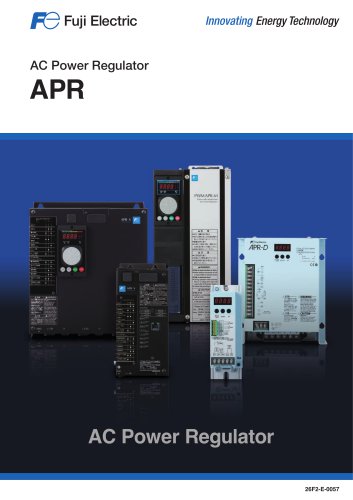
Power controller - APR series
This document is a technical catalog from Fuji Electric, detailing the specifications and applications of their AC Power Regulators (APR). It includes safety considerations, product specifications, and application examples.
Before using the product, it is crucial to read the instruction manual thoroughly. Wiring should only be conducted by qualified engineers. Special systems such as atomic-energy control or medical devices require consultation with the sales office. Safety measures should be prepared for systems affecting human lives or property.
The APR is a device used to adjust AC voltage, current, and power steplessly. It is commonly used for temperature control in electric furnaces, light dimming, and AC stabilization. Fuji Electric's APRs utilize semiconductors like thyristors and IGBTs for control.
1. Phase Control Method: Controls voltage by adjusting the phase angle. Suitable for most loads but may cause harmonic disturbances.
2. Cycle Control Method: Adjusts voltage by controlling the on/off ratio within a power cycle. Not available for all applications.
3. PWM Control Method: Uses high-frequency switching to control voltage amplitude, resulting in a sine wave output and reduced harmonic currents.
Instruments for measuring APR outputs should be chosen based on their operating principles. RMS value calculation digital types are best suited, while rectifier and digital testers are unsuitable.
Feedback control ensures the APR output remains as specified despite fluctuations. Various methods are available, including current limit regulation (CLR) and automatic voltage regulation (AVR). These methods help extend heater life and prevent damage.
APRs are used in welding machines, electric furnaces, film stretching devices, and more. They provide voltage stabilization, heat control, and light dimming capabilities.
This catalog provides comprehensive information on the selection, application, and control methods of Fuji Electric's AC Power Regulators, emphasizing safety and efficiency in various industrial applications.
The document describes how APRs can be configured for DC or AC systems. For DC systems, voltage regulation is achieved by detecting DC current and converting it to an insulated voltage. For AC systems, the detection input is AC voltage or current.
Various control methods are outlined, such as Current Limit Regulation (CLR), Automatic Current Regulation (ACR), Automatic Voltage Regulation (AVR), and Automatic Wattage Regulation (AWR). Each method is suited for different applications and requires specific external devices.
The document highlights the importance of selecting the appropriate APR model based on the load type, such as resistive, inductive, or capacitive loads. It emphasizes the need for current limit regulation for systems with significant resistance changes, like pure metal or silicon carbide systems.
Guidelines for selecting the appropriate APR series are provided, considering factors like waveform control method, number of power phases, voltage, current, and load type. The document includes a flowchart for series selection based on these criteria.
Different APR series are described, highlighting their features, applications, and configurations. The PWMAPR-M series, for example, uses PWM control to eliminate harmonic current issues and is suitable for high-precision applications.
The PWMAPR-M series offers benefits such as energy savings, reduced harmonic distortion, and compatibility with various loads. It is noted for its compact design and compliance with international standards.
The document provides comprehensive information on selecting and using APRs for different applications, emphasizing the importance of matching the control method and APR model to the specific load and application requirements.
- Outputs a clean sine wave across any output range without the need for a transformer.
- Maintains stable output voltage (±2% FS) even with input voltage fluctuations of ±10%.
- Supports conventional applications like heater control with high accuracy.
- Does not generate harmonics or flicker, nor does it deteriorate the power factor.
- Longer maintenance cycle expected due to the absence of a battery.
- Product inspection testing facilities requiring stable output.
- Locations with poor power supply conditions, such as overseas.
- Laboratory facilities requiring advanced power control.
- Single-phase input voltage: 200-240 V AC, 50/60 Hz.
- Rated current options: 20 A, 80 A, 160 A.
- Cooling system: Air cooling.
- Control circuit power supply: 200-240 V AC, 25 VA power capacity.
- Output voltage adjustment range: 0-97%.
- Distortion rate: 5% or less for both input and output current (resistive load, output voltage 50% or higher).
- Manual, automatic, and digital settings available for output voltage control.
- Soft start and up/down time settings: 0.1-100 seconds.
- Current and voltage limit regulation settings: 0-100% of rated current/output voltage.
- Network communication options: Modbus RTU, CC-Link.
- Overcurrent, overheating, CPU memory, communication, and power supply errors are monitored.
- Alarm outputs for major and minor failures.
- Feedback control options include automatic current, voltage, and wattage regulation.
- Operating temperature: -5 to +40°C.
- Storage temperature: -20 to +60°C.
- Humidity: 30-90% RH (no condensation).
- Includes terminal functions and external connection diagrams for single-phase 200-240 V AC.
- Recommendations for circuit breaker installation and wiring practices.
The document provides detailed technical specifications and features of the Fuji AC Power Regulator (APR) and its series, including the PWMAPR-M and APR-V Series. It includes information on external dimensions, terminal specifications, features, and order specifications.
The document outlines the external dimensions for various models such as RPME2020-M, RPME2080-M, and RPME2160-M, specifying unit sizes in millimeters and mass in kilograms. It also details the terminal screw sizes and tightening torque for different current ratings (20 A, 80 A, 160 A).
Key features include various feedback control types (AVR, ACR, AWR), a multi-indicator for visual status confirmation, and a heater disconnection detection function. The APR-V Series offers switchable phase and cycle control, high-precision feedback control, and supports imbalance correction for three-phase systems. It is compatible with network parameter settings and does not require a 400 V system operating transformer.
The document explains the order types for the APR-V Series, detailing input voltage, phase number, rated current, and optional specifications. It includes codes for different configurations and optional accessories, such as communication boards and analog output boards.
The APR-V Series complies with the EU RoHS Directive and revised Chinese RoHS. It is also compliant with the new EMC and Low Voltage Directives, making it suitable for international standards.
The APR-V Series includes a built-in high-performance heater disconnection detecting function, standardized thyristor pure anti-parallel system, and enhanced abnormality detection with alarm LEDs. It supports various communication specifications and offers a full lineup of options for customization.
The document specifies that magnetic flux density should be maintained between 1.0 to 1.2 T or less to prevent bias magnetism. It also advises against using cycle control except for single-phase P types and states that for three-phase systems, the load imbalance should be 10% or less.
Frequent RUN and STOP cycles can cause significant temperature differences in the thyristor element, leading to thermal fatigue and reduced life expectancy. It is recommended to select a capacity with a load current less than 80% of the rated current for such applications.
The document provides a table indicating allowable load currents for different ambient temperatures and system types (single-phase and three-phase).
Details are provided for main circuit terminal covers for three-phase systems, with specific types listed for different RPVW models. Single-phase systems do not require a main circuit terminal cover as it is standard.
The document explains the input-output characteristics for resistive loads, including base load and gradient settings. It describes how output varies linearly with setting inputs and how these settings can be adjusted for desired characteristics.
The RUN/STOP function is controlled by the RUN-COM terminal, with soft start and soft up/down functions to manage output changes. The soft start time can be set between 0.5 to 100 seconds.
The APR-V Series offers various operational configurations, including quick selection, error detection history, high-precision digital setting, and compliance with Chinese RoHS. It is not compatible with APD1 or APD2.
Specifications for the APD3 setting indicator include protective structure, ambient conditions, and mounting method. Hardware specifications cover remote control connection cables and communication distances.
Feedback control accuracy is detailed for various control methods, with conditions for power supply and load fluctuations. The document also describes phase control, cycle control, and combined control methods, highlighting their applicability and effects on harmonic disturbance and power factor.
Standard and high-performance specifications for heater disconnection detection are provided, including applicable heaters, load capacity, and detection settings. The document explains how to enable high-performance specifications using the APD3 setting indicator.
When using the APD3 setting indicator, function code settings can be made, and external wiring can be omitted. The document details the control terminal functions and how they can be configured for different operations.
The document provides detailed technical specifications and connection diagrams for Fuji AC Power Regulators (APR), specifically the APR-V Series. It includes information on alarm codes, external connections, power supply configurations, and mounting instructions.
The APR system displays alarm codes Z1, Z2, and ZC on the setting indicator (APD3). These codes can be read via network communications to identify major (Z1) and minor (Z2) failures.
The document includes diagrams for single-phase and three-phase external connections, detailing the main circuit and control power supply connections. It specifies voltage ratings and connection methods for different control types (C, D, E).
The document outlines the connection diagrams for both single-phase and three-phase systems, specifying the necessary voltage ratings and phase order requirements to avoid alarms.
External dimension diagrams for various models (RPVE and RPVW series) are provided, along with detailed mounting instructions to ensure proper heat dissipation and avoid interference.
Detailed wiring methods are described, including the use of crimp terminals, grounding requirements, and noise prevention techniques. Specific instructions are given for wiring main circuit terminals, control power supply terminals, and signal terminals.
The document explains the control circuit functions, including manual and automatic settings, alarm reset procedures, and communication board connections for network integration.
The APR-V Series supports various waveform control methods and is compatible with different load types. It also includes options for remote control and compliance with international standards (UL, cUL, CE).
The document outlines the specifications for the APR-D Series, a single-phase AC power regulator. It supports input voltages from 100 to 240 V AC and operates at frequencies of 50/60 Hz. The rated current options are 20 A, 45 A, 60 A, and 100 A. The device features self-cooling and is suitable for resistive and inductive loads, as well as transformer and rectifier primary control. It includes a waveform control method using a single-phase thyristor anti-parallel connection and offers phase control, cycle control, and phase angle proportion control.
The APR-D Series allows for individual settings of soft start, soft up, and soft down times between 0 to 100 seconds. It supports auto-identification of input voltage and frequency, and offers current limit control and automatic current feedback control. The device can detect heater disconnection and supports communication control as an optional function.
All models comply with CE marking, the EU revised RoHS Directive, the new EMC Directive, and the new Low Voltage Directive. They also comply with the revised Chinese RoHS standards.
For optimal performance, it is recommended to carefully select the rated current, especially for applications with large inrush currents. The document advises maintaining the use rate of rated current below 80% to extend the life expectancy of the thyristor element. It also suggests using a fast-acting fuse for protection, as the main circuit does not contain one.
The APR-D Series is designed for space-saving and cost-effective operation, with improved functionality and performance due to its built-in CPU. It supports parallel operation of up to 50 units and offers various settings and monitoring capabilities via RS485 (Modbus RTU). The device includes error detection and protection features, such as CPU memory error detection, power supply error detection, and thyristor abnormality detection.
The document provides detailed connection diagrams for different main circuit voltages and outlines the terminal functions for both the main circuit and control circuit terminals. It also describes the optional communication and parallel run connectors.
The document provides technical specifications and operational guidelines for the Fuji AC Power Regulator (APR-D Series), focusing on both single-phase and three-phase models. It includes details on installation, configuration, and operational features.
- The APR-D Series supports various control methods, including phase control, cycle control, and phase angle proportion control.
- Output range is 0 to 100% of the main circuit power supply voltage, excluding voltage drop due to thyristor resistance.
- Power supply voltage ranges are 200 to 240 V AC and 380 to 480 V AC.
- Compliant with CE marking, EU RoHS Directive, and EMC and Low Voltage Directives.
- Install in a dust-free environment with high cooling efficiency.
- Ensure sufficient space for heat dissipation and wiring access.
- Maximum panel temperature should not exceed 55°C; reduce load current if ambient temperature exceeds 40°C.
- Includes display/operation units for monitoring and setting adjustments.
- Supports soft start, soft up, and soft down time settings between 0 to 100 seconds.
- Allows communication control via RS485 (Modbus RTU) as an optional function.
- Parallel operation is possible with up to 50 units.
- Details on screw sizes and tightening torques for various terminal blocks are provided.
- Ground wiring should use the product's mounting hole.
- Various function codes are available for setting basic functions, feedback, network, alarm, and utility functions.
- Manual and gradient digital settings are adjustable, with specific ranges and default values provided.
- Important notes on power cycle life expectancy and the use of fast-acting fuses are included.
- Recommendations for minimizing temperature fluctuations to extend the life of the thyristor element.
- Details on product codes, optional accessories, and operational transformers are provided.
- Instructions for specifying order types and additional options are included.
The APR-D Series by Fuji Electric is a three-phase AC power regulator with various models (RPDW□020-T, RPDW□045-T, RPDW□060-T, RPDW□100-T) supporting input voltages of 200 to 240 V AC and 380 to 480 V AC. The frequency is 50/60 Hz with a power capacity of 15 VA or less. The output current ranges from 20 A to 100 A, with a self-cooled cooling system and resistive load application.
The control methods include phase control, cycle control, and phase angle proportion control. The output voltage can be adjusted from 0 to 100% of the main circuit power supply voltage. Input-output characteristics are linear with a setting signal range of 10 to 90%. Various setting options are available, including manual, digital, and auto settings with current and voltage signals.
Alarms are triggered by CPU memory errors, power frequency abnormalities, and connection issues with auto and manual settings. The system detects open phase/phase sequence failures and communication errors. Alarm outputs are open collector 24 V DC/0.1 A.
The ambient temperature range is -10°C to +55°C, with storage temperatures from -20°C to +60°C. Humidity should be between +5 to +95% RH without condensation. The device should be used indoors at altitudes of 1000 m or less.
Dielectric strength is 2 kV AC for 200 to 240 V and 2.5 kV AC for 380 to 480 V. Insulation resistance is 10 MΩ or higher.
The document provides detailed wiring diagrams for different voltage configurations and lists terminal functions for main circuit, control power supply, and control input terminals. Communication connectors support RS-485 input/output for network and parallel run configurations.
Fast-acting fuses and replacement adapters are available for different APR types. The document includes a table for fast-acting fuse applications and details on terminal functions.
External dimensions and mass are specified for different current ratings, with identical dimensions for 200 V and 400 V series. Mounting pitch and screw sizes are provided.
The APR-D Series includes a display/operation unit with a data display, alarm lamp, and keys for mode selection and data setting. Various settings can be configured, including basic functions, network functions, alarm functions, and initial settings.
The APR-D Series is a versatile and robust power regulator suitable for various industrial applications, offering precise control, comprehensive alarm functions, and flexible configuration options.
The document outlines the specifications for an AC Power Regulator (APR) and associated components. The input voltage code is 4, with CE marking not supported. The output current ranges from 20 to 100 A, rated for three-phase voltages of 380, 400, and 440 V/210 V at 20 VA. The type is ML3C2954 with a mass of 1.7 kg. An operating transformer (Type: TR3-300R/UL) is provided for input voltage code 4, with a primary voltage mass of 8.5 kg.
Important notes for installation include placing the APR in a dust-free area with high cooling efficiency. It should be mounted on a vertical metal surface with sufficient space for heat dissipation. The maximum temperature inside the panel should not exceed 55°C, and the reference ambient temperature for rated current is 40°C. Adequate space should be maintained for wiring tools, and care should be taken to avoid dropping objects into the APR's top opening.
The document provides guidelines for selecting instruments like voltmeters and ammeters, emphasizing the importance of using RMS value calculation digital types for accurate readings. It warns against using rectifier and digital testers for APR phase-controlled waveforms due to potential inaccuracies.
Options for CT and VT are available for various voltage levels, with specifications for rated secondary outputs and accuracy classes. The document includes detailed dimensions and mass for these components.
Users are advised to read the instruction manual thoroughly and ensure wiring is conducted by qualified engineers. Special systems or devices require consultation with the sales office. Safety measures should be in place for systems affecting human lives or property.
The document notes that product specifications and appearances may change without notice, and printed colors may differ from actual colors. For detailed product information, users should contact their dealer or sales office.
Catalog excerpts
Innovating Energy Technology
Open the catalog to page 1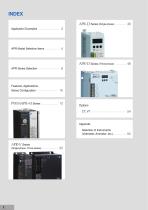
Fuji FujiAC ACPower PowerRegulator Regulator[APR] [APR] Appendix Appendix INDEX INDEX ………………………………3 3 Application ApplicationExamples Examples……………………………… (Single-phase)……………… ………………40 40 Series(Single-phase) APR-D APR-DSeries ……………………4 4 APR APRModel ModelSelection SelectionItems Items…………………… ………………………………8 8 APR APRSeries SeriesSelection Selection……………………………… (Three-phase)……………… ………………46 46 APR-D Series(Three-phase) APR-DSeries Features, Features,Applications, Applications, ………………………………10 Series guration SeriesConfi Confi guration……………………………… 10 ………………………12 PWMAPR-M 12 Series……………………… PWMAPR-MSeries...
Open the catalog to page 2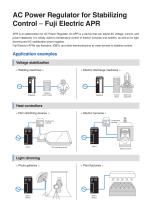
AC Power Regulator for Stabilizing Control – Fuji Electric APR APR is an abbreviation for AC Power Regulator. An APR is a device that can adjust AC voltage, current, and power steplessly. It is widely used for temperature control of electric furnaces and heaters, as well as for light dimming and AC stabilization power supplies. Fuji Electric’s APRs use thyristors, IGBTs, and other semiconductors as main devices to stabilize control. Application examples Voltage stabilization < Welding machines > < Electric discharge machines > Welding power supply Control device Machining equipment Heat controllers...
Open the catalog to page 3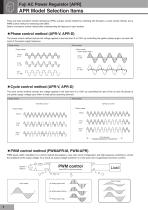
Fuji AC Power Regulator [APR] APR Model Selection Items There are three waveform control methods for APRs: a phase control method for switching with thyristors, a cycle control method, and a PWM control method for switching with IGBTs. Select a waveform control method after understanding the features of each method. Phase control method (APR-V, APR-D) The phase control method controls the voltage applied to the load from 0 to 100% by controlling the ignition phase angle α at each half cycle of the power supply frequency. Single-phase Output voltage Output voltage ,JQLWLRQSKDVHDQJOHњ Cycle control...
Open the catalog to page 4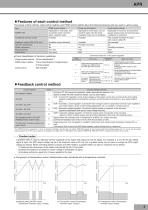
■ Features of each control methodThe phase control method, cycle control method, and PWM control method have the following features and are used in various ways. Item “Conversion factor Ki” of AC power regulator *The PWMAPR-M series supports B, C, and D as standard (switchable using the main unit setting). PWM-APR supports C only. D series single phase products support only T, A, and B, and three phase products support only T. Mini and aA series are not supported. For details, refer to “ ■ Feedback control method (PWMAPR-M, PWM-APR, APR-V)” on page 6 and the items in each series. —^Gradient setter^)-...
Open the catalog to page 5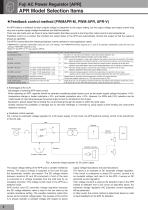
■ Fuji AC Power Regulator [APR] An APR without a feedback function outputs voltage in proportion to the output setting, but the output voltage and output current may vary due to power supply voltage fluctuations and load fluctuations. There are also loads such as those of pure metal heaters that draw several to ten times their rated current at low temperatures. Feedback control is a function that monitors the output status of the APR and automatically corrects the output so that the output is always as specified. The APR-V series offers the following feedback control methods to meet application...
Open the catalog to page 6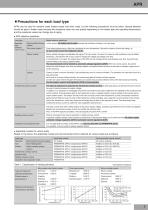
APRs can be used for resistive loads (heater loads) and other loads, but the following precautions must be taken: Special attention should be paid to heater loads because the resistance value can vary greatly depending on the heater type and operating temperature, and the resistance values can change due to aging.
Open the catalog to page 7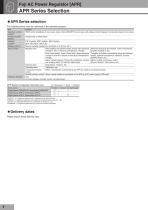
HFuji AC Power Regulator [APR] *KANTHAL® is a registered trademark and a trademark of the Sandvik Group. *EREMAL® is a registered trademark and a trademark of Tokai Konetsu Kogyo Co., LTD. *SiliconitL® is a registered trademark and a trademark of Siliconit Co., Ltd. *PYROMAXL® is a registered trademark and a trademark of Riken Corporation.
Open the catalog to page 8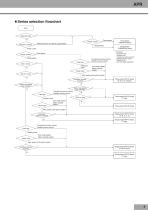
Series selection flowchart Start Capacitive load PWM (harmonic and flicker suppressible) Waveform control Phase, cycle Three-phase Phase number Single-phase Transformer primary control Rectifier primary control Load type Resistive load Single-phase PWMAPR-M Series Load types, Capacitive load Inductive load Transformer primary control Rectifier primary control Resistive load and other loads supported. Pure metal system Silicon carbide system Heater type 150 A or more Three-phase PWM-APR Series Y Alloy system and carbon system Feedback function required N Built-in fast-acting fuse required Three-phase...
Open the catalog to page 9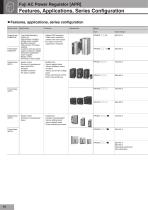
Fuji AC Power Regulator [APR] Features, Applications, Series Configuration Features, applications, series configuration Series name Single-phase ・Test facility/laboratory facility, etc. PWMAPR-M high-precision constantvoltage power supplies ・Rectifier-combined high-precision DC power supplies Three-phase ・Locations with poor power supply conditions (Voltage PWM-APR fluctuation) stabilization power supplies ・Heater control ・Dimming of various lights ・Utilizes IGBT-equipped PWM control method to achieve sine wave output ・No need for harmonic suppression measures Single-phase ・Heater control APR-V...
Open the catalog to page 10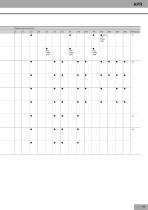
Rated output current [A]
Open the catalog to page 11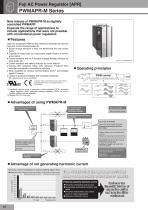
Fuji AC Power Regulator [APR] PWMAPR-M Series New release of PWMAPR-M as digitally controlled PWMAPR Expands the range of applications to include applications that were not possible with conventional power regulators Features Uses our proprietary PWM control method to eliminate the need for harmonic current countermeasures ● Saves energy because it does not deteriorate the load power factor ● Capable of being used as a test power supply thanks to its sine wave output ● Comes standard with VLR function (voltage limiting) effective for lamp loads, etc. ● Comes standard with setting indicator as...
Open the catalog to page 12All FUJI ELECTRIC France catalogs and technical brochures
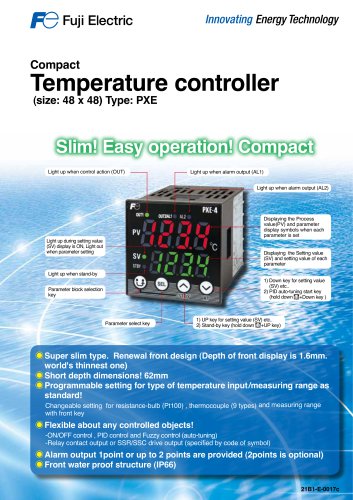 Temperature controller PXE
2 Pages
 Temperature controllers
24 Pages
 HMI Technoshot TS1000 series
7 Pages
 HMI Technoshot TS2000 serie
2 Pages
 HMI Monitouch X1 series
14 Pages
 Gas analysers
21 Pages
 CROSS STACK LASER GAS ANALYZER
12 Pages
 ZKM Oxygen Gas Analyzers
8 Pages
 ZPAF Biogas analyser
4 Pages


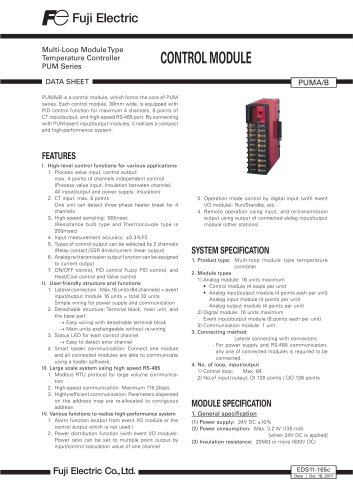
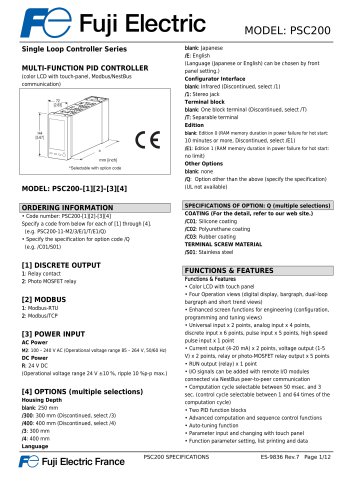
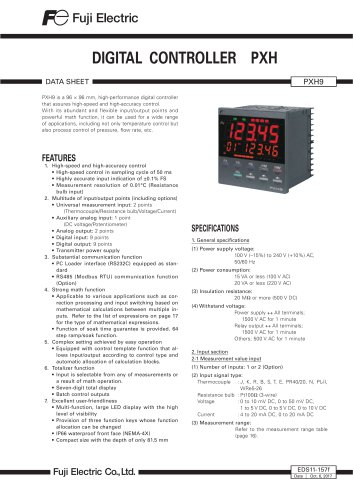
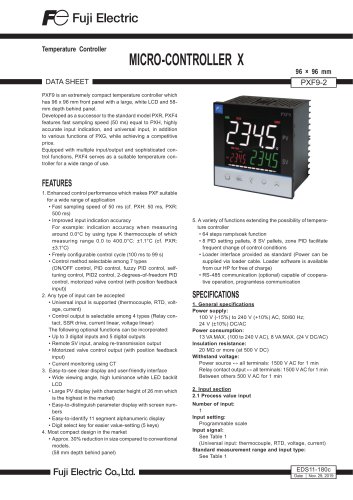






- Fuji Electric flow meter
- Temperature probe
- Fuji Electric volume flow meter
- Fuji Electric liquid flow meter
- Fuji Electric gas analyzer
- Fuji Electric concentration analyzer
- Automation software solution
- Fuji Electric monitoring analyzer
- Industrial display panel
- Resistance temperature sensor
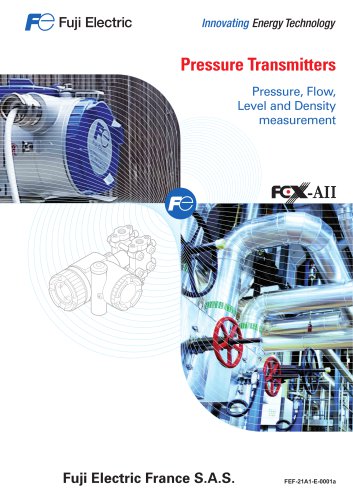
- Fuji Electric pressure transmitter
- Analysis software solution
- Process software
- Real-time software
- Fuji Electric analog pressure transmitter
- Control software
- Fuji Electric waterproof flow meter
- Color display panel
- Fuji Electric gas flow meter