
- Catalogs
- FUCHS PETROLUB SE
- Refrigeration Oils

- Products
- Catalogs
- News & Trends
- Exhibitions
Refrigeration Oils
Refrigeration Oils
FUCHS LUBRICANTS GERMANY, a subsidiary of FUCHS SE, is a prominent supplier of lubricant solutions, emphasizing innovative and sustainable products. The company operates from multiple locations in Germany and offers a wide range of over 3,000 products certified to various international standards.
Refrigeration oils are essential for the longevity and efficiency of refrigerant compressors. Key properties include solubility with refrigerants, low-temperature flowability, thermal stability, and chemical resistance. These oils ensure proper lubrication, heat dissipation, and sealing within the compressor.
FUCHS focuses on climate protection in its R&D efforts, emphasizing sustainable refrigerants with low Global Warming Potential (GWP). The company conducts extensive tests on stability, miscibility, and wear protection to ensure the performance of its refrigeration oils.
The RENISO product line includes mineral oil-based and various synthetic refrigeration oils tailored for different refrigerants, such as CO2, NH3, hydrocarbons, and HFOs.
RENISO oils offer high thermo-chemical stability, low sludge formation, excellent miscibility with refrigerants, and reliable wear protection, outperforming standard polyol ester oils.
According to DIN 51503, refrigeration oils are classified based on their compatibility with specific refrigerants. Each class has specific requirements for miscibility and water content to ensure optimal performance and prevent undesirable reactions.
Key parameters for refrigeration oils include color, density, acid number, and water content, which are critical for maintaining the integrity and performance of the oils in refrigeration systems.
The document outlines specifications for refrigeration oils, focusing on pour-point, flashpoint, miscibility, and compatibility with refrigerants. The pour-point and threshold viscosity determine the lowest temperature at which refrigeration oil can be used, significantly affected by dissolved refrigerants. Flashpoint provides information on the base oil and its vapor-pressure behavior.
Testing procedures include cooling samples under defined conditions and evaluating their flow behavior. Miscibility behavior is tested using pressure-resistant glass tubes or autoclaves, and compatibility is assessed using the Sealed Tube Test according to ASHRAE 97-2007.
The document references several standards, including DIN ISO 3016 for pour-point testing, DIN ISO 2592 for flashpoint, DIN 51514 for miscibility, and ASHRAE 97-2007 for refrigerant compatibility.
Refrigeration oils should have low water content to maintain chemical stability. The document advises using high-performance additives for wear protection and selecting oils based on their viscosity and compatibility with specific refrigerants.
Pressure-viscosity-temperature charts (pVT diagrams) are used to evaluate the amount of refrigerant dissolved in oil and its effect on viscosity. Miscibility gap diagrams illustrate the miscibility behavior of oils with refrigerants. The document includes data on water absorption and viscosity changes in refrigeration oils.
Refrigeration oils must maintain a balance between viscosity for lubrication and low viscosity for reliable oil transport. The document highlights the importance of selecting oils based on compressor type and application, considering factors like thermal stability and chemical compatibility.
Hydrocarbon refrigerants are favored for their low Global Warming Potential (GWP) of 3 to 6, making them exempt from F-Gas Regulation restrictions. However, their flammability necessitates explosion-proof system designs and risk assessments.
Hydrocarbon refrigerants mix well with conventional refrigeration oils, forming homogeneous mixtures with both mineral and synthetic lubricants. However, high solubility can lead to lubricant dilution, reducing the lubricating film's load-bearing properties and potentially increasing compressor wear. Selecting lubricants with higher initial viscosity and using more powerful oil heaters can mitigate these issues.
The RENISO LPG series, based on synthetic polyalkylene glycol (PAG), is designed to reduce refrigerant dissolution, maintaining lubricant film thickness. It offers high aging and thermal stability, reliable wear protection, and reduced foaming during pressure drops. It is suitable for various hydrocarbon refrigerants and applications, including refrigeration, air conditioning, and natural gas compression.
Other oils like RENISO TRITON SE/SEZ (POE), RENISO SYNTH 68 (PAO), and RENISO WF series (mineral oil) are also used for hydrocarbon refrigerants, offering benefits like reduced refrigerant dissolution and improved wear protection.
With the EU regulation to reduce HFC emissions, HFO refrigerants like R1234yf and R1234ze(E) are gaining importance. These have low GWP values but come with flammability concerns. FUCHS offers PAG oils for vehicle air conditioning and POE-based RENISO TRITON SE/SEZ oils for stationary applications.
FUCHS is actively involved in developing solutions for HFO and HFO/HFC refrigerants, focusing on miscibility, stability, and viscosity. The RENISO TRITON SE/SEZ series offers excellent miscibility with HFO refrigerants, high viscosity index, and reliable wear protection.
The document lists various HFO/HFC refrigerants, their GWP values, and safety classifications, highlighting their role in replacing high-GWP HFC refrigerants.
Manufacturing involves stainless steel components and an inert gas (N2) atmosphere. Special containers are used for storage and transport.
Testing of used refrigeration oils and evaluation of results. Intensive consulting and application engineering support.
FUCHS emphasizes the importance of consulting with application engineers to select the best lubricant system for specific applications. Continuous improvement and adaptation to new technologies are key aspects of FUCHS's approach to developing refrigeration oils.
Catalog excerpts

MOVING YOUR WORLD
Open the catalog to page 1
FUCHS LUBRICANTS GERMANY We don't just develop lubricants. For highly complex challenges in a wide range of industries, we develop innovative lubricant solutions that enable the mobility of tomorrow. Our goal: to keep our customers' world in motion. Efficient, sustainable, reliable. Today and tomorrow. What can we move for you?
Open the catalog to page 2
Refrigeration Oils FUCHS LUBRICANTS GERMANY Facts and figures Company: FUCHS LUBRICANTS GERMANY GmbH, a company of the FUCHS Group Locations: Mannheim, Dohna, Kaiserslautern, Kiel and Wedel; approx. 1,400 employees Product range: A full range of more than 3,000 products for all application areas Certifications i. a.: ISO 9001, IATF 16949, ISO 14001, ISO 45001, ISO 50001, ISO 21469, HALAL, KOSHER (detailed certifications at www.fuchs.com/de/en) Gate-to-Gate* CO2-compensated FUCHS LUBRICANTS GERMANY is a subsidiary of FUCHS SE, the world's largest independent supplier of lubricant solutions. Around...
Open the catalog to page 3
The development of highperformance refrigeration oils Requirements and classification of refrigeration oils Mineral oil-based refrigeration oils 4 good reasons for using RENISO refrigeration oils Physical and chemical data of refrigeration oils
Open the catalog to page 4
Refrigeration oils play an important role in the area of lubricants and lubrication technology. The expected long life of refrigerant compressors largely depends on the quality of the used refrigeration oil. Apart from favourable solubility characteristics with the refrigerant, good low-temperature flowability, high thermal stability, good ageing resistance and high chemical stability in the presence of refrigerant are additional important parameters. Sealing compatibility of RENISO refrigeration oils Overview of RENISO products Typical technological tests for refrigeration oils Refrigeration...
Open the catalog to page 5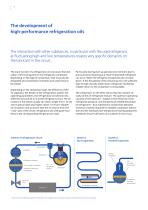
The development of high-performance refrigeration oils The interaction with other substances, in particular with the used refrigerant, at fluctuating high and low temperatures creates very specific demands on the lubricant in the circuit. The main function of a refrigeration oil is to ensure the lubrication of all moving parts in the refrigerant compressor. Depending on the type of compressor, heat must also be dissipated and compression chambers and valves have to be sealed. Depending on the compressor type, the efficiency of the oil separator, the design of the refrigeration system, the operating...
Open the catalog to page 6
RENISO Refrigeration Oils under the sign of climate protection Our research and development department deals with comprehensive researches on refrigeration oils with all relevant refrigerants. In general sustainable refrigerants are becoming more and more important. Low GWP refrigerants (GWP = Global Warming Potential = contribution of a refrigerant to the global warming) like e.g. carbon dioxide, R744 (GWP=1) and propane, R290 (GWP=3), but also synthetic fluorinated alternatives like R1234yf and R1234ze(E) (both GWP<1) are already increasing in their use. In contrast, the use of common refrigerants...
Open the catalog to page 7
4 good reasons for using RENISO refrigeration oils Performance comparison RENISO TRITON SEZ 80 versus standard polyol ester (POE) refrigeration oils. High thermo-chemical stability e.g. in Sealed Glass Tube Test (ASHRAE 97-2007) Low varnish / low sludge formation e.g. in FUCHS In-house test (evaluation of oil sludge in beaker with bearing roller after 168h/135 °C) High stability Standard POE refrigeration oils Very good miscibility with HFC/FC: e.g. in miscibility evaluation (DIN 51514) Standard POE refrigeration oils Reliable wear protection e.g. in bearing wear testing (DIN 51819-3) Good miscibility...
Open the catalog to page 8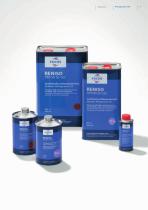
RENISO Refrigeration Oils 9 RENISOTRITON SE/SEZSynthetisches KaitemaschinenblRENISOTRITON SE/SEZ Synlhetisches Kaitemastlimenol PelyufestH (POI) Sdtonipnlciff fur d*r €ln-rni! HfKW-. FKW- uml HFO-K*Ue«*lH«'ln Pt»lyi?l «rtw f**0O lubfk^ni udldfeto for ito LKP With HTC K Jtnd HTO «»trlgff*arm
Open the catalog to page 9
REQUIREMENTS AND CLASSIFICATION OF REFRIGERATION OILS DIN 51503 describes the minimum requirements refrigeration oils have to fulfil. This standard applies to oils which are used to lubricate and cool refrigerant compressors while under the influence of the refrigerant. For hydrocarbon refrigerants also so called gas compressor oils can be applied, e.g. RENOLIN LPG 185 in combination with propane or propene. It has to be considered that these lubricants are not dried during production and therefore may have to undergo a drying procedure prior to be filled in refrigerant equipment.
Open the catalog to page 10
Refrigeration Oils The classification of refrigeration oils according to DIN 51503, part 1 (December 2021) is in line with the refrigerant used in the refrigeration system KAA – for ammonia (R717) Refrigeration oils not miscible with ammonia – mineral oils and/or synthetic oils – based on polyalphaolefin (PAO) or alkyl benzene (AB) or hydrogenated mineral oils. In most cases, highly-refined, naphthenic refrigeration oils are used as KAA products. Hydrogenated mineral oils and PAO get more and more important. mineral oils and alkyl benzenes (in some cases ester oils also possible). Mostly highly-refined,...
Open the catalog to page 11
PHYSICAL AND CHEMICAL DATA OF REFRIGERATION OILS Additional information on the characteristics of refrigeration oils is included in the appendix to DIN 51503, part 1 (2021). Important parameters such as the flocculation point with corresponding refrigerants, copper corrosion, electrical conductivity in correlation with water content, Falex lubricity test or the modified Almen-Wieland test under refrigerant atmosphere are included. The appendix also names the corresponding pVT diagrams (Daniel Plots) of the oil-refrigerant combinations. The water contents given in DIN 51503, part 1 (2021), are...
Open the catalog to page 12
Refrigeration Oils Typical data to characterize a refrigeration oil Colour number according to DIN ISO 2049: The colour number is product specific and can vary between crystal-clear (colour number 0) and dark brown (colour number 5). Density according to DIN 51757 (ASTM 4052): Density refers to the mass of a fluid in relation to its volume. In general to characterize a refrigeration oil the density at 15 °C is reported. The density of a refrigeration oil is largely dependent on the temperature of the fluid because the volume increases with higher temperature. Density correspondingly falls at...
Open the catalog to page 13All FUCHS PETROLUB SE catalogs and technical brochures
 Semiconductor Industry
20 Pages
 railway traffic
28 Pages
 E-Mobility
7 Pages
 Asphalt Processing
16 Pages
 Product overview
4 Pages
 Hydraulic Fluids
20 Pages
 Food Grade Products
56 Pages
 Automotive Lubricants 2026
116 Pages
 Compressor Oils
20 Pages
 Industrial Lubricants
240 Pages
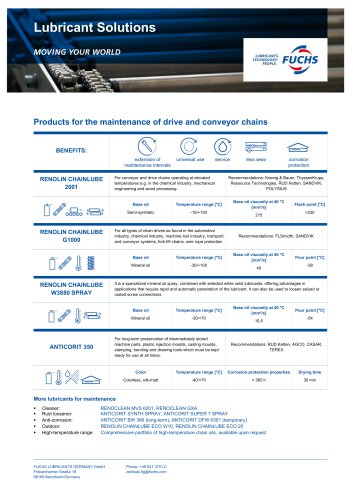 Lubricant Solutions
1 Page


- High-performance lubricant
- Mineral lubricant
- Anti-corrosion lubricant
- Bearing lubricant
- High-temperature lubricant
- Industrial oil
- High-performance oil
- Gear lubricant
- Bearing grease
- Metal lubricant
- Anti-corrosion oil
- Long-life lubricant
- Metal oil
- Universal lubricant
- Oil for automotive applications
- High-temperature oil
- Low-temperature lubricant