
- Catalogs
- FRONTIER LAB
- MicroJet Cryo-trap MJT-2030E

MicroJet Cryo-trap MJT-2030E

MicroJet Cryo-trap MJT-2030E
The document discusses the MicroJet Cryo-Trap (MJT-2030E), a cryo-trapping system used in gas chromatography (GC) for high-resolution separation analysis of low boiling point compounds. This system is an improvement over the previous model, offering enhanced ease of use and energy efficiency.
Specifications
- Cryo-trapping temperature: -196 ºC
- Cooling achieved within 2 minutes
- Liquid nitrogen consumption: less than 1/3 of competitors
- Power requirement: 100 - 240 VAC, 40 VA
- Supported GC models: Agilent, Thermo Fisher, Shimadzu, Perkin Elmer, and Scion
Operation Principle
The system uses a liquid nitrogen jet to cool the head of a separation column, trapping low boiling point compounds. Rapid thermal desorption is achieved using the heat of the GC oven at a rate of 800 ºC/min. The nitrogen gas flow rate can be adjusted to control the cooling temperature.
Features
- Energy-efficient rapid cooling and instant thermal desorption
- Variable cooling temperatures
- Automatic heart-cut analysis of gases evolved from ceramic composites
- Anti-icing baffles to prevent moisture icing
Applications
- Headspace analysis of red wine: Volatiles such as CO2, ethanol, and glycerol were detected.
- Analysis of biomass plastic bags: Various additives like Irganox 1076 and stearic acid were identified.
Conclusion
The MJT-2030E offers significant improvements in energy efficiency and ease of use for cryo-trapping in GC analysis. It supports a wide range of GC models and can be used in various analytical applications, providing reliable and efficient separation of low boiling point compounds.
Catalog excerpts

A cryo-trapping temperature at -196 ˚C in GC Compact and energy saving design with safety features Capillary column
Open the catalog to page 1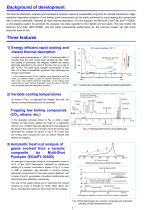
Background of development The thermal desorption analysis and headspace analysis require a considerably long time for sample introduction. Highresolution separation analysis of low boiling point compounds can be easily achieved by cryo-trapping the compounds with a narrow bandwidth, followed by rapid thermal desorption. For this purpose, the MicroJet Cryo-Trap (MJT-1030Ex), a cryo-trapping system for pyrolysis GC analysis, has been supplied to the market over ten years. The new model, the MicroJet Cryo-Trap (MJT-2030E), has the same fundamental performance as the previous model, yet with much...
Open the catalog to page 2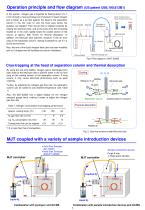
Operation principle and flow diagram Newly designed tip of liquid nitrogen feed tube. Flow controller Pyrolyzer or other devices MicroJet tube Nitrogen cylinder In this system, nitrogen gas is liquefied by flowing about 3 to 7 L/min through a heat exchange coil immersed in liquid nitrogen and is blown as a jet flow against the head of the separation column in the GC oven to cool the local area where the analytes are trapped. Then the jet flow is stopped instantly by closing the solenoid valve, and at the same time the circulating heated air in the oven rapidly heats the cooled section of the...
Open the catalog to page 3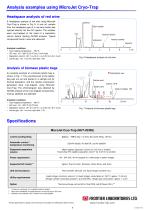
Analysis examples using MicroJet Cryo-Trap Headspace analysis of red wine A headspace analysis of red wine using MicroJet Cryo-Trap is shown in Fig. 6. A one mL sample from the headspace gas of a red wine bottle was injected directly into the GC injector. The volatiles were cryo-trapped at the head of a separation column before starting GC/MS analysis. Typical compounds found in wine are observed. Ethanol Ethyl acetate Isoamyl alcohol Isoamyl acetate Glycerol Analytical conditions 0 ・ Cryo-trapping temperature: -196 ºC ・ GC oven: 40 – 280 ºC (20 ºC/min, 5 min hold) ・ Separation column: UA+-1...
Open the catalog to page 4All FRONTIER LAB catalogs and technical brochures
 IQ MILL-2070
2 Pages
 SS-1010E
2 Pages
 AS-2020E
1 Page
 HP-3050FC
1 Page
 MP-3050FC
1 Page
 MSC
MSC1 Page
 UV-1048E
2 Pages
 MFS-2015E
2 Pages
 CGS-1050Ex
1 Page
 F-Search MPs 2.0
1 Page
 F-Search system Ver. 3.7
1 Page


- Grinding mill
- Analysis software solution
- Gas detector
- Measurement software
- Horizontal lump breaker
- Flow controller
- Creation software
- Pneumatic flow regulator
- Laboratory reactor
- Gas flow regulator
- Automatic sampler
- Automatic detector
- Calibration software
- Liquid sampler
- Laboratory detector
- Compact lump breaker
- High-speed grinding mill
- Rotary drum mill
- Lamp illumination
- Digital flow regulator