
- Catalogs
- The Fredericks Company
- Electrolytictilt

Electrolytictilt

Electrolytictilt
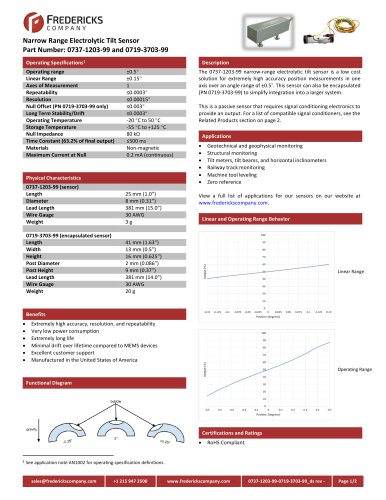
The electrolytic tilt sensor measures angles or level positions relative to gravity, expressed in degrees, arc minutes, or arc seconds. A single axis sensor measures in one direction, while a dual axis sensor or two single axis sensors at 90 degrees can measure in all directions.
Selection:
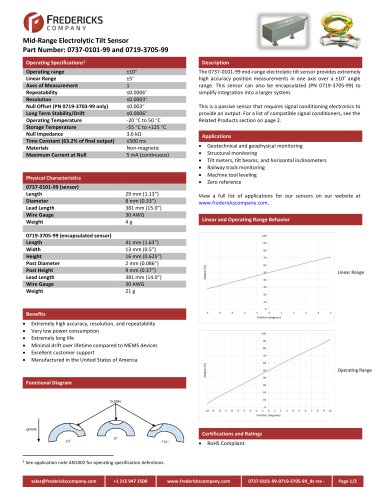
Choosing the right sensor depends on the angle range and sensitivity needed. For precise leveling, a single axis horizontal vial level is used, offering high sensitivity with a limited range. For larger angles, a vertical pool type level is suitable, available in single or dual axis with ranges up to ±90 degrees.
Operation:
The sensor outputs a voltage proportional to the tilt angle. Single axis levels have three electrodes, while dual axis levels have five. The fluid inside alters the conductive path as the level tilts, similar to a potentiometer.
Operating Parameters:
Sensors must operate in AC mode to avoid instability. Current must not exceed maximum limits to prevent self-heating and drift. Impedance must match the circuit type to control current.
Excitation:
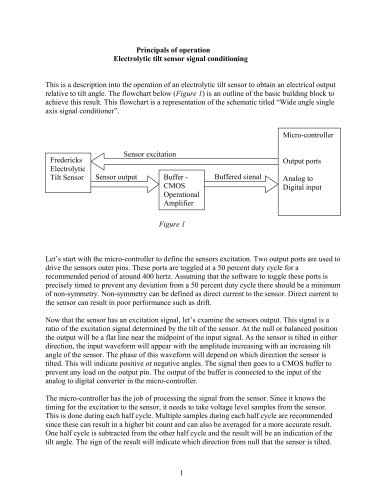
Sensors can be energized using a bridge circuit or by exciting outer electrodes. Bridge circuits allow impedance matching, but require temperature compensation. Exciting outer electrodes measures impedance ratio, not absolute value, and requires careful current management. Microcontroller output ports can drive the sensor, ensuring no DC component is present.
Catalog excerpts
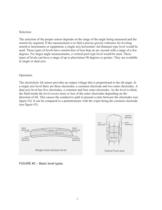
Selection: The selection of the proper sensor depends on the range of the angle being measured and the sensitivity required. If the measurement is to find a precise gravity reference for leveling sensitive instruments or equipment, a single axis horizontal vial (banana) type level would be used. These types of levels have sensitivities of less than an arc second with a range of a few degrees. For larger angle measurements, a vertical pool type level would be used. These types of levels can have a range of up to plus/minus 90 degrees or greater. They are available in single or dual axis. Operation:...
Open the catalog to page 2
FIGURE #3 Electrical equivalent. Operating parameters: Electrolytic tilt sensors must be operated in the AC mode. Any direct current (DC) will cause the level to become unstable and even inoperable. The amount of current through the level must not exceed the maximum. Currents that are above the typical recommended value will cause the level to self heat and the readings will drift. The impedance value of the level must be specified to match the type of circuit used in order to limit the current. Excitation: The electrolytic tilt sensor (level) can be energized in a number of ways depending on...
Open the catalog to page 3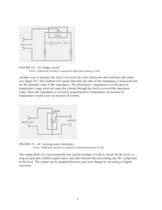
(Note: Additional circuitry is required to determine polarity of tilt) > . (Note: Additional circuitry is required to determine polarity of tilt) >
Open the catalog to page 4All The Fredericks Company catalogs and technical brochures
 Televac br5003
6 Pages
 Televac MP7FR Cold Cathode
2 Pages
 Televac MX4A Convection
2 Pages








Archived catalogs
 2 A Thermocouple Sensor
2 Pages
 Single Axis Narrow Angle
1 Page
 0711-0768-99-0719-1143-99_ds
2 Pages
 0703-0703-99 TrueTilt
2 Pages






- Communication gateway
- Tilt sensor
- Industrial gateway
- Ethernet gateway
- Serial gateway
- Digital inclination sensor
- 2-axis tilt sensor
- RS-485 gateway
- MEMS inclination sensor
- Signal conditioner
- Multi-axis tilt sensor
- Analog inclination sensor
- High-precision tiltmeter
- IP67 inclination sensor
- 1-axis tilt sensor
- Sensor signal conditioner
- Vacuum sensor
- Analog signal conditioner
- Tilt switch
- Angle measurement inclination sensor